Healthcare Services

Brazil Patient Engagement Solutions Market Analysis
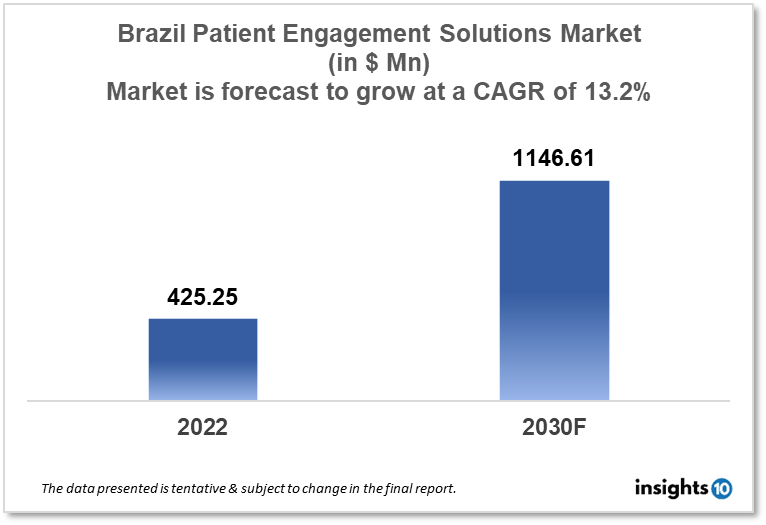
Brazil's patient engagement solutions market is projected to grow from $425.25 Mn in 2022 to $1146.61 Mn by 2030, registering a CAGR of 13.2% during the forecast period of 2022-30. The main factors driving the growth would be the growing healthcare sector, increasing adoption of EHRs, rising healthcare costs and government support. The market is segmented by component, delivery mode, application, therapeutic area, functionality and by end-user. Some of the major players include BoaConsulta, iClinic, Buddy Healthcare, Siemens Healthineers, Wolters Kluwer, Oracle and IBM.
Buy Now

Brazil Patient Engagement Solutions Market Executive Summary
Brazil's patient engagement solutions market is projected to grow from $425.25 Mn in 2022 to $1146.61 Mn by 2030, registering a CAGR of 13.2% during the forecast period of 2022-30. Brazilian healthcare spending as a share of GDP in 2019 was 9.59% or $853 per person. Brazil's health spending as a proportion of GDP tended to rise between 2000 and 2019 despite significant recent volatility.
Brazil's government started making significant investments in healthcare technology in the early 2000s, which is when patient engagement solutions first became popular there. The government made an effort to increase access to healthcare services and lower the expenses related to conventional healthcare delivery models. The adoption of telemedicine technologies was one of the first patient engagement strategies to catch on in Brazil. Telemedicine systems were created in the early 2000s to offer patients in rural or underserved areas of the nation remote healthcare services.
Brazil's patient engagement solutions have developed over time to now comprise a variety of technology and services. Electronic health records (EHRs), patient portals, telemedicine services, electronic health records, patient portals and other patient interaction tools are currently available to Brazilian patients.
Market Dynamics
Market Growth Drivers
The Brazil patient engagement solutions market is expected to be driven by factors such as the growing healthcare sector, increasing adoption of EHRs, rising healthcare costs and government support. The Brazilian government has backed efforts involving healthcare technology, such as patient involvement programs. As a result of government investments in programs to increase healthcare access and save costs, the nation now has a favourable environment for the expansion of patient engagement solutions.
Market Restraints
The funding for healthcare services and technology remains constrained, notwithstanding recent increases in healthcare spending in Brazil. This might make it challenging for healthcare organisations to spend money on patient engagement programs, especially in regions where resources are already at a high price.
Competitive Landscape
Key Players
- BoaConsulta (BRA)
- iClinic (BRA)
- Buddy Healthcare
- Siemens Healthineers
- Wolters Kluwer
- Oracle
- IBM
Notable Deals
March 2021: Buddy Healthcare, a health technology company, has raised $2.11 Mn in funding to improve its automated care coordination platform BuddyCare. UTU Invest Oy and the Swedish investment company Nidoco AB are leading this most recent round of financing.
Healthcare Policies and Regulatory Landscape
The patient engagement solutions industry in Brazil has been significantly shaped by the country's healthcare policies and regulatory environment. The Sistema nico de Salud (SUS), a national healthcare system in Brazil, offers free or inexpensive medical care to all citizens. Patient engagement solutions that are implemented within the SUS must adhere to the rules and specifications of the system.
The Brazilian Health Regulatory Agency and the National Health Surveillance Agency (ANVISA) are two other regulatory organisations that govern healthcare in Brazil in addition to the SUS (ANSA). These organisations are in charge of overseeing the regulation of drugs, healthcare technology, and patient engagement solutions.
Reimbursement Scenario
In Brazil, reimbursement policies are crucial to the acceptance and expansion of patient engagement solutions. There aren't any explicit policies regarding patient engagement solution reimbursement in the nation right now. The Brazilian government, however, has put in place a number of programs to encourage the adoption of digital health technology, such as patient engagement programs, in the public healthcare system. Patients receive free or inexpensive care through the SUS, which funds medical services and technology. Patient engagement programs are often supported by the government or through public-private partnerships, and they must adhere to the rules and standards of the SUS.
1. Executive Summary
1.1 Service Overview
1.2 Global Scenario
1.3 Country Overview
1.4 Healthcare Scenario in Country
1.5 Healthcare Services Market in Country
1.6 Recent Developments in the Country
2. Market Size and Forecasting
2.1 Market Size (With Excel and Methodology)
2.2 Market Segmentation (Check all Segments in Segmentation Section)
3. Market Dynamics
3.1 Market Drivers
3.2 Market Restraints
4. Competitive Landscape
4.1 Major Market Share
4.2 Key Company Profile (Check all Companies in the Summary Section)
4.2.1 Company
4.2.1.1 Overview
4.2.1.2 Product Applications and Services
4.2.1.3 Recent Developments
4.2.1.4 Partnerships Ecosystem
4.2.1.5 Financials (Based on Availability)
5. Reimbursement Scenario
5.1 Reimbursement Regulation
5.2 Reimbursement Process for Services
5.3 Reimbursement Process for Treatment
6. Methodology and Scope
Patient Engagement Solutions Market Segmentation
By component (Revenue, USD Billion):
- Hardware
- Software
- Standalone Software
- Integrated Software
- Services
By Delivery Mode (Revenue, USD Billion):
- PREMISE Mode
- CLOUD-BASED Mode
By Application (Revenue, USD Billion):
- Health Management
- Home Health Management
- Social
- Financial Health Management
By Therapeutic area (Revenue, USD Billion):
- Chronic Diseases
- Cardiovascular Diseases (CVD)
- Diabetes
- Obesity
- Other chronic Diseases
- Women's Health
- Fitness
- Other Therapeutic Areas
By Functionality (Revenue, USD Billion):
- E-Prescribing
- Virtual Consultation
- Patient/Client Scheduling
- Document Management
By End-user (Revenue, USD Billion):
- Providers
- Payers
- Patients
- Other End users
Methodology for Database Creation
Our database offers a comprehensive list of healthcare centers, meticulously curated to provide detailed information on a wide range of specialties and services. It includes top-tier hospitals, clinics, and diagnostic facilities across 30 countries and 24 specialties, ensuring users can find the healthcare services they need.
Additionally, we provide a comprehensive list of Key Opinion Leaders (KOLs) based on your requirements. Our curated list captures various crucial aspects of the KOLs, offering more than just general information. Whether you're looking to boost brand awareness, drive engagement, or launch a new product, our extensive list of KOLs ensures you have the right experts by your side. Covering 30 countries and 36 specialties, our database guarantees access to the best KOLs in the healthcare industry, supporting strategic decisions and enhancing your initiatives.
How Do We Get It?
Our database is created and maintained through a combination of secondary and primary research methodologies.
1. Secondary Research
With many years of experience in the healthcare field, we have our own rich proprietary data from various past projects. This historical data serves as the foundation for our database. Our continuous process of gathering data involves:
- Analyzing historical proprietary data collected from multiple projects.
- Regularly updating our existing data sets with new findings and trends.
- Ensuring data consistency and accuracy through rigorous validation processes.
With extensive experience in the field, we have developed a proprietary GenAI-based technology that is uniquely tailored to our organization. This advanced technology enables us to scan a wide array of relevant information sources across the internet. Our data-gathering process includes:
- Searching through academic conferences, published research, citations, and social media platforms
- Collecting and compiling diverse data to build a comprehensive and detailed database
- Continuously updating our database with new information to ensure its relevance and accuracy
2. Primary Research
To complement and validate our secondary data, we engage in primary research through local tie-ups and partnerships. This process involves:
- Collaborating with local healthcare providers, hospitals, and clinics to gather real-time data.
- Conducting surveys, interviews, and field studies to collect fresh data directly from the source.
- Continuously refreshing our database to ensure that the information remains current and reliable.
- Validating secondary data through cross-referencing with primary data to ensure accuracy and relevance.
Combining Secondary and Primary Research
By integrating both secondary and primary research methodologies, we ensure that our database is comprehensive, accurate, and up-to-date. The combined process involves:
- Merging historical data from secondary research with real-time data from primary research.
- Conducting thorough data validation and cleansing to remove inconsistencies and errors.
- Organizing data into a structured format that is easily accessible and usable for various applications.
- Continuously monitoring and updating the database to reflect the latest developments and trends in the healthcare field.
Through this meticulous process, we create a final database tailored to each region and domain within the healthcare industry. This approach ensures that our clients receive reliable and relevant data, empowering them to make informed decisions and drive innovation in their respective fields.
To request a free sample copy of this report, please complete the form below.
We value your inquiry and offer free customization with every report to fulfil your exact research needs.
The Brazil patient engagement solutions market is projected to grow from $425.25 Mn in 2022 to $1146.61 Mn by 2030, registering a CAGR of 13.2% during the forecast period of 2022 - 2030.
The Brazil patient engagement solutions market is segmented by component (hardware, software, standalone software, integrated software and services), by delivery mode (premise mode and cloud-based mode), by application (health management, home health management, social health management and financial health management), by therapeutic area (chronic diseases, cardiovascular diseases, diabetes, obesity, women’s health, fitness and other therapeutic areas), by functionality (e-prescribing, virtual consultation, patient/client scheduling and document management) and by end-user (providers, payers, patients and end-user).
Some of the major players in Brazil's patient engagement solutions market are BoaConsulta, iClinic, Buddy Healthcare, Siemens Healthineers, Wolters Kluwer, Oracle and IBM.

Related reports (by category)
Healthcare Services
Turkey Dental Care Market Analysis
Healthcare Services
South Korea Home Healthcare Market Analysis
Healthcare Services
North America Healthcare Claims Management Market Analysis
Related reports (by geography)

Pharmaceuticals
Brazil Prostate Cancer Drugs Market Analysis
Healthcare Services
Brazil Medical Fiber Optics Market Analysis
Healthcare Services
Brazil Organ-On-Chip (OOC) Market Analysis
Pharmaceuticals