Pharmaceuticals

Vietnam Liver Diseases Therapeutics Market Analysis
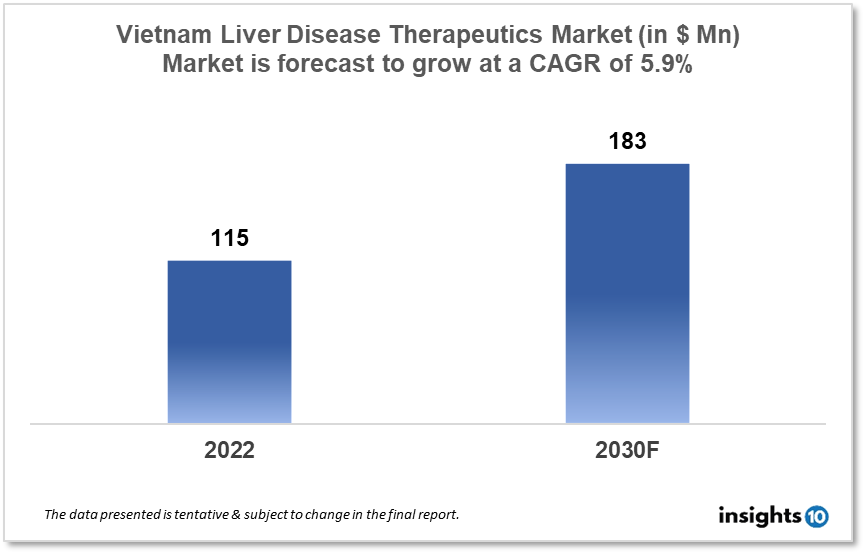
By 2030, it is anticipated that the Vietnam Liver Disease Therapeutics market will reach a value of $183 Mn from $115 Mn in 2022, growing at a CAGR of 5.9% during 2022-2030. Liver Disease Therapeutics in Vietnam is dominated by domestic pharmaceutical companies such as Domesco, Ha Tay Pharmaceutical, and OPC. The Liver Disease Therapeutics market in Vietnam is segmented into different types of disease and different therapy types. Some of the significant factors affecting the Vietnam Liver Disease Therapeutics market are the growing prevalence of liver diseases and unhealthy and dynamic lifestyles.
Buy Now

Vietnam Liver Disease Therapeutics Analysis Summary
By 2030, it is anticipated that the Vietnam Liver Disease Therapeutics market will reach a value of $183 Mn from $115 Mn in 2022, growing at a CAGR of 5.9% during 2022-2030.
Vietnam is a low-middle-income, developing country located in Southeastern Asia bordering the Gulf of Thailand, the Gulf of Tonkin, and the South China Sea. The World Health Organization (WHO) reports that viral hepatitis B and C are the primary causes of liver disease in Vietnam. In 2015, it was projected that roughly 10 Mn Vietnamese people have chronic hepatitis B and C. Patients with chronic liver illness may also be eligible for specialised care through the Vietnam National Hospital of Gastroenterology, which offers diagnostic tests, specialist consultations, and liver transplant services.
According to the latest WHO data published in 2020 Liver Disease Deaths in Viet Nam reached 23,900 or 3.49% of total deaths. The age-adjusted Death Rate is 23.34 per 100,000 population ranks Viet Nam 81st in the world. Vietnam's government spent 4.7% of its GDP on healthcare in 2020.
Market Dynamics
Market Growth Drivers Analysis
For decades, Vietnam has battled a viral hepatitis pandemic. While the infection incidence in the country's urban areas is thought to be as high as 10%, up to 40% of persons in rural Vietnam are infected with the hepatitis B virus. According to the World Health Organization, Vietnam is one of 11 nations that account for half of the global burden of chronic viral hepatitis. Vietnam's economy is thriving, with one of the fastest growth rates in the area. Vietnam's massive labour pool and inexpensive labour costs facilitate firm expansion. These aspects could boost the Vietnam Liver Disease Therapeutics market.
Market Restraints
While there are some innovative treatments for liver illnesses available in Vietnam, they can be costly and may not be covered by insurance. For certain people, this can be a barrier to access. Business climate shortcomings in Vietnam, fuelled by concerns about data transparency and corruption perceptions, can make doing business challenging. These factors may deter new entrants into the Vietnam Liver Disease Therapeutics market.
Competitive Landscape
Key Players
- Domesco Medical Import-Export Joint Stock Corporation (DOMESCO): DOMESCO is a Vietnamese pharmaceutical company that produces a wide range of therapeutic products, including those for liver disease
- Ha Tay Pharmaceutical Joint Stock Company (DHG Pharma): DHG Pharma is a Vietnamese pharmaceutical company that develops and produces a variety of therapeutics, including those for liver disease
- OPC Pharmaceutical Joint Stock Company (OPC): OPC is a Vietnamese pharmaceutical company that produces a range of therapeutic products, including those for liver disease
- Traphaco Joint Stock Company (TRAPHACO): TRAPHACO is a Vietnamese pharmaceutical company that produces a variety of therapeutics, including those for liver disease
Healthcare Policies and Reimbursement Scenarios
The Ministry of Health and the Social Health Insurance (SHI) system are in charge of the regulation and reimbursement of liver treatments in Vietnam. In terms of reimbursement, the SHI system pays for qualifying patients' liver therapies. The Vietnam Social Security Administration manages the reimbursement process, determining which therapies are qualified for payment and the conditions under which they will be funded.
1. Executive Summary
1.1 Disease Overview
1.2 Global Scenario
1.3 Country Overview
1.4 Healthcare Scenario in Country
1.5 Patient Journey
1.6 Health Insurance Coverage in Country
1.7 Active Pharmaceutical Ingredient (API)
1.8 Recent Developments in the Country
2. Market Size and Forecasting
2.1 Epidemiology of Disease
2.2 Market Size (With Excel & Methodology)
2.3 Market Segmentation (Check all Segments in Segmentation Section)
3. Market Dynamics
3.1 Market Drivers
3.2 Market Restraints
4. Competitive Landscape
4.1 Major Market Share
4.2 Key Company Profile (Check all Companies in the Summary Section)
4.2.1 Company
4.2.1.1 Overview
4.2.1.2 Product Applications and Services
4.2.1.3 Recent Developments
4.2.1.4 Partnerships Ecosystem
4.2.1.5 Financials (Based on Availability)
5. Reimbursement Scenario
5.1 Reimbursement Regulation
5.2 Reimbursement Process for Diagnosis
5.3 Reimbursement Process for Treatment
6. Methodology and Scope
Liver Disease Therapeutics Segmentation
By Treatment Type (Revenue, USD Billion):
- Chemotherapy
- Antiviral Drugs
- Vaccines
- Immunosuppressants
- Corticosteroids
- Immunoglobulins
- Targeted Therapy
By Disease Type (Revenue, USD Billion):
- Non-alcoholic Fatty Liver Disease (NAFLD)
- Autoimmune Diseases
- Cancer
- Hepatitis
- Genetic Disorder
- Others
By Distribution Channel (Revenue, USD Billion):
- Hospital Pharmacies
- Retail Pharmacies
- Online Pharmacies
Methodology for Database Creation
Our database offers a comprehensive list of healthcare centers, meticulously curated to provide detailed information on a wide range of specialties and services. It includes top-tier hospitals, clinics, and diagnostic facilities across 30 countries and 24 specialties, ensuring users can find the healthcare services they need.
Additionally, we provide a comprehensive list of Key Opinion Leaders (KOLs) based on your requirements. Our curated list captures various crucial aspects of the KOLs, offering more than just general information. Whether you're looking to boost brand awareness, drive engagement, or launch a new product, our extensive list of KOLs ensures you have the right experts by your side. Covering 30 countries and 36 specialties, our database guarantees access to the best KOLs in the healthcare industry, supporting strategic decisions and enhancing your initiatives.
How Do We Get It?
Our database is created and maintained through a combination of secondary and primary research methodologies.
1. Secondary Research
With many years of experience in the healthcare field, we have our own rich proprietary data from various past projects. This historical data serves as the foundation for our database. Our continuous process of gathering data involves:
- Analyzing historical proprietary data collected from multiple projects.
- Regularly updating our existing data sets with new findings and trends.
- Ensuring data consistency and accuracy through rigorous validation processes.
With extensive experience in the field, we have developed a proprietary GenAI-based technology that is uniquely tailored to our organization. This advanced technology enables us to scan a wide array of relevant information sources across the internet. Our data-gathering process includes:
- Searching through academic conferences, published research, citations, and social media platforms
- Collecting and compiling diverse data to build a comprehensive and detailed database
- Continuously updating our database with new information to ensure its relevance and accuracy
2. Primary Research
To complement and validate our secondary data, we engage in primary research through local tie-ups and partnerships. This process involves:
- Collaborating with local healthcare providers, hospitals, and clinics to gather real-time data.
- Conducting surveys, interviews, and field studies to collect fresh data directly from the source.
- Continuously refreshing our database to ensure that the information remains current and reliable.
- Validating secondary data through cross-referencing with primary data to ensure accuracy and relevance.
Combining Secondary and Primary Research
By integrating both secondary and primary research methodologies, we ensure that our database is comprehensive, accurate, and up-to-date. The combined process involves:
- Merging historical data from secondary research with real-time data from primary research.
- Conducting thorough data validation and cleansing to remove inconsistencies and errors.
- Organizing data into a structured format that is easily accessible and usable for various applications.
- Continuously monitoring and updating the database to reflect the latest developments and trends in the healthcare field.
Through this meticulous process, we create a final database tailored to each region and domain within the healthcare industry. This approach ensures that our clients receive reliable and relevant data, empowering them to make informed decisions and drive innovation in their respective fields.
To request a free sample copy of this report, please complete the form below.
We value your inquiry and offer free customization with every report to fulfil your exact research needs.

Related reports (by category)
Pharmaceuticals
Spain Proliferative Diabetic Retinopathy Market Analysis
Pharmaceuticals
US Hepatitis B Drugs Market Analysis
Pharmaceuticals
Italy Obesity Drugs Market Analysis
Related reports (by geography)
Pharmaceuticals
Vietnam Gynecology Drugs Market Analysis
Medical Devices
Vietnam Hemodialysis Equipment Market Analysis
Medical Devices