Medical Devices
UAE Bio-Implant Market Analysis
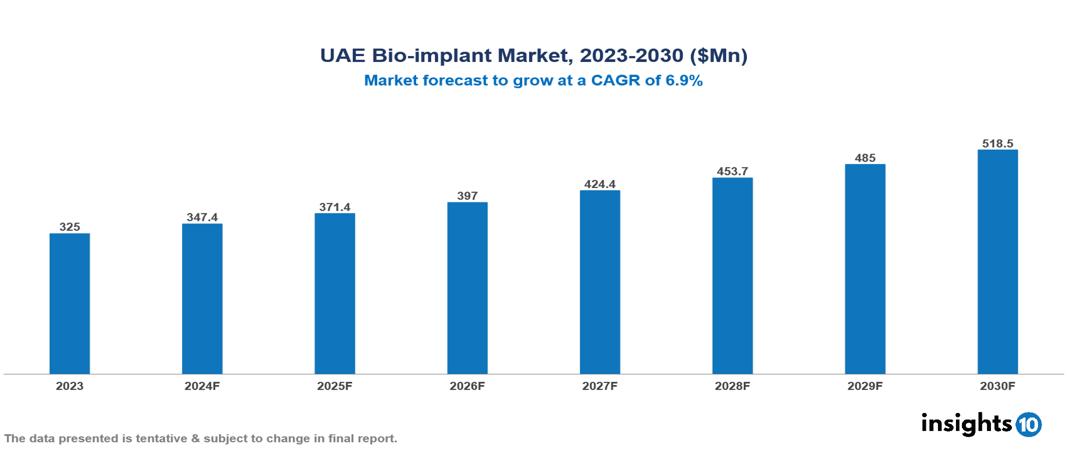
The UAE Bio-implant Market was valued at $325 Mn in 2023 and is predicted to grow at a CAGR of 6.9% from 2023 to 2030, to $518.5 Mn by 2030. The UAE Bio-implant Market is growing due to the Growing Aging Population, Government Initiatives and Healthcare Infrastructure Development, and Rising Chronic Disease Prevalence. The market is primarily dominated by players such as ProvenMed, Global Med Hub FZ LLC, Sinterex, ThermoMind, Zimmer Biomet, Boston Scientific Corporation, Otto Bock Holding GmbH & Co. KG, and Medtronic plc.
Buy Now

UAE Bio-implant Market Executive Summary
The UAE Bio-implant Market is at around $325 Mn in 2023 and is projected to reach $518.5 Mn in 2030, exhibiting a CAGR of 6.9% during the forecast period.
Bioimplants are advanced medical devices designed to be implanted into the body in order to support or replace a biological structure or function. These instruments range significantly in complexity and purpose from simple dental implants to sophisticated gadgets like pacemakers, prosthetic joints, and neurological implants. One of the primary objectives of bioimplants is to enhance the quality of life for people with a range of diseases or injuries by using implantable devices to restore lost or damaged functions. Bio-implants, which are often composed of biocompatible materials, reduce the likelihood of rejection. Innovations like adding wireless connectivity and sensors to bioimplants, which enable real-time physiological data monitoring and remote modifications, are driving the market's growth.
In the UAE, chronic diseases like diabetes and cardiovascular conditions are prevalent due to lifestyle factors and an aging population. Approximately 19% of the population is aged 50 and above, with projections indicating a rise to 25% by 2030. Demographically, expatriates make up around 88% of the population, influencing healthcare demands and preferences. Therefore, the market is driven by significant factors like Growing Aging Population, Government Initiatives and Healthcare Infrastructure Development, and Rising Chronic Disease Prevalence. However, the High Cost of Treatment, Regulatory challenges, and Limited Insurance Coverage restrict the growth and potential of the market.
ThermoMind is a renowned company that specializes in neurosurgical implants. They have been creating and releasing cutting-edge implants to treat neurological disorders.
Market Dynamics
Market Growth Drivers
Growing Aging Population: The UAE's population is experiencing a demographic shift towards an aging population, which increases the demand for orthopedic and dental implants. According to recent statistics from the UAE National Bureau of Statistics, the percentage of people aged 60 years and above has increased to 3.2% of the total population, reflecting a significant segment with potential healthcare needs.
Government Initiatives and Healthcare Infrastructure Development: Government initiatives to enhance healthcare infrastructure and services support market expansion. The UAE's Vision 2021 and Vision 2030 frameworks prioritize healthcare excellence, aiming to position the country as a global healthcare hub. Investments in hospitals, clinics, and medical tourism facilities bolster bioimplant adoption rates.
Rising Chronic Disease Prevalence: Like many developed nations, the UAE faces an increasing prevalence of chronic diseases such as diabetes, cardiovascular diseases, and orthopedic ailments. These conditions often necessitate the use of bioimplants for effective treatment. For instance, diabetes affects around 19.3% of the UAE population, driving demand for bioimplants like insulin pumps and glucose monitoring devices.
Market Restraints
High Cost of Treatment: Bioimplants, including orthopedic implants and dental implants, can be expensive, making them inaccessible to a significant portion of the population, particularly those without adequate health insurance coverage. According to recent statistics, the average cost of dental implants in the UAE ranges from $ 2,000 to $ 5,000 per implant, depending on the complexity and materials used. For orthopedic implants, such as knee or hip replacements, costs can vary widely but often exceed $15,000 per procedure, putting them out of reach for many patients without substantial financial resources.
Regulatory Challenges: Another restraint is the regulatory environment governing medical devices and implants in the UAE. While the UAE has made strides in enhancing its regulatory framework to align with international standards, navigating the approval process for new bioimplants can still be complex and time-consuming for manufacturers. Recent data shows that the regulatory approval process for medical devices in the UAE can take several months to over a year, depending on the type of implant and its classification.
Limited Insurance Coverage: Insurance coverage for bioimplant procedures in the UAE can be limited, particularly for elective surgeries or specialized implants not covered under basic healthcare plans. Recent statistics highlight that while comprehensive health insurance coverage is growing in the UAE, coverage for advanced bioimplant procedures may require additional premiums or be subject to strict reimbursement policies, thereby limiting patient access to these treatments.
Regulatory Landscape and Reimbursement Scenario
The regulatory landscape for the UAE bio implant market is overseen primarily by the Ministry of Health and Prevention (MOHAP). MOHAP plays a crucial role in regulating the import, sale, and distribution of bio implants, ensuring they meet stringent safety and quality standards. Companies seeking to enter the market must obtain regulatory approvals from MOHAP, which involves rigorous testing and documentation to demonstrate compliance with local health regulations. MOHAP's guidelines also encompass post-market surveillance to monitor the performance and safety of bio implants once they are available to patients. Compliance with these regulations is essential for market entry and ongoing operations in the UAE, reflecting the government's commitment to safeguarding public health and maintaining high standards in medical device safety and efficacy.
Despite technological advancements and increasing healthcare investments, reimbursement policies often lack comprehensive coverage for bioimplants, impacting market growth. Private health insurance dominates, but coverage gaps persist, particularly for advanced and costly implants. This restricts patient access and dampens market expansion, requiring alignment between healthcare policies and industry needs to foster sustainable growth in the bioimplant sector in the UAE.
Competitive Landscape
Key Players
Here are some of the major key players in the UAE Bio-implant Market:
- ProvenMed
- Global Med Hub FZ LLC
- Sinterex
- ThermoMind
- Straumann AG
- Zimmer Biommer
- Boston Scientific Corporation
- Otto Bock Holding GmbH & Co. KG
- Medtronic
- Boston Scientific Corporation
- Johnson & Johnson Services, Inc.
- LifeNet Health
- Smith & Nephew
- Arthrex, Inc
- Clinic Lemanic
- DePuy Synthes
- Exactech, Inc.
- Cochlear Ltd
1. Executive Summary
1.1 Device Overview
1.2 Global Scenario
1.3 Country Overview
1.4 Healthcare Scenario in Country
1.5 Regulatory Landscape for Medical Device
1.6 Health Insurance Coverage in Country
1.7 Type of Medical Device
1.8 Recent Developments in the Country
2. Market Size and Forecasting
2.1 Market Size (With Excel and Methodology)
2.2 Market Segmentation (Check all Segments in Segmentation Section)
3. Market Dynamics
3.1 Market Drivers
3.2 Market Restraints
4. Competitive Landscape
4.1 Major Market Share
4.2 Key Company Profile (Check all Companies in the Summary Section)
4.2.1 Company
4.2.1.1 Overview
4.2.1.2 Product Applications and Services
4.2.1.3 Recent Developments
4.2.1.4 Partnerships Ecosystem
4.2.1.5 Financials (Based on Availability)
5. Reimbursement Scenario
5.1 Reimbursement Regulation
5.2 Reimbursement Process for Diagnosis
5.3 Reimbursement Process for Treatment
6. Methodology and Scope
UAE Bio-implant Market Segmentation
By Material
- Ceramics
- Polymers
- Alloys
- Biomaterials Metals
By Type
- Dental Bio-implants
- Orthopedic Bio-implants
- Spinal Bio-implants
- Ophthalmology Bio-implants
- Cardiovascular Bio-implants
- Others
By Mode of Administration
- Surgical
- Injectable
By End User
- Hospitals
- Speciality Clinics
- Ambulatory surgical centers
By Origin
- Autograft
- Allograft
- Xenograft
- Synthetic
Methodology for Database Creation
Our database offers a comprehensive list of healthcare centers, meticulously curated to provide detailed information on a wide range of specialties and services. It includes top-tier hospitals, clinics, and diagnostic facilities across 30 countries and 24 specialties, ensuring users can find the healthcare services they need.
Additionally, we provide a comprehensive list of Key Opinion Leaders (KOLs) based on your requirements. Our curated list captures various crucial aspects of the KOLs, offering more than just general information. Whether you're looking to boost brand awareness, drive engagement, or launch a new product, our extensive list of KOLs ensures you have the right experts by your side. Covering 30 countries and 36 specialties, our database guarantees access to the best KOLs in the healthcare industry, supporting strategic decisions and enhancing your initiatives.
How Do We Get It?
Our database is created and maintained through a combination of secondary and primary research methodologies.
1. Secondary Research
With many years of experience in the healthcare field, we have our own rich proprietary data from various past projects. This historical data serves as the foundation for our database. Our continuous process of gathering data involves:
- Analyzing historical proprietary data collected from multiple projects.
- Regularly updating our existing data sets with new findings and trends.
- Ensuring data consistency and accuracy through rigorous validation processes.
With extensive experience in the field, we have developed a proprietary GenAI-based technology that is uniquely tailored to our organization. This advanced technology enables us to scan a wide array of relevant information sources across the internet. Our data-gathering process includes:
- Searching through academic conferences, published research, citations, and social media platforms
- Collecting and compiling diverse data to build a comprehensive and detailed database
- Continuously updating our database with new information to ensure its relevance and accuracy
2. Primary Research
To complement and validate our secondary data, we engage in primary research through local tie-ups and partnerships. This process involves:
- Collaborating with local healthcare providers, hospitals, and clinics to gather real-time data.
- Conducting surveys, interviews, and field studies to collect fresh data directly from the source.
- Continuously refreshing our database to ensure that the information remains current and reliable.
- Validating secondary data through cross-referencing with primary data to ensure accuracy and relevance.
Combining Secondary and Primary Research
By integrating both secondary and primary research methodologies, we ensure that our database is comprehensive, accurate, and up-to-date. The combined process involves:
- Merging historical data from secondary research with real-time data from primary research.
- Conducting thorough data validation and cleansing to remove inconsistencies and errors.
- Organizing data into a structured format that is easily accessible and usable for various applications.
- Continuously monitoring and updating the database to reflect the latest developments and trends in the healthcare field.
Through this meticulous process, we create a final database tailored to each region and domain within the healthcare industry. This approach ensures that our clients receive reliable and relevant data, empowering them to make informed decisions and drive innovation in their respective fields.
To request a free sample copy of this report, please complete the form below.
We value your inquiry and offer free customization with every report to fulfil your exact research needs.

Related reports (by category)
Medical Devices
Qatar Coronary Stents Market Analysis
Medical Devices
UAE Dental Implant Market Analysis
Medical Devices
China Pain Management Devices Market Analysis
Related reports (by geography)

Pharmaceuticals
UAE Pediatric Healthcare Market Analysis

Rare Diseases
UAE POMC Genetic Obesity Drugs Market Analysis
Medical Devices
UAE Dental Caries Detectors Market Analysis
Digital Health