Medical Devices
Philippines MRI Market Analysis
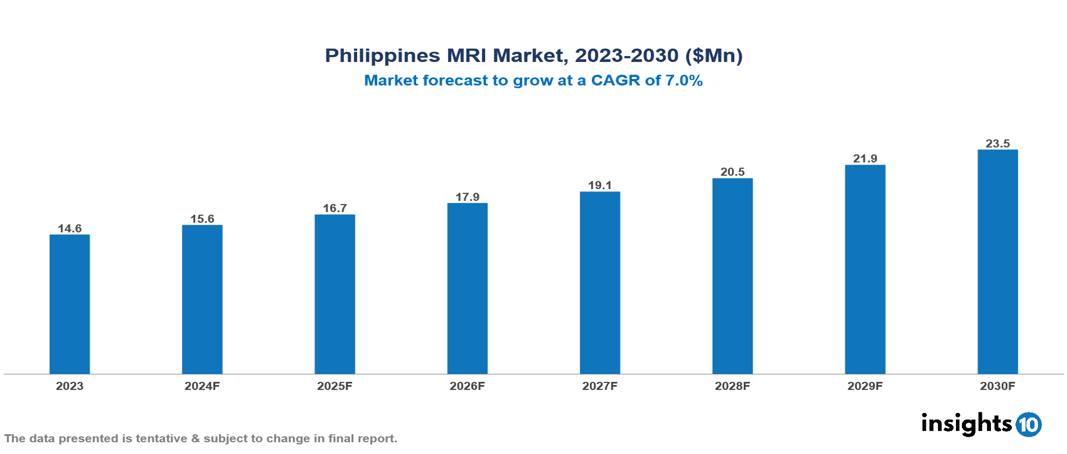
The Philippines MRI Market was valued at $14.61 Mn in 2023 and is predicted to grow at a CAGR of 7% from 2023 to 2030, to $23.46 Mn by 2030. The key drivers of this industry include increasing awareness, rising burden of chronic diseases, and government initiatives. The key players in the industry are GE Healthcare, Esaote, and Hitachi Medical Corporation, Siemens Healthineers among others.
Buy Now

Philippines MRI Market Executive Summary
The Philippines MRI Market is at around $14.61 Mn in 2023 and is projected to reach $23.46 Mn in 2030, exhibiting a CAGR of 7% during the forecast period.
Magnetic resonance imaging (MRI) is a type of diagnostic test that can create detailed images of nearly every structure and organ inside the body. It uses strong magnetic fields and radio waves to produce detailed images of the inside of the body. The MRI machine is a large, cylindrical (tube-shaped) device that generates a powerful magnetic field around the patient and emits pulses of radio waves from a scanner. Some MRI machines resemble narrow tunnels, while others are more spacious. The intense magnetic field produced by the MRI scanner causes the atoms in your body to align in the same direction. Subsequently, radio waves are emitted from the MRI machine, which disrupt this alignment, causing the atoms to return to their original positions. As the radio waves cease, the atoms revert to their initial alignment and emit radio signals. These signals are then picked up by a computer, which transforms them into an image of the area being examined. This image is displayed on a viewing monitor.
In Philippines Road accidents are so prevalent that it leads to 109,322 injuries. The market therefore is driven by significant factors like increasing awareness, rising burden of chronic diseases, and government initiatives. However, high cost, infrastructural limitation, and scarcity of skilled professionals restrict the growth of the market.
The leading pharmaceutical companies include GE Healthcare and Koninklijke Philips N.V. for MRI machines. Esaote, Toshiba Medical Systems Corporation, and Shinagawa Diagnostic & Preventive Care are also significant contributors to the MRI market, with continuous research and development activities.
Market Dynamics
Market Growth Drivers
Rising Burden of Chronic Diseases: Similar to many countries, the Philippines faces an increase in chronic illnesses like diabetes, cardiovascular diseases, and cancer. These conditions often require advanced diagnostic techniques like MRI for accurate detection and monitoring, driving demand for MRI machines. Cardiovascular diseases are a leading cause of death in the Philippines, accounting for about 35% of all deaths.
Increasing Awareness: Growing public awareness about health issues and the benefits of early detection leads to a higher demand for diagnostic procedures like MRI scans. Patients become more proactive in seeking advanced diagnostics for timely treatment.
Supportive Government Initiative: Philippine government, through the General Appropriations Act, is providing funding for the construction of MRI facilities. Specifically, the Batangas Medical Center is procuring the design and construction of an MRI building, which suggests the government is investing in expanding MRI infrastructure
Market Restraints
High Cost: MRI machines are incredibly expensive to purchase, install, and maintain. The complex technology and specialized facilities required create a significant financial barrier for many hospitals and clinics, especially smaller ones. Patients also face high procedure costs, potentially restricting access to this valuable diagnostic tool.
Infrastructure Limitation: A reliable and strong electricity supply is crucial for operating MRI machines. Uneven power infrastructure, particularly in rural regions, can pose challenges for consistent operation. Hospitals and diagnostic centers in these regions may face greater challenges in securing a reliable electricity supply to operate MRI machines consistently.
Scarcity of Skilled Professionals: Without enough skilled professionals to operate and interpret MRI scans, healthcare facilities are unable to fully leverage their MRI equipment, constraining access to these important diagnostic services for patients. A lack of qualified radiologists and technicians restricts the number of MRI procedures performed and strains existing resources.
Regulatory Landscape and Reimbursement Scenario
Food and Drug Administration (FDA) is responsible for ensuring the safety, efficacy, and quality of MRI machines as medical devices. MRI machines require registration with the FDA before being imported, distributed, or used in the Philippines. This process involves meeting specific safety and technical standards. It also provides guidelines for implementing quality control and safety protocols for MRI services.
PhilHealth covers some MRI scans under specific conditions. However, coverage details and limitations vary depending on the specific medical condition and the patient's PhilHealth membership type. Additionally, the MediCard plan provides a 30% discount on outpatient laboratory and diagnostic tests, which could include MRI services.
Competitive Landscape
Key Players
Here are some of the major key players in the Philippines MRI Market:
- GE Healthcare
- Koninklijke Philips NV
- Siemens Healthineers
- Canon (Canon Medical Systems Corporation)
- Toshiba Medical Systems Corporation
- Paramed Medical Systems
- Hitachi Medical Corporation
- Esaote
- Shinagawa Diagnostic & Preventive Care
- Biocare Medical
1. Executive Summary
1.1 Device Overview
1.2 Global Scenario
1.3 Country Overview
1.4 Healthcare Scenario in Country
1.5 Regulatory Landscape for Medical Device
1.6 Health Insurance Coverage in Country
1.7 Type of Medical Device
1.8 Recent Developments in the Country
2. Market Size and Forecasting
2.1 Market Size (With Excel and Methodology)
2.2 Market Segmentation (Check all Segments in Segmentation Section)
3. Market Dynamics
3.1 Market Drivers
3.2 Market Restraints
4. Competitive Landscape
4.1 Major Market Share
4.2 Key Company Profile (Check all Companies in the Summary Section)
4.2.1 Company
4.2.1.1 Overview
4.2.1.2 Product Applications and Services
4.2.1.3 Recent Developments
4.2.1.4 Partnerships Ecosystem
4.2.1.5 Financials (Based on Availability)
5. Reimbursement Scenario
5.1 Reimbursement Regulation
5.2 Reimbursement Process for Diagnosis
5.3 Reimbursement Process for Treatment
6. Methodology and Scope
Philippines MRI Market Segmentation
By Architecture
- Closed MRI Systems
- Open MRI Systems
By Field Strength
- Low Field MRI Systems
- High Field MRI Systems
- Ultra-High Field MRI Systems
By Application
- Neurology
- Musculoskeletal
- Cardiovascular
- Oncology
- Others ( Abdominal, Pediatric)
By End-User
- Hospitals and Clinics
- Diagnostic Imaging Centers
- Research Institutes
Methodology for Database Creation
Our database offers a comprehensive list of healthcare centers, meticulously curated to provide detailed information on a wide range of specialties and services. It includes top-tier hospitals, clinics, and diagnostic facilities across 30 countries and 24 specialties, ensuring users can find the healthcare services they need.
Additionally, we provide a comprehensive list of Key Opinion Leaders (KOLs) based on your requirements. Our curated list captures various crucial aspects of the KOLs, offering more than just general information. Whether you're looking to boost brand awareness, drive engagement, or launch a new product, our extensive list of KOLs ensures you have the right experts by your side. Covering 30 countries and 36 specialties, our database guarantees access to the best KOLs in the healthcare industry, supporting strategic decisions and enhancing your initiatives.
How Do We Get It?
Our database is created and maintained through a combination of secondary and primary research methodologies.
1. Secondary Research
With many years of experience in the healthcare field, we have our own rich proprietary data from various past projects. This historical data serves as the foundation for our database. Our continuous process of gathering data involves:
- Analyzing historical proprietary data collected from multiple projects.
- Regularly updating our existing data sets with new findings and trends.
- Ensuring data consistency and accuracy through rigorous validation processes.
With extensive experience in the field, we have developed a proprietary GenAI-based technology that is uniquely tailored to our organization. This advanced technology enables us to scan a wide array of relevant information sources across the internet. Our data-gathering process includes:
- Searching through academic conferences, published research, citations, and social media platforms
- Collecting and compiling diverse data to build a comprehensive and detailed database
- Continuously updating our database with new information to ensure its relevance and accuracy
2. Primary Research
To complement and validate our secondary data, we engage in primary research through local tie-ups and partnerships. This process involves:
- Collaborating with local healthcare providers, hospitals, and clinics to gather real-time data.
- Conducting surveys, interviews, and field studies to collect fresh data directly from the source.
- Continuously refreshing our database to ensure that the information remains current and reliable.
- Validating secondary data through cross-referencing with primary data to ensure accuracy and relevance.
Combining Secondary and Primary Research
By integrating both secondary and primary research methodologies, we ensure that our database is comprehensive, accurate, and up-to-date. The combined process involves:
- Merging historical data from secondary research with real-time data from primary research.
- Conducting thorough data validation and cleansing to remove inconsistencies and errors.
- Organizing data into a structured format that is easily accessible and usable for various applications.
- Continuously monitoring and updating the database to reflect the latest developments and trends in the healthcare field.
Through this meticulous process, we create a final database tailored to each region and domain within the healthcare industry. This approach ensures that our clients receive reliable and relevant data, empowering them to make informed decisions and drive innovation in their respective fields.
To request a free sample copy of this report, please complete the form below.
We value your inquiry and offer free customization with every report to fulfil your exact research needs.

Related reports (by category)
Medical Devices
Saudi Arabia Cardiac Surgery Instruments Market Analysis
Medical Devices
Mexico Dental Endodontics Market Analysis
Medical Devices
UK Neurology Devices Market Analysis
Related reports (by geography)

Digital Health
Philippines 3D Imaging Market Analysis

Pharmaceuticals
Philippines Dry Eye Medication Market Analysis
Pharmaceuticals
Philippines PEGylated Proteins Market Analysis
Pharmaceuticals