Philippines Clinical Nutrition Market Analysis
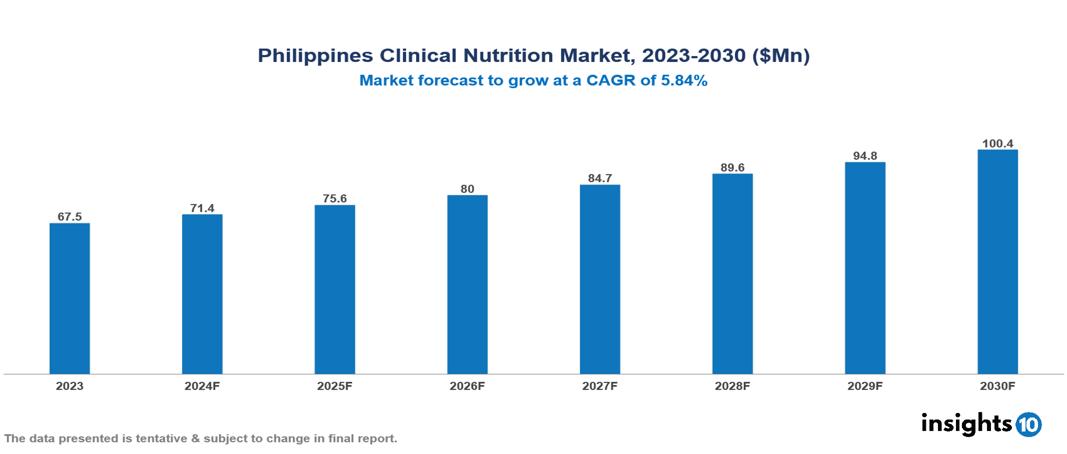
The Philippines Clinical Nutrition Market was valued at $67.5 Mn in 2023 and is projected to grow at a CAGR of 5.84% from 2023 to 2023, to $100.4 Mn by 2030. The key drivers of this industry are increasing prevalence of chronic diseases and metabolic disorders, aging population, increasing awareness of the importance of nutrition for health, product innovations and technological advancements, government initiatives and rising healthcare expenditure, rising incidence of malnutrition especially in paediatric patients which has contributed to market growth. The industry is primarily dominated by players such as Vitacare, BioEssence, United Laboratories, USANA Health Sciences, Mead Johnson & Company, LLC among others.
Buy Now

Philippines Clinical Nutrition Market Executive Summary
The Philippines Clinical Nutrition Market is at around $67.5 Mn in 2023 and is projected to reach $100.4 Mn in 2030, exhibiting a CAGR of 5.84% during the forecast period 2023-2030.
The use of dietary concepts to promote health and prevent disease in individuals, especially in a healthcare context, is known as clinical nutrition. In order to enhance health outcomes, it entails determining the dietary needs of each patient, developing individualized nutrition programs, and putting evidence-based therapies into practice. Clinical nutrition is largely concerned with the diagnosis, treatment, and prevention of dietary modifications in patients with long-term illnesses and ailments in the medical field. In this context, "clinical" refers to the treatment of patients, encompassing both inpatients at hospitals and outpatients at clinics and private practices. It mainly encompasses the scientific domains of dietetics and nutrition. In addition, clinical nutrition tries to give patients enough protein, vitamin, and mineral intake in addition to preserving a balanced energy system. When a problem is referred to as clinical malnutrition, it means that it can be treated with clinical intervention utilizing specific nutrients that are regarded as legitimate pharmaceuticals as opposed to supplements. By giving the body enough supplements, such as vitamins, minerals, and other nutrients, clinical nutrition solutions help patients stay healthy and strengthen their metabolic system. Advances in medical research and technology are driving a shift in the clinical nutrition industry. Emerging key themes include the use of bioactive substances, customized nutrition solutions, and inventive formulations. Producers are investing in research and development in order to create goods that meet basic nutritional needs while also offering additional health benefits.
The Philippines has seen a rise in the prevalence of various chronic diseases, including cardiovascular diseases, cancer, diabetes, and respiratory illnesses. According to the Department of Health, chronic non-communicable diseases account for 67% of all deaths in the country. The major drivers of Clinical Nutrition industry in Philippines are, increasing prevalence of chronic diseases and metabolic disorders, aging population, increasing awareness of the importance of nutrition for health, product innovations and technological advancements, government initiatives and rising healthcare expenditure, rising incidence of malnutrition especially in paediatric patients.
The industry is primarily dominated by players such as Vitacare, BioEssence, United Laboratories, USANA Health Sciences, Mead Johnson & Company, LLC among others.
Market Dynamics
Market Drivers
Increasing Prevalence of Chronic Diseases: The Philippines has seen a rise in the prevalence of various chronic diseases, including cardiovascular diseases, cancer, diabetes, and respiratory illnesses. According to the Department of Health, chronic non-communicable diseases account for 67% of all deaths in the country. This growing burden of chronic conditions has led to greater demand for specialized clinical nutrition products to help manage these diseases. Thus, the growing prevalence rate is boosting the Clinical Nutrition market.
Rising Consumer Health Awareness: Filipino consumers are becoming more conscious about their health and wellness, with many looking to boost their immune systems, reduce stress, improve sleep, and enhance skin, hair and nail health. This has driven increased interest in nutritional supplements and functional foods that can provide these benefits. A 2021 Euromonitor report found that 68% of Filipino consumers are willing to pay more for products that support their health and well-being.
Popularity of Specialty Health Stores: The Philippines has seen a rise in the number of specialty health stores and pharmacies that cater to the growing demand for nutritional and dietary supplements. These retail channels provide convenient access to a wide range of clinical nutrition products, helping to drive market growth.
Market Restraints
Lack of Access to Reliable Information: Many Filipino consumers lack access to reliable and comprehensive information about the benefits of clinical nutrition products. This makes it difficult for them to make informed purchasing decisions, hindering market growth.
Affordability Challenges: Clinical nutrition products, particularly specialized formulas and supplements, can be relatively expensive in the Philippines. This poses affordability barriers, especially for lower-income consumers who could potentially benefit the most from these products.
Limited Insurance Coverage: The national health insurance program, PhilHealth, currently does not cover dietary supplements and clinical nutrition products. While some private insurance plans may provide limited coverage, the lack of widespread reimbursement further limits accessibility for consumers.
Regulatory Landscape and Reimbursement Scenario
Clinical nutrition regulation and reimbursement in the Philippines are integrated into the country's evolving healthcare system, which combines public and private sector involvement. The Department of Health (DOH) is the primary regulatory body overseeing healthcare policies, including those related to clinical nutrition. The Food and Drug Administration (FDA) of the Philippines, operating under the DOH, is responsible for regulating food, drugs, medical devices, and cosmetics, including nutritional products and supplements used in clinical settings.
The Philippine Health Insurance Corporation (PhilHealth), a government-owned and controlled corporation, implements the national health insurance program. PhilHealth coverage has been expanding in recent years as part of the country's push towards universal health care. However, the coverage for clinical nutrition services under PhilHealth is generally limited.
Reimbursement for clinical nutrition services varies depending on the healthcare setting and insurance coverage. In public hospitals, basic nutritional support is typically included in the overall patient care, but more specialized interventions may require out-of-pocket payments.
The Philippine government has been implementing various initiatives, including the expansion of PhilHealth coverage, the development of clinical practice guidelines that include nutritional care, and public health nutrition programs aimed at addressing malnutrition. The Philippine Society for Parenteral and Enteral Nutrition (PhilSPEN) plays a crucial role in promoting excellence in clinical nutrition practice and advocating for improved nutrition care policies.
Competitive Landscape
Key Players
Here are some of the major key players in the Philippines Clinical Nutrition Market:
- USANA Health Sciences
- United Laboratories (Unilab)
- Uni-President Enterprises Corporation
- BioEssence
- Watsons
- Vitacare
- GlaxoSmithKline
- Abbott Nutrition
- Nestle
- Mead Johnson & Company, LLC
1. Executive Summary
1.1 Disease Overview
1.2 Global Scenario
1.3 Country Overview
1.4 Healthcare Scenario in Country
1.5 Patient Journey
1.6 Health Insurance Coverage in Country
1.7 Active Pharmaceutical Ingredient (API)
1.8 Recent Developments in the Country
2. Market Size and Forecasting
2.1 Epidemiology of Disease
2.2 Market Size (With Excel & Methodology)
2.3 Market Segmentation (Check all Segments in Segmentation Section)
3. Market Dynamics
3.1 Market Drivers
3.2 Market Restraints
4. Competitive Landscape
4.1 Major Market Share
4.2 Key Company Profile (Check all Companies in the Summary Section)
4.2.1 Company
4.2.1.1 Overview
4.2.1.2 Product Applications and Services
4.2.1.3 Recent Developments
4.2.1.4 Partnerships Ecosystem
4.2.1.5 Financials (Based on Availability)
5. Reimbursement Scenario
5.1 Reimbursement Regulation
5.2 Reimbursement Process for Diagnosis
5.3 Reimbursement Process for Treatment
6. Methodology and Scope
Philippines Clinical Nutrition Market Segmentation
By Product
- Oral Clinical Nutrition
- Parenteral Nutrition
- Carbohydrates
- Parenteral Lipid Emulsion
- Single Dose Amino Acid Solutions
- Trace Elements
- Vitamins & Minerals
- Enteral Feeding Formulas
- Standard Formula
- Disease-specific Formulas
- Others
By Application
- Alzheimer’s Disease
- Nutrition Deficiency
- Cancer Care
- Diabetes
- Chronic Kidney Diseases
- Orphan Diseases
- Dysphagia
- Pain Management
- Malabsorption/GI Disorder/Diarrhea
- Others
By Sales Channel
- Retail Sales Channels
- Online Sales Channels
- Institutional Sales Channels
- Others
End Users
- Geriatric
- Adults
- Paediatric
Methodology for Database Creation
Our database offers a comprehensive list of healthcare centers, meticulously curated to provide detailed information on a wide range of specialties and services. It includes top-tier hospitals, clinics, and diagnostic facilities across 30 countries and 24 specialties, ensuring users can find the healthcare services they need.
Additionally, we provide a comprehensive list of Key Opinion Leaders (KOLs) based on your requirements. Our curated list captures various crucial aspects of the KOLs, offering more than just general information. Whether you're looking to boost brand awareness, drive engagement, or launch a new product, our extensive list of KOLs ensures you have the right experts by your side. Covering 30 countries and 36 specialties, our database guarantees access to the best KOLs in the healthcare industry, supporting strategic decisions and enhancing your initiatives.
How Do We Get It?
Our database is created and maintained through a combination of secondary and primary research methodologies.
1. Secondary Research
With many years of experience in the healthcare field, we have our own rich proprietary data from various past projects. This historical data serves as the foundation for our database. Our continuous process of gathering data involves:
- Analyzing historical proprietary data collected from multiple projects.
- Regularly updating our existing data sets with new findings and trends.
- Ensuring data consistency and accuracy through rigorous validation processes.
With extensive experience in the field, we have developed a proprietary GenAI-based technology that is uniquely tailored to our organization. This advanced technology enables us to scan a wide array of relevant information sources across the internet. Our data-gathering process includes:
- Searching through academic conferences, published research, citations, and social media platforms
- Collecting and compiling diverse data to build a comprehensive and detailed database
- Continuously updating our database with new information to ensure its relevance and accuracy
2. Primary Research
To complement and validate our secondary data, we engage in primary research through local tie-ups and partnerships. This process involves:
- Collaborating with local healthcare providers, hospitals, and clinics to gather real-time data.
- Conducting surveys, interviews, and field studies to collect fresh data directly from the source.
- Continuously refreshing our database to ensure that the information remains current and reliable.
- Validating secondary data through cross-referencing with primary data to ensure accuracy and relevance.
Combining Secondary and Primary Research
By integrating both secondary and primary research methodologies, we ensure that our database is comprehensive, accurate, and up-to-date. The combined process involves:
- Merging historical data from secondary research with real-time data from primary research.
- Conducting thorough data validation and cleansing to remove inconsistencies and errors.
- Organizing data into a structured format that is easily accessible and usable for various applications.
- Continuously monitoring and updating the database to reflect the latest developments and trends in the healthcare field.
Through this meticulous process, we create a final database tailored to each region and domain within the healthcare industry. This approach ensures that our clients receive reliable and relevant data, empowering them to make informed decisions and drive innovation in their respective fields.
To request a free sample copy of this report, please complete the form below.
We value your inquiry and offer free customization with every report to fulfil your exact research needs.

Related reports (by category)
Denmark Vitamin and Minerals Market Analysis
Philippines Oral Anti-Diabetes Drugs Market Analysis
Canada Contraceptives Drugs Market Analysis
Related reports (by geography)
Philippines CT Scan Market Analysis
Philippines End-stage Renal Disease(ESRD) Market Analysis
Philippines Enzyme Inhibitors Market Analysis