Healthcare Services
Germany Radiology Service Market Analysis
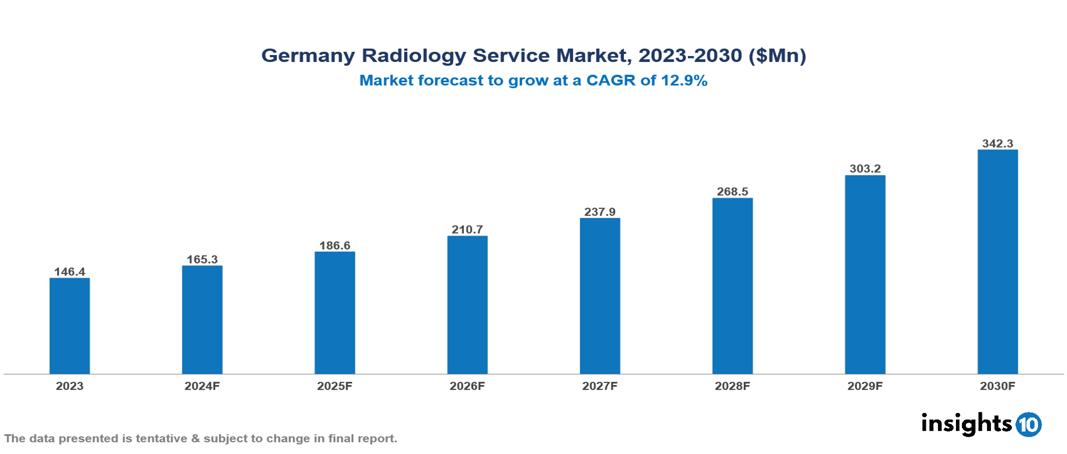
The Germany Radiology Service Market was valued at $146.4 Mn in 2023 and is predicted to grow at a CAGR of 12.9% from 2023 to 2030, to $342.3 Mn by 2030. The key drivers of the market include increasing burden of chronic diseases, aging population, and technological advancements. The prominent players of the Germany Radiology Service Market are Clinic Passautraces, Helios Amper Hospital, Mittelbaden Clinic, Starnbergof Clinic, University Hospital Rechts der Isar, and University Hospital of Munich (LMU), among others.
Buy Now

Germany Radiology Service Market Executive Summary
The Germany Radiology Service market is at around $146.4 Mn in 2023 and is projected to reach $342.3 Mn in 2030, exhibiting a CAGR of 12.9% during the forecast period.
Radiology, also known as diagnostic imaging, is a branch of medicine that uses imaging technology to diagnose, characterize, monitor, and treat diseases. Some of the most common imaging techniques include X-ray, MRI, ultrasound, CT scan and PET scan. Radiology is important as every sector within the healthcare field relies on radiology, including surgery, paediatrics, obstetrics, oncology, emergency medicine, to name a few. Radiology is a broader term composed of diagnostic radiology, interventional radiology, and therapeutic radiology which use radiant energy to diagnose and treat the diseases. Diagnostic radiology involves visualization of the various images of the body for evaluating symptoms, screening of illnesses, and diagnosis of diseases. Diagnostic radiology is usually non-invasive and performed without any incisions or surgical interventions. Interventional radiology is basically image-guided surgery and is used as a part of the medical treatment process. The various procedures under interventional radiology include angiography, angioplasty, embolization, gastrostomy, stent placement, catheter placement, and many more. It is often used to help treat cancer, lymphatic diseases, and vascular abnormalities. Therapeutic radiology is also referred to as radiation oncology or radiation therapy which involves treatment of cancer and other diseases using radiation.
The Germany faces a heavy burden in the healthcare sector due to the rising chronic diseases and increased mortality cases in the nation, with the rising demand for medical imaging services. The Germany diagnostics imaging is expected to reach a revenue of $3.96 Bn by the end of 2024. The Germany Radiology Service Market is thus driven by significant factors such as the increasing burden of chronic diseases, aging population, and technological advancements. However, high cost, radiation exposure concerns, and competition from other diagnostic services restrict the growth and potential of the market.
The major players of the Germany Radiology Service Market are Clinic Passautraces, Helios Amper Hospital, Mittelbaden Clinic, Starnbergof Clinic, University Hospital Rechts der Isar, and University Hospital of Munich (LMU), among others.
Market Dynamics
Market Growth Drivers
Increasing Burden of Chronic Diseases: In Germany, three disease groups account for 44% of the total disability-adjusted life years. These are accounted for 19.5%, 18.8%, 5.8% by cancer, cardiovascular diseases and diabetes, respectively. Radiology services play a crucial role in managing these chronic diseases, especially neurological disorders by providing detailed and accurate imaging that aids in early diagnosis, ongoing monitoring, and treatment planning. Due to the crucial role of radiology services in every stage of disease, the Radiology Service Market is at its full potential growth.
Aging Population: In 2022, Germany had 18.66% of individuals aged 65 years and above. This geriatric population is more susceptible to chronic disorders, especially the neurodegenerative and musculoskeletal disorders. So, medical imaging is extremely useful for early diagnosis and prevention. Overall, the aging population increases the demand for radiology services, which contributes to the growth of the Radiology Service Market.
Technological Advancements: Many technological innovations have been made in the field of the radiology and medical imaging which have significantly improved image resolution and quality. The high-definition images have allowed professionals to observe minute details and abnormalities with greater precision. This enhanced clarity facilitates accurate diagnosis, improves treatment planning, enhances patient care. These developments in in radiology have led to market growth.
Market Restraints
High Cost: Radiology is expensive, attributed to the expensive equipment, such as MRI, CT, and PET scanners, which can cost millions of dollars each. In fact, radiology services are one of the costliest in the medical sector. The cost can be considered a major barrier for obtaining the treatment which ultimately affects the growth of Radiology Service Market.
Radiation Exposure Concerns: Different diagnostic tests in radiology vary with the amount of radiation used. Even though radiation is low and generally considered safe, there are chances of cancer and tissue damage, which can raise doubts for patient safety, public perception, and regulatory standards. Such concerns negatively affect the expansion of the Radiology Service Market.
Competition From Other Diagnostic Services: The growth of alternative diagnostic services such as laboratory tests and genetic testing reduces the demand for radiology services. Comparatively older tests such as CT and MRI scan are more likely to be affected by new diagnostic technologies. These technologies substitute the traditional imaging methods and this reduces the Radiology Services Market growth.
Regulatory Landscape and Reimbursement Scenario
The Federal Institute for Drugs and Medical Devices (BfArM, Bundesinstitut für Arzneimittel und Medizinprodukte) is the primary regulating body in Germany for pharmaceuticals. The main goal of BfArM is to protect public health in Germany by guaranteeing the efficacy, safety, and quality of pharmaceuticals and medical equipment. BfArM reviews and grants marketing authorizations for new drugs and medical devices for ensuring strict safety and efficacy requirements. Clinical trials carried out in Germany are also supervised to ensure they follow ethical principles and protect the rights of study participants.
For approval, the pharmaceutical companies must submit a completed MAA (Marketing Authorization Application) which can be used for drugs meant for the France market (National Procedure) or for the drugs intended for commercialization throughout the European Union (EU) through the EMA (European Medicines Agency). Through the EMA, products can be authorized through the National Procedure, the Centralised Procedure (CP), Decentralised Procedure (DCP) or Mutual Recognition Procedure (MRP). In this case, BfArM acts as a national competent authority (NCA) within the EMA framework. It then issues a final decision of either approval, conditional approval or refusal after conducting a review and evaluation of the MAA based on safety, efficacy, quality, and risk-benefit ratio.
The majority of people in Germany are covered by statutory health insurance (SHI), which is based on the social insurance model of healthcare delivery. A wide range of services are covered by statutory health insurance (SHI), including hospital stays, doctor visits, specialist consultations, preventive care, and rehabilitation. Employer and employee contributions provide the funding for SHI. Some people have the option of purchasing private health insurance (PHI), which has lower co-payments and more comprehensive coverage than SHI.
Competitive Landscape
Key Players
Here are some of the major key players in the Germany Radiology Service Market:
- Clinic Passautraces
- Helios Amper Hospital
- Mittelbaden Clinic
- Starnbergof Clinic
- University Hospital Rechts der Isar
- University Hospital of Munich (LMU)
- Hospital Nuremberg
- Clinic Nordwest
- Helios Medical Group
- Asklepios Medical group
- Freiburg University Hospital
1. Executive Summary
1.1 Service Overview
1.2 Global Scenario
1.3 Country Overview
1.4 Healthcare Scenario in Country
1.5 Healthcare Services Market in Country
1.6 Recent Developments in the Country
2. Market Size and Forecasting
2.1 Market Size (With Excel and Methodology)
2.2 Market Segmentation (Check all Segments in Segmentation Section)
3. Market Dynamics
3.1 Market Drivers
3.2 Market Restraints
4. Competitive Landscape
4.1 Major Market Share
4.2 Key Company Profile (Check all Companies in the Summary Section)
4.2.1 Company
4.2.1.1 Overview
4.2.1.2 Product Applications and Services
4.2.1.3 Recent Developments
4.2.1.4 Partnerships Ecosystem
4.2.1.5 Financials (Based on Availability)
5. Reimbursement Scenario
5.1 Reimbursement Regulation
5.2 Reimbursement Process for Services
5.3 Reimbursement Process for Treatment
6. Methodology and Scope
Germany Radiology Service Market Segmentation
By Type
- Diagnostic Radiology
- Interventional Radiology
By Services
- X-Ray Imaging
- Fusion Imaging
- Nuclear Medicine
- Ultrasound
- Positron Emission Tomography (PET)
- Computed Tomography (CT)
- Magnetic Imaging (MRI)
By Service Provider
- Clinics
- Hospitals
- Diagnostic Centres
Methodology for Database Creation
Our database offers a comprehensive list of healthcare centers, meticulously curated to provide detailed information on a wide range of specialties and services. It includes top-tier hospitals, clinics, and diagnostic facilities across 30 countries and 24 specialties, ensuring users can find the healthcare services they need.
Additionally, we provide a comprehensive list of Key Opinion Leaders (KOLs) based on your requirements. Our curated list captures various crucial aspects of the KOLs, offering more than just general information. Whether you're looking to boost brand awareness, drive engagement, or launch a new product, our extensive list of KOLs ensures you have the right experts by your side. Covering 30 countries and 36 specialties, our database guarantees access to the best KOLs in the healthcare industry, supporting strategic decisions and enhancing your initiatives.
How Do We Get It?
Our database is created and maintained through a combination of secondary and primary research methodologies.
1. Secondary Research
With many years of experience in the healthcare field, we have our own rich proprietary data from various past projects. This historical data serves as the foundation for our database. Our continuous process of gathering data involves:
- Analyzing historical proprietary data collected from multiple projects.
- Regularly updating our existing data sets with new findings and trends.
- Ensuring data consistency and accuracy through rigorous validation processes.
With extensive experience in the field, we have developed a proprietary GenAI-based technology that is uniquely tailored to our organization. This advanced technology enables us to scan a wide array of relevant information sources across the internet. Our data-gathering process includes:
- Searching through academic conferences, published research, citations, and social media platforms
- Collecting and compiling diverse data to build a comprehensive and detailed database
- Continuously updating our database with new information to ensure its relevance and accuracy
2. Primary Research
To complement and validate our secondary data, we engage in primary research through local tie-ups and partnerships. This process involves:
- Collaborating with local healthcare providers, hospitals, and clinics to gather real-time data.
- Conducting surveys, interviews, and field studies to collect fresh data directly from the source.
- Continuously refreshing our database to ensure that the information remains current and reliable.
- Validating secondary data through cross-referencing with primary data to ensure accuracy and relevance.
Combining Secondary and Primary Research
By integrating both secondary and primary research methodologies, we ensure that our database is comprehensive, accurate, and up-to-date. The combined process involves:
- Merging historical data from secondary research with real-time data from primary research.
- Conducting thorough data validation and cleansing to remove inconsistencies and errors.
- Organizing data into a structured format that is easily accessible and usable for various applications.
- Continuously monitoring and updating the database to reflect the latest developments and trends in the healthcare field.
Through this meticulous process, we create a final database tailored to each region and domain within the healthcare industry. This approach ensures that our clients receive reliable and relevant data, empowering them to make informed decisions and drive innovation in their respective fields.
To request a free sample copy of this report, please complete the form below.
We value your inquiry and offer free customization with every report to fulfil your exact research needs.

Related reports (by category)
Healthcare Services
UAE Kidney Cancer Diagnostic Market Analysis
Healthcare Services
US Liquid Biopsy Market Analysis
Healthcare Services
US Metabolomics Market Analysis
Related reports (by geography)

Pharmaceuticals
Germany Compounding Pharmacies Market Analysis
Healthcare Services
Germany Interventional Radiology Market Analysis
Healthcare Services