Medical Devices
Vietnam MRI Market Analysis
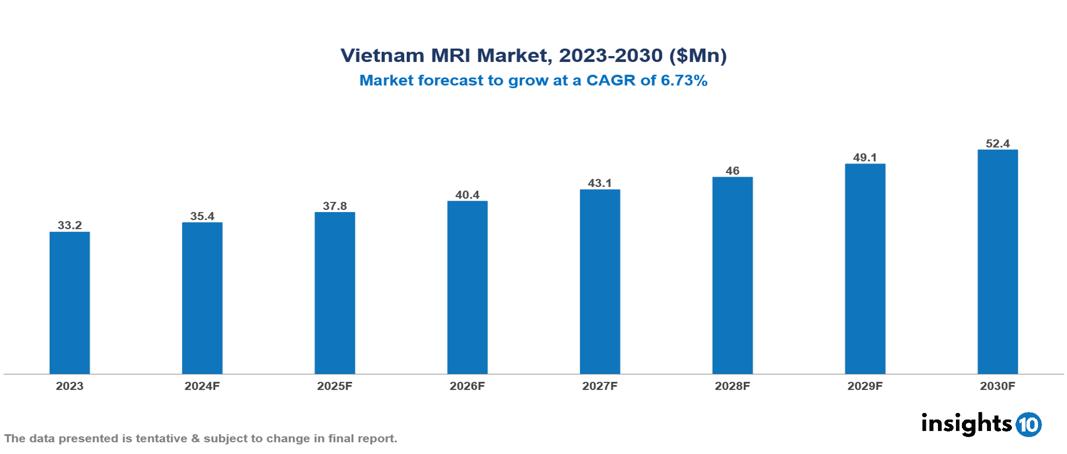
The Vietnam MRI Market was valued at $33.20 Mn in 2023 and is predicted to grow at a CAGR of 6.73% from 2023 to 2030, to $52.38 Mn by 2030. The key drivers of this industry include increasing prevalence of chronic diseases, increase healthcare expenditure, and focus on early detection. The key players in the industry are Siemens Healthineers, Neusoft Medical Systems Vietnam, and IBM Watson Health among others.
Buy Now

Vietnam MRI Market Executive Summary
The Vietnam MRI Market is at around $33.20 Mn in 2023 and is projected to reach $52.38 Mn in 2030, exhibiting a CAGR of 6.73% during the forecast period.
Magnetic resonance imaging (MRI) is a type of diagnostic test that can create detailed images of nearly every structure and organ inside the body. It uses strong magnetic fields and radio waves to produce detailed images of the inside of the body. The MRI machine is a large, cylindrical (tube-shaped) device that generates a powerful magnetic field around the patient and emits pulses of radio waves from a scanner. Some MRI machines resemble narrow tunnels, while others are more spacious. The intense magnetic field produced by the MRI scanner causes the atoms in your body to align in the same direction. Subsequently, radio waves are emitted from the MRI machine, which disrupt this alignment, causing the atoms to return to their original positions. As the radio waves cease, the atoms revert to their initial alignment and emit radio signals. These signals are then picked up by a computer, which transforms them into an image of the area being examined. This image is displayed on a viewing monitor.
Road accidents are a major public health concern in Vietnam accounting for about 6,700 fatalities and 10,804 injuries, this leads to extensive use of MRI. The market therefore is driven by significant factors like increasing prevalence of chronic diseases, increase healthcare expenditure, and focus on early detection. However, high cost, infrastructure constraints, and shortage of skilled professionals restrict the growth of the market.
The leading pharmaceutical companies include GE Healthcare and Vinmed for MRI machines. Siemens Healthineers, Fujifilm Medical Systems, and Neusoft Medical Systems Vietnam are also significant contributors to the MRI market, with continuous research and development activities.
Market Dynamics
Market Growth Drivers
Increase Healthcare Expenditure: Vietnam has experienced robust economic growth, with an average annual GDP growth rate of around 6.5% over the last decade. This economic expansion has led to a significant increase in the country's GDP. Private healthcare expenditure in Vietnam is expected to grow largely due to increasing insurance coverage for citizens.
Growing Prevalence of Chronic Diseases: The increasing incidence of diseases like cancer, heart conditions, and bone and muscle disorders in Vietnam is driving up the demand for MRI scans for identification and monitoring purposes. Cancer ranks as the second leading cause of mortality in the country, following cardiovascular diseases. The substantial impact of these health challenges necessitates the use of MRI scans for early detection, diagnosis, and evaluation of treatment
Focus on Early Detection: In Vietnam, the MRI market is thriving due to a growing awareness of early diagnosis benefits. This means people understand that catching diseases early with MRI scans leads to better treatment outcomes. This fuels demand for MRI technology as accurate diagnoses improve patient care and potentially save lives.
Market Restraints
High Cost: The significant capital and operational expenses associated with MRI equipment can significantly affect market growth due to budgetary constraints, affordability issues, and accessibility challenges faced by both healthcare providers and patients. These increased costs hinder the adoption and utilization of these advanced imaging technologies.
Infrastructure Constraint: The distribution and accessibility of MRI services are hindered by infrastructure constraints, particularly in rural and remote areas of Vietnam. This leads to disparities in healthcare provision and limits the reach of advanced diagnostic imaging technologies.
Shortage of Skilled Professionals: The shortage of qualified radiologists and MRI technicians in Vietnam is a critical factor impeding the growth of the MRI market. The lack of skilled personnel to operate and maintain these advanced imaging systems is limiting the adoption and utilization of MRI services, especially in rural and underserved areas of the country. This deficiency in trained professionals is obstructing access to MRI scans and hindering the expansion of MRI services nationwide.
Regulatory Landscape and Reimbursement Scenario
Department of Medical Equipment and Health Works (DMEHW) under the Ministry of Health oversees the regulation of MRI in Vietnam. The MRI industry in Vietnam must adhere to strict compliance requirements and safety standards set by regulatory authorities. These regulations cover the installation, operation, and maintenance of MRI systems to ensure patient safety and quality of care. The Vietnamese government has established quality standards and guidelines for MRI systems and imaging services. The use of MRI technology in Vietnam is subject to strict radiation safety regulations, which aim to protect patients, healthcare workers, and the general public from potential radiation exposure.
The most common reimbursement mechanism in Vietnam for both outpatient and inpatient care, including MRI services, is the fee-for-service (FFS) model. Under FFS, healthcare providers are reimbursed based on the specific services and procedures performed, which can incentivize the provision of more care than is clinically necessary.
Competitive Landscape
Key Players
Here are some of the major key players in the Vietnam MRI Market:
- GE Healthcare
- Philips Healthcare Vietnam
- Canon Medical Systems Vietnam
- Siemens Healthineers
- Japan Vietnam Medical Instrument
- Hitachi Medical Systems
- Vinmed
- Fujifilm Medical Systems
- Neusoft Medical Systems Vietnam
- IBM Watson Health
1. Executive Summary
1.1 Device Overview
1.2 Global Scenario
1.3 Country Overview
1.4 Healthcare Scenario in Country
1.5 Regulatory Landscape for Medical Device
1.6 Health Insurance Coverage in Country
1.7 Type of Medical Device
1.8 Recent Developments in the Country
2. Market Size and Forecasting
2.1 Market Size (With Excel and Methodology)
2.2 Market Segmentation (Check all Segments in Segmentation Section)
3. Market Dynamics
3.1 Market Drivers
3.2 Market Restraints
4. Competitive Landscape
4.1 Major Market Share
4.2 Key Company Profile (Check all Companies in the Summary Section)
4.2.1 Company
4.2.1.1 Overview
4.2.1.2 Product Applications and Services
4.2.1.3 Recent Developments
4.2.1.4 Partnerships Ecosystem
4.2.1.5 Financials (Based on Availability)
5. Reimbursement Scenario
5.1 Reimbursement Regulation
5.2 Reimbursement Process for Diagnosis
5.3 Reimbursement Process for Treatment
6. Methodology and Scope
Vietnam MRI Market Segmentation
By Architecture
- Closed MRI Systems
- Open MRI Systems
By Field Strength
- Low Field MRI Systems
- High Field MRI Systems
- Ultra-High Field MRI Systems
By Application
- Neurology
- Musculoskeletal
- Cardiovascular
- Oncology
- Others ( Abdominal, Pediatric)
By End-User
- Hospitals and Clinics
- Diagnostic Imaging Centers
- Research Institutes
Methodology for Database Creation
Our database offers a comprehensive list of healthcare centers, meticulously curated to provide detailed information on a wide range of specialties and services. It includes top-tier hospitals, clinics, and diagnostic facilities across 30 countries and 24 specialties, ensuring users can find the healthcare services they need.
Additionally, we provide a comprehensive list of Key Opinion Leaders (KOLs) based on your requirements. Our curated list captures various crucial aspects of the KOLs, offering more than just general information. Whether you're looking to boost brand awareness, drive engagement, or launch a new product, our extensive list of KOLs ensures you have the right experts by your side. Covering 30 countries and 36 specialties, our database guarantees access to the best KOLs in the healthcare industry, supporting strategic decisions and enhancing your initiatives.
How Do We Get It?
Our database is created and maintained through a combination of secondary and primary research methodologies.
1. Secondary Research
With many years of experience in the healthcare field, we have our own rich proprietary data from various past projects. This historical data serves as the foundation for our database. Our continuous process of gathering data involves:
- Analyzing historical proprietary data collected from multiple projects.
- Regularly updating our existing data sets with new findings and trends.
- Ensuring data consistency and accuracy through rigorous validation processes.
With extensive experience in the field, we have developed a proprietary GenAI-based technology that is uniquely tailored to our organization. This advanced technology enables us to scan a wide array of relevant information sources across the internet. Our data-gathering process includes:
- Searching through academic conferences, published research, citations, and social media platforms
- Collecting and compiling diverse data to build a comprehensive and detailed database
- Continuously updating our database with new information to ensure its relevance and accuracy
2. Primary Research
To complement and validate our secondary data, we engage in primary research through local tie-ups and partnerships. This process involves:
- Collaborating with local healthcare providers, hospitals, and clinics to gather real-time data.
- Conducting surveys, interviews, and field studies to collect fresh data directly from the source.
- Continuously refreshing our database to ensure that the information remains current and reliable.
- Validating secondary data through cross-referencing with primary data to ensure accuracy and relevance.
Combining Secondary and Primary Research
By integrating both secondary and primary research methodologies, we ensure that our database is comprehensive, accurate, and up-to-date. The combined process involves:
- Merging historical data from secondary research with real-time data from primary research.
- Conducting thorough data validation and cleansing to remove inconsistencies and errors.
- Organizing data into a structured format that is easily accessible and usable for various applications.
- Continuously monitoring and updating the database to reflect the latest developments and trends in the healthcare field.
Through this meticulous process, we create a final database tailored to each region and domain within the healthcare industry. This approach ensures that our clients receive reliable and relevant data, empowering them to make informed decisions and drive innovation in their respective fields.
To request a free sample copy of this report, please complete the form below.
We value your inquiry and offer free customization with every report to fulfil your exact research needs.

Related reports (by category)
Medical Devices
India Dental Caries Detectors Market Analysis
Medical Devices
Canada 3D Printing Medical Devices Market Analysis
Medical Devices
South Africa ENT Devices Market Analysis
Related reports (by geography)

Pharmaceuticals
Vietnam Inflammatory Bowel Disease (IBD) Drugs Market Analysis
Pharmaceuticals
Vietnam Pharmacy Market Analysis
Pharmaceuticals
Vietnam Dry Eye Medication Market Analysis

Clinical Trials