Healthcare Services

Vietnam Connected Healthcare Market Analysis
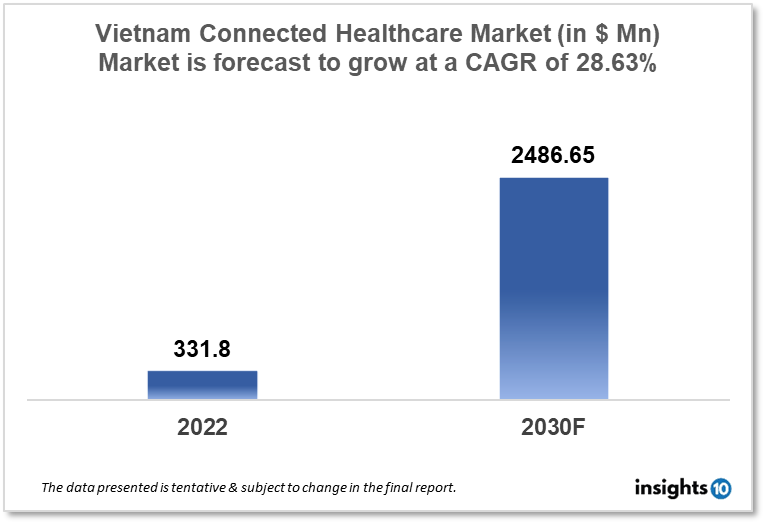
The Vietnam-connected healthcare market is projected to grow from $331.8 Mn in 2022 to $2486.65 Mn by 2030, registering a CAGR of 28.63% during the forecast period of 2022 - 2030. The main factors driving the growth would be government support, improved healthcare infrastructure, rising healthcare spending, and growing demand for remote healthcare. The market is segmented by type, function and by application. Some of the major players include Viettel Group, eDoctor, Med247, Samsung, IBM and GE Healthcare.
Buy Now

Vietnam Connected Healthcare Market Executive Summary
The Vietnam-connected healthcare market is projected to grow from $331.8 Mn in 2022 to $2486.65 Mn by 2030, registering a CAGR of 28.63% during the forecast period of 2022 - 2030. In 2019, Vietnam's healthcare spending as a percentage of GDP increased from 5.03% to 5.25%. The current economic and demographic developments in Vietnam give enormous possibilities for the country's healthcare business.
Connected healthcare solutions enable healthcare professionals to deliver healthcare services remotely, improve disease surveillance and public health management, and increase the quality and efficiency of healthcare services.
In Vietnam, digital technology is altering healthcare. Vietnam hospitals are in the early stages of becoming smart, with an emphasis on incorporating modern technologies like HIS, LIS, PACS, and EMR. Telemedicine, artificial intelligence, and robotic applications are among the other technologies. The COVID-19 pandemic has spurred the growth of Vietnam's connected healthcare sector, as the government has supported the adoption of telemedicine and other digital health solutions to reduce infection risk and assure healthcare service continuity. The pandemic has also emphasised the significance of digital health solutions in increasing the efficiency and efficacy of healthcare services and tackling the issues of Vietnam's healthcare system.
Market Dynamics
Market Growth Drivers
The Vietnam-connected healthcare market is expected to be driven by factors such as:
- Government support- The Vietnamese government has actively promoted the use of digital technologies in the healthcare business, including the use of electronic medical records and telemedicine services
- Improved healthcare infrastructure- The Vietnamese government has made significant investments in strengthening the country's healthcare infrastructure, including the construction of new hospitals and medical institutions. This is projected to lay a solid basis for the connected healthcare market's growth
- Rising healthcare spending- Vietnam's healthcare spending has continually increased, owing to an ageing population, the incidence of chronic diseases, and growing public awareness of the value of healthcare. As a result, there is an increased desire for novel healthcare solutions, such as those offered by connected technologies
- Growing demand for remote healthcare- The COVID-19 pandemic has increased the move towards remote healthcare in Vietnam, as patients seek to avoid overcrowded hospitals and clinics. This has increased demand for telemedicine and other connected healthcare technologies, which are expected to remain popular in the post-pandemic age
Market Restraints
The following factors are expected to limit the growth of the connected healthcare market in Vietnam:
- Regulatory challenges- In Vietnam, there are still certain regulatory hurdles to overcome, particularly in the areas of data privacy and security. This can make implementing connected healthcare solutions that rely on sensitive patient data more complex
- Limited awareness- While awareness of connected healthcare solutions is expanding, a sizable segment of the population is still unfamiliar with this technology. This has the potential to limit adoption rates and delay market expansion
- Limited internet connectivity- Despite significant smartphone penetration, internet access in some places in Vietnam might be limited. This can make it challenging to supply connected healthcare services consistently, especially in rural locations
Competitive Landscape
Key Players
- Viettel Group (VNM)- Viettel, a major provider of telecommunications services, has diversified into the healthcare industry. It provides a variety of online healthcare services, such as telemedicine and remote health monitoring
- eDoctor (VNM)- eDoctor is a mobile health platform that gives patients access to a variety of healthcare services, including telemedicine, health coaching, and prescription management
- Med247 (VNM)- Med247 is a healthcare company that runs a 24/7 network of clinics throughout Vietnam. It provides a selection of online healthcare services, such as telemedicine, health tracking, and medication delivery
- Samsung- Samsung has introduced a number of connected healthcare solutions, such as telemedicine platforms and devices for remote patient monitoring
- IBM- A variety of healthcare solutions, including connected healthcare, are provided by IBM Watson Health. It has introduced a number of products in Vietnam, such as telemedicine platforms and health information systems
- GE Healthcare- A variety of connected healthcare solutions are provided by GE Healthcare, including telemedicine, remote patient monitoring, and diagnostic imaging equipment
1. Executive Summary
1.1 Service Overview
1.2 Global Scenario
1.3 Country Overview
1.4 Healthcare Scenario in Country
1.5 Healthcare Services Market in Country
1.6 Recent Developments in the Country
2. Market Size and Forecasting
2.1 Market Size (With Excel and Methodology)
2.2 Market Segmentation (Check all Segments in Segmentation Section)
3. Market Dynamics
3.1 Market Drivers
3.2 Market Restraints
4. Competitive Landscape
4.1 Major Market Share
4.2 Key Company Profile (Check all Companies in the Summary Section)
4.2.1 Company
4.2.1.1 Overview
4.2.1.2 Product Applications and Services
4.2.1.3 Recent Developments
4.2.1.4 Partnerships Ecosystem
4.2.1.5 Financials (Based on Availability)
5. Reimbursement Scenario
5.1 Reimbursement Regulation
5.2 Reimbursement Process for Services
5.3 Reimbursement Process for Treatment
6. Methodology and Scope
Vietnam Connected Healthcare Market Segmentation
By Type (Revenue, USD Billion):
Based on the Type the market is segmented into mHealth services, mHealth Devices, and E- Prescription
- MHealth services
- mHealth Devices
- E- Prescription
By FunctionType (Revenue, USD Billion):
- Remote patient monitoring
- Clinical monitoring
- Telemedicine
- Others (Assisted Living)
By Application Type (Revenue, USD Billion):
- Diagnosis and Treatment
- Monitoring Application
- Wellness and Prevention
- Healthcare management
- Others
Methodology for Database Creation
Our database offers a comprehensive list of healthcare centers, meticulously curated to provide detailed information on a wide range of specialties and services. It includes top-tier hospitals, clinics, and diagnostic facilities across 30 countries and 24 specialties, ensuring users can find the healthcare services they need.
Additionally, we provide a comprehensive list of Key Opinion Leaders (KOLs) based on your requirements. Our curated list captures various crucial aspects of the KOLs, offering more than just general information. Whether you're looking to boost brand awareness, drive engagement, or launch a new product, our extensive list of KOLs ensures you have the right experts by your side. Covering 30 countries and 36 specialties, our database guarantees access to the best KOLs in the healthcare industry, supporting strategic decisions and enhancing your initiatives.
How Do We Get It?
Our database is created and maintained through a combination of secondary and primary research methodologies.
1. Secondary Research
With many years of experience in the healthcare field, we have our own rich proprietary data from various past projects. This historical data serves as the foundation for our database. Our continuous process of gathering data involves:
- Analyzing historical proprietary data collected from multiple projects.
- Regularly updating our existing data sets with new findings and trends.
- Ensuring data consistency and accuracy through rigorous validation processes.
With extensive experience in the field, we have developed a proprietary GenAI-based technology that is uniquely tailored to our organization. This advanced technology enables us to scan a wide array of relevant information sources across the internet. Our data-gathering process includes:
- Searching through academic conferences, published research, citations, and social media platforms
- Collecting and compiling diverse data to build a comprehensive and detailed database
- Continuously updating our database with new information to ensure its relevance and accuracy
2. Primary Research
To complement and validate our secondary data, we engage in primary research through local tie-ups and partnerships. This process involves:
- Collaborating with local healthcare providers, hospitals, and clinics to gather real-time data.
- Conducting surveys, interviews, and field studies to collect fresh data directly from the source.
- Continuously refreshing our database to ensure that the information remains current and reliable.
- Validating secondary data through cross-referencing with primary data to ensure accuracy and relevance.
Combining Secondary and Primary Research
By integrating both secondary and primary research methodologies, we ensure that our database is comprehensive, accurate, and up-to-date. The combined process involves:
- Merging historical data from secondary research with real-time data from primary research.
- Conducting thorough data validation and cleansing to remove inconsistencies and errors.
- Organizing data into a structured format that is easily accessible and usable for various applications.
- Continuously monitoring and updating the database to reflect the latest developments and trends in the healthcare field.
Through this meticulous process, we create a final database tailored to each region and domain within the healthcare industry. This approach ensures that our clients receive reliable and relevant data, empowering them to make informed decisions and drive innovation in their respective fields.
To request a free sample copy of this report, please complete the form below.
We value your inquiry and offer free customization with every report to fulfil your exact research needs.

Related reports (by category)
Healthcare Services
Canada Medication Access Programs Market Analysis
Healthcare Services
Brazil HIV Diagnostic Market Analysis
Healthcare Services
Brazil Organ-On-Chip (OOC) Market Analysis
Related reports (by geography)

Pharmaceuticals
Vietnam Heart Failure Drugs Market Analysis
Pharmaceuticals
Vietnam Antiviral Drugs Market Analysis
Pharmaceuticals
Vietnam Medical Electronics Market Analysis
Pharmaceuticals