Pharmaceuticals
UK HIV Therapeutics Market Analysis
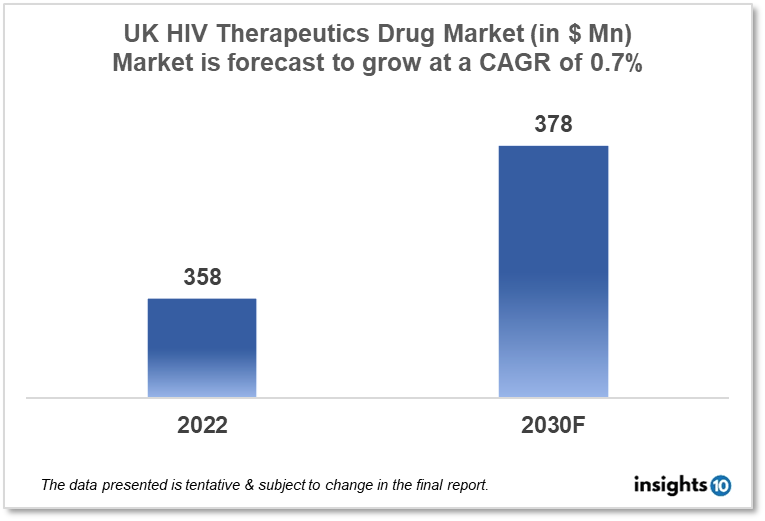
By 2030, it is anticipated that the UK HIV therapeutics market will reach a value of $378.29 Mn from $357.76 Mn in 2022, growing at a CAGR of 0.7% during 2022-30. The market is primarily dominated by local players such as AstraZeneca, ViiV Healthcare, and British Biologicals. The market is driven by innovation in research and development, increasing awareness campaigns, and government funding policies. The HIV therapeutics market in the UK is segmented by type, product, geography, end user, and distribution channel.
Buy Now

UK HIV Therapeutics Market Analysis Summary
By 2030, it is anticipated that the UK HIV therapeutics market will reach a value of $378.29 Mn from $357.76 Mn in 2022, growing at a CAGR of 0.7% during 2022-30, The UK met the national UNAIDS 90-90-90 target in 2019 for the third time in a row. In the past year, 94% of people living with HIV have received a diagnosis, and 98% of those diagnosed and 97% of those receiving treatment have a viral load that cannot be detected.
Almost all people engaged in HIV care were receiving antiretroviral therapy (ART), 98% in 2019. The National Health Service (NHS) offers free antiretroviral therapy (ART) to those in need as part of the UK government's extensive efforts to combat the HIV/AIDS epidemic in the nation. Additionally, the UK government finances initiatives related to HIV/AIDS in the private sector.
The National Health Service (NHS) of the UK also stated that the country was on track to end all new HIV transmissions by 2030, making it the first country in the world to do so. The UK's success in treating HIV over the past 10 years has made this effort possible. The current health expenditure in the UK was 10.2% of the GDP in 2019.
Market Dynamics
Market Growth Drivers Analysis
In order to stop the disease from spreading, the UK government has also implemented a number of awareness-raising and prevention campaigns, such as encouraging testing and early diagnosis. The number of people receiving HIV treatment keeps increasing due to life-saving interventions and ongoing transmission.
Market Restraints
The potential growth of the HIV therapeutics market in the UK may be limited by systemic shortcomings and inequities that have an impact on the health system in various ways. Additionally, it is unlikely that the government has a complete picture of how severely HIV affects black and other global majority communities due to the low rate of testing for HIV infection.
Competitive Landscape
Key Players
- GSK (GlaxoSmithKline) (GBR)
- AstraZeneca (GBR)
- ViiV Healthcare (GBR)
- British Biologicals (GBR)
- Immunocore (GBR)
- Summit plc (GBR)
- Moderna
- GlaxoSmithKline
- Gilead
Recent Notable Updates
March 2022: By 2025, Moderna said it would have developed and started testing vaccines against 15 of the most dangerous pathogens on the planet. Additionally, it would have permanently waived the patents on its COVID-19 vaccine for use in certain low- and middle-income nations. Prior to the Global Pandemic Preparedness Summit, Moderna unveiled its strategy. The summit was supported by the UK government and the Coalition for Epidemic Preparedness Innovations (CEPI), a global alliance formed five years ago to foresee potential future disease threats. These partnerships include the International AIDS Vaccine Initiative and the HIV vaccine with the Gates Foundation.
Healthcare Policies and Reimbursement Scenarios
The organization in charge of regulating the HIV and AIDS therapeutics market in the UK is called the Medicines and Healthcare Products Regulatory Agency (MHRA). This includes monitoring the efficacy and security of HIV and AIDS treatments.
The National Health Service (NHS) in the UK is in charge of providing and covering the cost of HIV and AIDS treatment to those who are eligible. Regardless of immigration status, HIV treatments are accessible to all people with HIV who are diagnosed in the UK. The NHS offers the treatments without charging a fee. NHS England covers the cost of HIV treatment through local commissioning and the HIV Drug Tariff.
1. Executive Summary
1.1 Disease Overview
1.2 Global Scenario
1.3 Country Overview
1.4 Healthcare Scenario in Country
1.5 Patient Journey
1.6 Health Insurance Coverage in Country
1.7 Active Pharmaceutical Ingredient (API)
1.8 Recent Developments in the Country
2. Market Size and Forecasting
2.1 Epidemiology of Disease
2.2 Market Size (With Excel & Methodology)
2.3 Market Segmentation (Check all Segments in Segmentation Section)
3. Market Dynamics
3.1 Market Drivers
3.2 Market Restraints
4. Competitive Landscape
4.1 Major Market Share
4.2 Key Company Profile (Check all Companies in the Summary Section)
4.2.1 Company
4.2.1.1 Overview
4.2.1.2 Product Applications and Services
4.2.1.3 Recent Developments
4.2.1.4 Partnerships Ecosystem
4.2.1.5 Financials (Based on Availability)
5. Reimbursement Scenario
5.1 Reimbursement Regulation
5.2 Reimbursement Process for Diagnosis
5.3 Reimbursement Process for Treatment
6. Methodology and Scope
UK HIV Therapeutics Segmentation
By Types (Revenue, USD Billion):
- Nucleoside-Analog Reverse Transcriptase Inhibitors (NRTIs)
- Coreceptor Antagonists
- Entry and Fusion Inhibitors
- Integrase Inhibitors
- Protease Inhibitors (PIs)
- Non-Nucleoside Reverse Transcriptase Inhibitors (NNRTIs)
By Distribution Channel (Revenue, USD Billion):
- Hospital Pharmacies
- Retail Pharmacies
- Online Pharmacies
- Others
Methodology for Database Creation
Our database offers a comprehensive list of healthcare centers, meticulously curated to provide detailed information on a wide range of specialties and services. It includes top-tier hospitals, clinics, and diagnostic facilities across 30 countries and 24 specialties, ensuring users can find the healthcare services they need.
Additionally, we provide a comprehensive list of Key Opinion Leaders (KOLs) based on your requirements. Our curated list captures various crucial aspects of the KOLs, offering more than just general information. Whether you're looking to boost brand awareness, drive engagement, or launch a new product, our extensive list of KOLs ensures you have the right experts by your side. Covering 30 countries and 36 specialties, our database guarantees access to the best KOLs in the healthcare industry, supporting strategic decisions and enhancing your initiatives.
How Do We Get It?
Our database is created and maintained through a combination of secondary and primary research methodologies.
1. Secondary Research
With many years of experience in the healthcare field, we have our own rich proprietary data from various past projects. This historical data serves as the foundation for our database. Our continuous process of gathering data involves:
- Analyzing historical proprietary data collected from multiple projects.
- Regularly updating our existing data sets with new findings and trends.
- Ensuring data consistency and accuracy through rigorous validation processes.
With extensive experience in the field, we have developed a proprietary GenAI-based technology that is uniquely tailored to our organization. This advanced technology enables us to scan a wide array of relevant information sources across the internet. Our data-gathering process includes:
- Searching through academic conferences, published research, citations, and social media platforms
- Collecting and compiling diverse data to build a comprehensive and detailed database
- Continuously updating our database with new information to ensure its relevance and accuracy
2. Primary Research
To complement and validate our secondary data, we engage in primary research through local tie-ups and partnerships. This process involves:
- Collaborating with local healthcare providers, hospitals, and clinics to gather real-time data.
- Conducting surveys, interviews, and field studies to collect fresh data directly from the source.
- Continuously refreshing our database to ensure that the information remains current and reliable.
- Validating secondary data through cross-referencing with primary data to ensure accuracy and relevance.
Combining Secondary and Primary Research
By integrating both secondary and primary research methodologies, we ensure that our database is comprehensive, accurate, and up-to-date. The combined process involves:
- Merging historical data from secondary research with real-time data from primary research.
- Conducting thorough data validation and cleansing to remove inconsistencies and errors.
- Organizing data into a structured format that is easily accessible and usable for various applications.
- Continuously monitoring and updating the database to reflect the latest developments and trends in the healthcare field.
Through this meticulous process, we create a final database tailored to each region and domain within the healthcare industry. This approach ensures that our clients receive reliable and relevant data, empowering them to make informed decisions and drive innovation in their respective fields.
To request a free sample copy of this report, please complete the form below.
We value your inquiry and offer free customization with every report to fulfil your exact research needs.

Related reports (by category)
Pharmaceuticals
Germany Burn Care Market Analysis
Pharmaceuticals
Malaysia Asthma and COPD Therapeutics Market Analysis
Pharmaceuticals
China Oral Anti-Diabetes Drugs Market Analysis
Related reports (by geography)
Healthcare Services
UK Interventional Radiology Market Analysis
Healthcare Services
UK Clinical Trial Planning and Design service Market Analysis
Pharmaceuticals
UK Proliferative Diabetic Retinopathy Market Analysis
Healthcare Services