Pharmaceuticals
UAE Acne Therapeutics Market Analysis
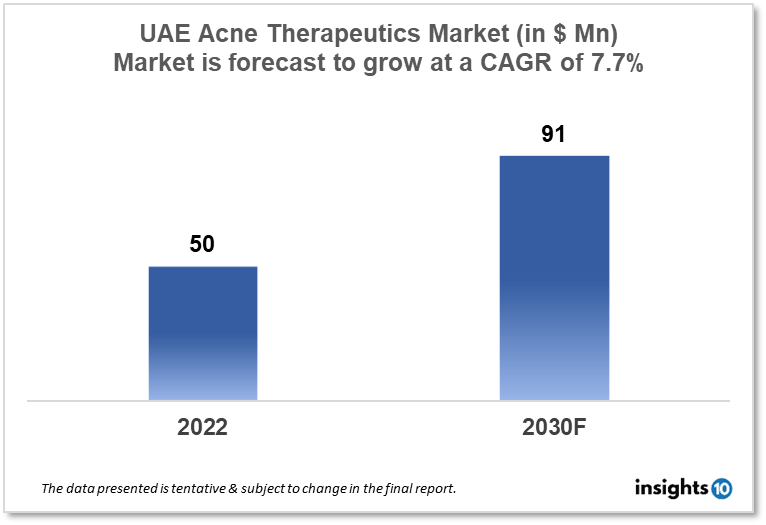
UAE's acne therapeutics market is projected to grow from $50 Mn in 2022 to $91 Mn in 2030 with a CAGR of 7.7% for the year 2022-30. as the citizens of UAE are becoming more aware of their skin and appearance. A plethora of therapeutic options available for the treatment of acne in the UAE is also responsible for the growth of the market. The UAE acne therapeutics market is segmented by treatment, route of administration, age group, and distribution channel. Pharmalink, UltraPharma, and Teva Pharmaceuticals are some of the key competitors in the market.
Buy Now

UAE Acne Therapeutics Market Executive Analysis
UAE's acne therapeutics market is projected to grow from $50 Mn in 2022 to $91 Mn in 2030 with a CAGR of 7.7% for the year 2022-30. The UAE's healthcare ecosystem has adopted data analytics for consumer-driven health decision-making, with an increasing emphasis on preventive care, improvements in patient care delivery, public-private partnerships, and digital transformation. In the federal budget for 2022–26, the UAE government has set aside $1.33 Bn (8.4% of the total budget) for healthcare and community security. Approximately 3.5% of the UAE's GDP is spent on healthcare, with 70% coming from public spending and only 30% coming from private industry. Due to the rapidly aging population, it is anticipated that UAE healthcare spending will increase by up to 9%. The Alpen healthcare report projects that costs will rise by an estimated $76.1 Bn, or 6.6%, annually, to reach up to $104.6 Bn in 2022. The report went on to explain the causes of this increase, citing the growing population, rising healthcare expenses, and the prevalence of severe and incurable illnesses.
Acne, which is now regarded as an illness in the medical community, affects nearly 80% of teenagers in the UAE. Acne is likely to affect eight out of ten people worldwide at some time in their lives. Residents of the UAE are not an exception, and dermatologists report an increase in the number of acne patients in the country. Poor nutrition, the environment, genetics, and hormonal changes are just a few of the potential causes of recurring pimples and daily rashes. Due to an increase in the production of the androgen sex hormone, the disease frequently affects young people. People who have acne frequently experiment with over-the-counter creams, gels, and moisturizers. However, depending on the severity of the condition, treatments for acne can vary from simple home remedies to stronger drugs.
Retinoids are the cornerstone of topical treatment for acne because they are anti-inflammatory, comedolytic, and heal the antecedent microcomedone lesion. By encouraging keratinocyte differentiation and reducing growth, retinoids have an impact on desquamation. Many different techniques have been used to treat acne. These traditional methods do have some drawbacks, though. Such instances include systemic isotretinoin's teratogenicity, topical antibiotic resistance, and unsatisfactory efficacy. Other essential methods for the treatment of acne vulgaris that alleviate these concerns include laser and light-based procedures.
Market Dynamics
Market Growth Drivers
People are more likely to seek out acne treatments as they become more conscious of the value of caring for their skin. In the UAE, a variety of acne treatments are offered, including cosmetic procedures, oral and topical medicines, and topical creams. Patients now have many choices to choose from, which may spur the UAE acne therapeutics market expansion.
Market Restraints
The adverse effects of numerous acne treatments can include skin irritability or dryness. This may cause some patients to stop receiving treatment or look for alternative therapies, which could slow the expansion of the UAE acne therapeutics market. Several cosmetic procedures, such as chemical peels or laser therapy, may assist in reducing the appearance of acne in addition to conventional acne treatments. These methods might be in competition with conventional acne treatments, which might slow the market's expansion.
Competitive Landscape
Key Players
- Shalina Healthcare (ARE)
- Julphar (ARE)
- Pharmax Pharmaceuticals (ARE)
- Pharmalink (ARE)
- UltraPharma (ARE)
- Teva Pharmaceuticals
- L'Oréal
- Sun Pharmaceuticals
- Johnson & Johnson
- Abbvie
Healthcare Policies and Regulatory Landscape
The main body in charge of regulating all aspects of the pharmaceutical industry in the UAE is the Ministry of Health and Prevention (MOHAP). All facets of the pharmaceutical industry are subject to regulation by the ministry, including the registration and approval of medications, the licensing of pharmaceutical firms, and the inspection of facilities to verify adherence to legal requirements. The Federal Law No. 4 of 1983, which governs the pharmaceutical industry in the UAE, establishes the framework within which the MOHAP works. The law sets the criteria for the quality, safety, and efficacy of medicines as well as the legal requirements for their registration, marketing, and distribution. In addition, the MOHAP has implemented a number of initiatives to ensure that pharmaceuticals are available and affordable for all residents of the UAE, including the implementation of price controls on certain medicines and the provision of free or low-cost medicines for certain populations, such as low-income individuals and the elderly. Overall, the MOHAP is essential in regulating the UAE's pharmaceutical sector and ensuring that the general public has access to secure and efficient medications.
1. Executive Summary
1.1 Disease Overview
1.2 Global Scenario
1.3 Country Overview
1.4 Healthcare Scenario in Country
1.5 Patient Journey
1.6 Health Insurance Coverage in Country
1.7 Active Pharmaceutical Ingredient (API)
1.8 Recent Developments in the Country
2. Market Size and Forecasting
2.1 Epidemiology of Disease
2.2 Market Size (With Excel & Methodology)
2.3 Market Segmentation (Check all Segments in Segmentation Section)
3. Market Dynamics
3.1 Market Drivers
3.2 Market Restraints
4. Competitive Landscape
4.1 Major Market Share
4.2 Key Company Profile (Check all Companies in the Summary Section)
4.2.1 Company
4.2.1.1 Overview
4.2.1.2 Product Applications and Services
4.2.1.3 Recent Developments
4.2.1.4 Partnerships Ecosystem
4.2.1.5 Financials (Based on Availability)
5. Reimbursement Scenario
5.1 Reimbursement Regulation
5.2 Reimbursement Process for Diagnosis
5.3 Reimbursement Process for Treatment
6. Methodology and Scope
Acne Therapeutics Market Segmentation
By Treatment (Revenue, USD Billion):
- Therapeutics
- Retinoid
- Antibiotics
- Hormonal Agents
- Anti-Inflammatory
- Other Agents
- Other Treatments
By Route of Administration (Revenue, USD Billion):
- Oral
- Topical
- Injectable
By Age Group (Revenue, USD Billion):
- 10 to 17
- 18 to 44
- 45 to 64
- 65 and above
By Distribution Channel (Revenue, USD Billion):
- Hospital Pharmacies
- Retail and Online Pharmacies
Methodology for Database Creation
Our database offers a comprehensive list of healthcare centers, meticulously curated to provide detailed information on a wide range of specialties and services. It includes top-tier hospitals, clinics, and diagnostic facilities across 30 countries and 24 specialties, ensuring users can find the healthcare services they need.
Additionally, we provide a comprehensive list of Key Opinion Leaders (KOLs) based on your requirements. Our curated list captures various crucial aspects of the KOLs, offering more than just general information. Whether you're looking to boost brand awareness, drive engagement, or launch a new product, our extensive list of KOLs ensures you have the right experts by your side. Covering 30 countries and 36 specialties, our database guarantees access to the best KOLs in the healthcare industry, supporting strategic decisions and enhancing your initiatives.
How Do We Get It?
Our database is created and maintained through a combination of secondary and primary research methodologies.
1. Secondary Research
With many years of experience in the healthcare field, we have our own rich proprietary data from various past projects. This historical data serves as the foundation for our database. Our continuous process of gathering data involves:
- Analyzing historical proprietary data collected from multiple projects.
- Regularly updating our existing data sets with new findings and trends.
- Ensuring data consistency and accuracy through rigorous validation processes.
With extensive experience in the field, we have developed a proprietary GenAI-based technology that is uniquely tailored to our organization. This advanced technology enables us to scan a wide array of relevant information sources across the internet. Our data-gathering process includes:
- Searching through academic conferences, published research, citations, and social media platforms
- Collecting and compiling diverse data to build a comprehensive and detailed database
- Continuously updating our database with new information to ensure its relevance and accuracy
2. Primary Research
To complement and validate our secondary data, we engage in primary research through local tie-ups and partnerships. This process involves:
- Collaborating with local healthcare providers, hospitals, and clinics to gather real-time data.
- Conducting surveys, interviews, and field studies to collect fresh data directly from the source.
- Continuously refreshing our database to ensure that the information remains current and reliable.
- Validating secondary data through cross-referencing with primary data to ensure accuracy and relevance.
Combining Secondary and Primary Research
By integrating both secondary and primary research methodologies, we ensure that our database is comprehensive, accurate, and up-to-date. The combined process involves:
- Merging historical data from secondary research with real-time data from primary research.
- Conducting thorough data validation and cleansing to remove inconsistencies and errors.
- Organizing data into a structured format that is easily accessible and usable for various applications.
- Continuously monitoring and updating the database to reflect the latest developments and trends in the healthcare field.
Through this meticulous process, we create a final database tailored to each region and domain within the healthcare industry. This approach ensures that our clients receive reliable and relevant data, empowering them to make informed decisions and drive innovation in their respective fields.
To request a free sample copy of this report, please complete the form below.
We value your inquiry and offer free customization with every report to fulfil your exact research needs.

Related reports (by category)
Pharmaceuticals
Denmark Breast Cancer Therapeutics Market Analysis
Pharmaceuticals
Vietnam Topical Pain Relief Market Analysis
Pharmaceuticals
South Africa Orphan Diseases Drugs Market Analysis
Related reports (by geography)
Pharmaceuticals
UAE Aminoglycosides Market Analysis
Healthcare Services
UAE ICU Beds Market Analysis
Pharmaceuticals
UAE Pharmaceutical Excipient Market Analysis
Healthcare Services