Pharmaceuticals
Turkey Infectious Disease Therapeutics Market Analysis
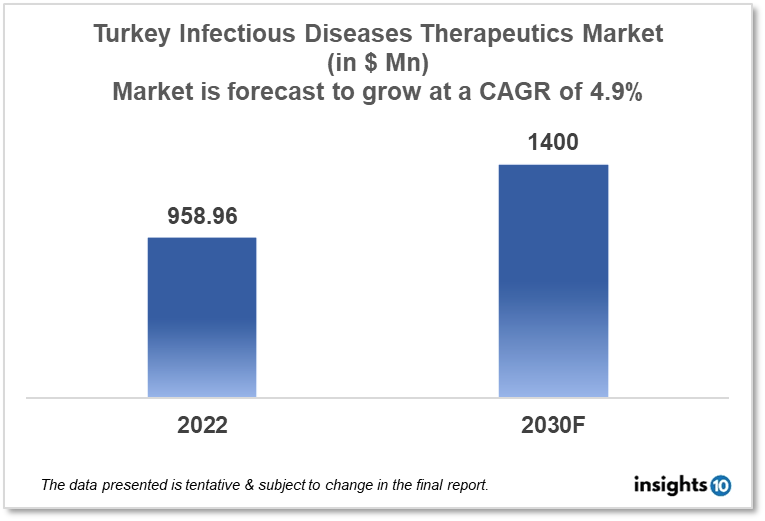
By 2030, it is anticipated that the Turkey infectious disease therapeutics market will reach a value of $1400 Mn from $958.96 Mn in 2022, growing at a CAGR of 4.9% during 2022-2030. Infectious Disease Therapeutics in Turkey is dominated by a few domestic pharmaceutical companies such as Abdi İbrahim, Deva Holding and Nobel İlaç. The Infectious Disease Therapeutics market in Turkey is segmented into different therapeutic areas and different diseases type. The major factors affecting the Turkey infectious disease therapeutics market are the increasing disease burden of communicable diseases like TB, hepatitis, COVID-19, and the amount of healthcare funding for infectious diseases treatment in various areas of Turkey.
Buy Now

Turkey Infectious Disease Therapeutics Analysis Summary
By 2030, it is anticipated that the Turkey infectious disease therapeutics market will reach a value of $1400 Mn from $958.96 Mn in 2022, growing at a CAGR of 4.9% during 2022-2030.
Turkey is an upper middle-income, developing transcontinental country located in Southeastern Europe and Southwestern Asia bordering the Black Sea. Aside from the coronavirus, viral infections, circulatory system illnesses, respiratory ailments, and cancer are all common causes of death in Turkey. Noncommunicable diseases accounted for 89 % of all fatalities in 2016. The spread of communicable diseases is aided not only by the warm oceanic climate, but also by Turkey's location between Africa, Asia, and Europe. Despite these factors, Turkey's vast healthcare system provides excellent care to its people.
With a poverty rate of 9.2 % in Turkey, many people cannot afford private health insurance or even pay their taxes. Turkey has established a system that ensures everyone has access to high-quality healthcare. Because of the Health Transformation Program led by the Turkish government and the World Bank, 98 % of Turkish inhabitants had access to healthcare since 2012. Turkey's government spends 4.6% of its GDP on healthcare.
Market Dynamics
Market Growth Drivers Analysis
Infectious disorders such as tuberculosis, hepatitis, and HIV/AIDS are prevalent in Turkey. As a result, there is a high demand for effective treatments and prevention techniques. Turkey has a young and educated workforce. Furthermore, Turkey has an advantageous geopolitical location and a robust economic recovery following COVID-19, which makes doing business easier. These aspects could boost Turkey's infectious disease therapeutics market.
Market Restraints
Turkey has also had to deal with developing infectious disease epidemics, such as the COVID-19 pandemic. In response to the pandemic, the Turkish government implemented strong border restrictions and quarantine measures, as well as encouraging vaccination and offering access to a variety of COVID-19 therapies. Turkey's manufacturing sector is heavily reliant on imports. These factors may deter new entrants into the Turkey infectious disease therapeutics market.
Competitive Landscape
Key Players
- Abdi İbrahim: Abdi İbrahim is a pharmaceutical company based in Istanbul, Turkey that develops and manufactures drugs for various diseases, including infectious diseases
- Deva Holding: Deva Holding is a pharmaceutical company based in Istanbul, Turkey that specializes in developing and manufacturing drugs for infectious diseases
- Mustafa Nevzat İlaç Sanayii: Mustafa Nevzat İlaç Sanayii is a pharmaceutical company based in Istanbul, Turkey that develops and manufactures drugs for various diseases, including infectious diseases
- Nobel İlaç
- Koçak Farma
- Ege University School of Medicine
Recent Notable Updates
December 2022: The Sterile Inhalation Facility, created in conjunction with the Investment Office of the Presidency of the Republic of Türkiye by Abdi Brahim and GSK Türkiye, has begun operations. The $18 Mn facility will allow Türkiye to benefit from innovative 'nebule' technology, which is utilised in the treatment of respiratory disorders. The facility is the first in the world to be capable of producing the whole GSK nebule portfolio.
Healthcare Policies and Reimbursement Scenarios
In Turkey, the regulation and reimbursement of infectious disease therapeutics are overseen by several entities, including the Ministry of Health (MoH) and the Turkish Medicines and Medical Devices Agency (TİTCK). The reimbursement process for infectious disease therapeutics in Turkey is largely determined by the Social Security Institution (SGK), which is the national health insurance system.
1. Executive Summary
1.1 Disease Overview
1.2 Global Scenario
1.3 Country Overview
1.4 Healthcare Scenario in Country
1.5 Patient Journey
1.6 Health Insurance Coverage in Country
1.7 Active Pharmaceutical Ingredient (API)
1.8 Recent Developments in the Country
2. Market Size and Forecasting
2.1 Epidemiology of Disease
2.2 Market Size (With Excel & Methodology)
2.3 Market Segmentation (Check all Segments in Segmentation Section)
3. Market Dynamics
3.1 Market Drivers
3.2 Market Restraints
4. Competitive Landscape
4.1 Major Market Share
4.2 Key Company Profile (Check all Companies in the Summary Section)
4.2.1 Company
4.2.1.1 Overview
4.2.1.2 Product Applications and Services
4.2.1.3 Recent Developments
4.2.1.4 Partnerships Ecosystem
4.2.1.5 Financials (Based on Availability)
5. Reimbursement Scenario
5.1 Reimbursement Regulation
5.2 Reimbursement Process for Diagnosis
5.3 Reimbursement Process for Treatment
6. Methodology and Scope
Infectious Disease Therapeutics Segmentation
By Mode of Treatment (Revenue, USD Billion):
- Vaccines
- Drugs
By Applications (Revenue, USD Billion):
- HIV/AIDS
- Influenza
- Hepatitis
- Malaria
- Tuberculosis
- Others
By Disease Type (Revenue, USD Billion):
- Viral Diseases
- Bacterial Diseases
- Fungal Diseases
- Parasitic Diseases
- Others
By Target Organism (Revenue, USD Billion):
- Antibiotics
- Antivirals
- Antifungals
- Anti-Parasitic
- Others
By End User (Revenue, USD Billion):
- Hospitals and Clinics
- Ambulatory Care Centers
- Others
Methodology for Database Creation
Our database offers a comprehensive list of healthcare centers, meticulously curated to provide detailed information on a wide range of specialties and services. It includes top-tier hospitals, clinics, and diagnostic facilities across 30 countries and 24 specialties, ensuring users can find the healthcare services they need.
Additionally, we provide a comprehensive list of Key Opinion Leaders (KOLs) based on your requirements. Our curated list captures various crucial aspects of the KOLs, offering more than just general information. Whether you're looking to boost brand awareness, drive engagement, or launch a new product, our extensive list of KOLs ensures you have the right experts by your side. Covering 30 countries and 36 specialties, our database guarantees access to the best KOLs in the healthcare industry, supporting strategic decisions and enhancing your initiatives.
How Do We Get It?
Our database is created and maintained through a combination of secondary and primary research methodologies.
1. Secondary Research
With many years of experience in the healthcare field, we have our own rich proprietary data from various past projects. This historical data serves as the foundation for our database. Our continuous process of gathering data involves:
- Analyzing historical proprietary data collected from multiple projects.
- Regularly updating our existing data sets with new findings and trends.
- Ensuring data consistency and accuracy through rigorous validation processes.
With extensive experience in the field, we have developed a proprietary GenAI-based technology that is uniquely tailored to our organization. This advanced technology enables us to scan a wide array of relevant information sources across the internet. Our data-gathering process includes:
- Searching through academic conferences, published research, citations, and social media platforms
- Collecting and compiling diverse data to build a comprehensive and detailed database
- Continuously updating our database with new information to ensure its relevance and accuracy
2. Primary Research
To complement and validate our secondary data, we engage in primary research through local tie-ups and partnerships. This process involves:
- Collaborating with local healthcare providers, hospitals, and clinics to gather real-time data.
- Conducting surveys, interviews, and field studies to collect fresh data directly from the source.
- Continuously refreshing our database to ensure that the information remains current and reliable.
- Validating secondary data through cross-referencing with primary data to ensure accuracy and relevance.
Combining Secondary and Primary Research
By integrating both secondary and primary research methodologies, we ensure that our database is comprehensive, accurate, and up-to-date. The combined process involves:
- Merging historical data from secondary research with real-time data from primary research.
- Conducting thorough data validation and cleansing to remove inconsistencies and errors.
- Organizing data into a structured format that is easily accessible and usable for various applications.
- Continuously monitoring and updating the database to reflect the latest developments and trends in the healthcare field.
Through this meticulous process, we create a final database tailored to each region and domain within the healthcare industry. This approach ensures that our clients receive reliable and relevant data, empowering them to make informed decisions and drive innovation in their respective fields.
To request a free sample copy of this report, please complete the form below.
We value your inquiry and offer free customization with every report to fulfil your exact research needs.

Related reports (by category)
Pharmaceuticals
Vietnam Anemia Therapeutics Market Analysis
Pharmaceuticals
Kenya Interferons Market Analysis
Pharmaceuticals
Saudi Arabia Proliferative Diabetic Retinopathy Market Analysis
Related reports (by geography)
OTC & Nutraceuticals
Turkey Over The Counter (OTC) Analgesics Market Analysis
Pharmaceuticals
Turkey Dermatology Drugs Market Analysis
Healthcare Services
Turkey Healthcare Claims Management Market Analysis
Pharmaceuticals