Healthcare Services

Turkey Healthcare Insurance Market Analysis
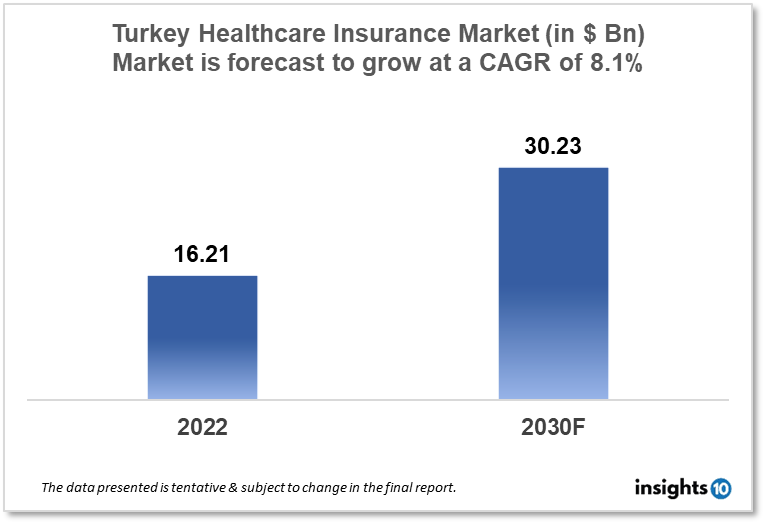
Turkey's healthcare insurance market is projected to grow from $16.21 Bn in 2022 to $30.23 Bn by 2030, registering a CAGR of 8.1% during the forecast period of 2022-2030. The main factors driving the growth would be increasing demand for healthcare services, government support and reforms and technological advancements. The market is segmented by component, the provider, coverage, by health insurance plans and end-user. Some of the major players include Anadolu Sigorta, Aksigorta, Acibadem Saglik ve Hayat Sigorta and Allianz.
Buy Now

Turkey Healthcare Insurance Market Executive Summary
Turkey's healthcare insurance market is projected to grow from $16.21 Bn in 2022 to $30.23 Bn by 2030, registering a CAGR of 8.1% during the forecast period of 2022-2030. The healthcare insurance market in Turkey is a dynamic, expanding sector that has recently undergone substantial changes. The Turkish government has been actively seeking to increase access to high-quality healthcare services throughout the nation.
The healthcare system in Turkey is a mix of private and public healthcare providers. Private health insurance companies, which offer coverage to a growing number of people and businesses, dominate the Turkish healthcare insurance market. For those who cannot afford private insurance, state-run insurance programs like Green Card Scheme and the Social Security Institution (SSI) are also available for them. More than 85% of the population is under SSI protection which has made it the largest health insurance provider in Turkey. It is a mandated program that provides all Turkish citizens and residents basic healthcare coverage which includes inpatient and outpatient services, medical equipment and drugs. While the Green Card Program provide coverage to people who cannot afford healthcare services because of financial restrictions.
Private health insurance providers in Turkey provide a wide range of services and products, such as travel insurance, supplemental health insurance plans, individual and group health insurance policies, and more. Compared to the SSI, these plans provide more extensive coverage and give access to private hospitals and clinics as well as speciality care and elective surgery.
Market Dynamics
Market Growth Drivers
The Turkey healthcare Insurance market is expected to be driven by factors such as:
- Increasing demand for healthcare services- The need for healthcare services is growing as the population is ageing and growing in Turkey. Turkey's population grew from 27.47 Mn in 1960 to 84.78 Mn in 2021. This is a growth of 208.6% over 61 years. Due to this increase in demand, the Turkish healthcare insurance industry is expanding
- Government initiatives support- The Turkish government has recently adopted many healthcare initiatives for improving the access to healthcare. The extension of health insurance coverage and the adoption of a universal healthcare system are some of the initiatives. Also, Turkey launched a significant healthcare project in 2003 through which the Social Security Institution (SGK) started paying private hospitals that agreed to provide medical care to those with public insurance at prices comparable to those paid to other hospitals. In order to construct brand-new public hospitals and renovate those that already exist, the MoH also used a public-private partnership model
- Advancements in technology- Technology breakthroughs are fueling innovation in healthcare services as the healthcare sector quickly changes. To enhance patient outcomes and streamline healthcare delivery, private healthcare providers are investing in cutting-edge medical technology including telemedicine, digital health records, and artificial intelligence
Market Restraints
The following factors are expected to limit the growth of the healthcare insurance market in Turkey:
- Economic uncertainty- The affordability and demand for private healthcare insurance may be impacted by the current economic turbulence in Turkey. The huge current account deficit and significant private debt in foreign currencies, along with President Recep Tayyip Erdogan's rising authoritarianism and unconventional views on interest rate policy, were the main contributors to the crisis in the Turkish economy
- Uneven distribution of healthcare services- There are significant regional differences in access to high-quality healthcare, despite the Turkish government's efforts to enhance access to healthcare services. The demand for private health insurance may be constrained in some locations due to the unequal distribution of healthcare services
- Limited awareness- Many people in Turkey are still unaware of the advantages of private health insurance, or they may not completely understand how it functions. The acceptance of private health insurance may be constrained by this ignorance and lack of comprehension
Competitive Landscape
Key Players
- Anadolu Sigorta (TUR)- Leading Turkish insurance provider Anadolu Sigorta provides a variety of insurance products, including health insurance. Since its founding, Anadolu Insurance Company has contributed significantly to the growth of Turkey's insurance business and, concurrently with that growth, to the modernization of the socioeconomic environment of the nation
- Aksigorta (TUR)- Offering a wide range of insurance products—from health to travel, motor to required earthquake insurance, business package to liability insurance—Aksigorta is focused on growing the Turkish insurance market, raising social insurance awareness by any means necessary, and providing insurance products and services to all facets of society
- Acibadem Saglik ve Hayat Sigorta (TUR)- It provides a variety of insurance products, such as personal accident insurance, critical illness insurance, and individual and group health insurance. To offer its consumers high-quality healthcare services, the business closely collaborates with the Acibadem Healthcare Group
- Allianz- Allianz is a major player in the Turkish insurance market. It runs the subsidiaries Allianz Sigorta for property, casualty, and health insurance, Allianz Yaşam ve Emeklilik and Allianz Hayat ve Emeklilik for life insurance, and Allianz Global Assistance (Mondial Assistance) and Euler Hermes for pension insurance
Notable Deals
November 2022- In order to give consumers with health insurance policies additional options, Allianz Partners announced three important upgrades to its lineup of health plans. First off, the new Allianz Summit plan gives SMEs more design flexibility when creating their employee health insurance benefits. It was created and is offered under the company's international health brand, Allianz Care. Second, the inclusion of moratorium underwriting enables quicker onboarding for both individuals and SMEs when buying health insurance. Finally, Wysa's wildly successful app is now available to all users at no extra charge for immediate, private, and top-notch mental health care.
Healthcare Policies and Regulatory Landscape
The Turkish Health Ministry and the Insurance Regulation and Supervision Agency (SEDDK) are in charge of supervising the market for health insurance, which is subject to stringent government regulation. The nation's government has been aggressively working to raise the standard of healthcare services and widen access to medical insurance.
1. Executive Summary
1.1 Service Overview
1.2 Global Scenario
1.3 Country Overview
1.4 Healthcare Scenario in Country
1.5 Healthcare Services Market in Country
1.6 Recent Developments in the Country
2. Market Size and Forecasting
2.1 Market Size (With Excel and Methodology)
2.2 Market Segmentation (Check all Segments in Segmentation Section)
3. Market Dynamics
3.1 Market Drivers
3.2 Market Restraints
4. Competitive Landscape
4.1 Major Market Share
4.2 Key Company Profile (Check all Companies in the Summary Section)
4.2.1 Company
4.2.1.1 Overview
4.2.1.2 Product Applications and Services
4.2.1.3 Recent Developments
4.2.1.4 Partnerships Ecosystem
4.2.1.5 Financials (Based on Availability)
5. Reimbursement Scenario
5.1 Reimbursement Regulation
5.2 Reimbursement Process for Services
5.3 Reimbursement Process for Treatment
6. Methodology and Scope
Healthcare Insurance Market Segmentation
By Provider (Revenue, USD Billion):
It mainly includes healthcare insurance that provides safety against the increasing cost of medical treatments and in case of health emergencies such as critical illnesses. Hence, it is the best way to safeguard medical expenses.
- Public
- Private
By Coverage Type (Revenue, USD Billion):
In terms of sales and market share, it is anticipated to rule the market over the projection period. This is explained by a number of benefits provided by life insurance, including guaranteed death payout and permanent coverage. Additionally, investing in these kinds of plans enables working professionals to save taxes
- Life Insurance
- Term Insurance
By Health Insurance Plans (Revenue, USD Billion):
- Health Maintenance Organization (HMO)
- Preferred Provider Organization (PPO)
- Exclusive Provider Organization (EPO)
- Point of Service (POS)
- High Deductible Health Plan (HDHP)
By Demographics (Revenue, USD Billion):
- Minors
- Adults
- Seniors
There is a high prevalence of lifestyle disease in the adult population that can increase health risks in the future. The population is more prone to cardiac and other diseases that require hospitalization. Healthcare insurance plans for seniors are more of a necessity, especially in the case of retirement. Also, it carries various advantages such as no medical screening before buying plans, includes coverage of the outpatient department, and provides the benefit of fee annual checkups along with lifetime renewability.
By End-user (Revenue, USD Billion):
- Individuals
- ?Corporates
A large number of people buy individual health plans as they are also customizable. Also, it gives more control over deductibles, co-pays, and benefits limits and is not dependent on employment status.
Methodology for Database Creation
Our database offers a comprehensive list of healthcare centers, meticulously curated to provide detailed information on a wide range of specialties and services. It includes top-tier hospitals, clinics, and diagnostic facilities across 30 countries and 24 specialties, ensuring users can find the healthcare services they need.
Additionally, we provide a comprehensive list of Key Opinion Leaders (KOLs) based on your requirements. Our curated list captures various crucial aspects of the KOLs, offering more than just general information. Whether you're looking to boost brand awareness, drive engagement, or launch a new product, our extensive list of KOLs ensures you have the right experts by your side. Covering 30 countries and 36 specialties, our database guarantees access to the best KOLs in the healthcare industry, supporting strategic decisions and enhancing your initiatives.
How Do We Get It?
Our database is created and maintained through a combination of secondary and primary research methodologies.
1. Secondary Research
With many years of experience in the healthcare field, we have our own rich proprietary data from various past projects. This historical data serves as the foundation for our database. Our continuous process of gathering data involves:
- Analyzing historical proprietary data collected from multiple projects.
- Regularly updating our existing data sets with new findings and trends.
- Ensuring data consistency and accuracy through rigorous validation processes.
With extensive experience in the field, we have developed a proprietary GenAI-based technology that is uniquely tailored to our organization. This advanced technology enables us to scan a wide array of relevant information sources across the internet. Our data-gathering process includes:
- Searching through academic conferences, published research, citations, and social media platforms
- Collecting and compiling diverse data to build a comprehensive and detailed database
- Continuously updating our database with new information to ensure its relevance and accuracy
2. Primary Research
To complement and validate our secondary data, we engage in primary research through local tie-ups and partnerships. This process involves:
- Collaborating with local healthcare providers, hospitals, and clinics to gather real-time data.
- Conducting surveys, interviews, and field studies to collect fresh data directly from the source.
- Continuously refreshing our database to ensure that the information remains current and reliable.
- Validating secondary data through cross-referencing with primary data to ensure accuracy and relevance.
Combining Secondary and Primary Research
By integrating both secondary and primary research methodologies, we ensure that our database is comprehensive, accurate, and up-to-date. The combined process involves:
- Merging historical data from secondary research with real-time data from primary research.
- Conducting thorough data validation and cleansing to remove inconsistencies and errors.
- Organizing data into a structured format that is easily accessible and usable for various applications.
- Continuously monitoring and updating the database to reflect the latest developments and trends in the healthcare field.
Through this meticulous process, we create a final database tailored to each region and domain within the healthcare industry. This approach ensures that our clients receive reliable and relevant data, empowering them to make informed decisions and drive innovation in their respective fields.
To request a free sample copy of this report, please complete the form below.
We value your inquiry and offer free customization with every report to fulfil your exact research needs.

Related reports (by category)
Healthcare Services
Middle East Healthcare Reimbursement Market Analysis
Healthcare Services
Japan Body Fat Reduction Market Analysis
Healthcare Services
Canada Stem Cell/Cord Blood Banking Market Analysis
Related reports (by geography)

Pharmaceuticals
Turkey Diabetes Therapeutics Market Analysis
Healthcare Services
Turkey Robotic Surgery Services Market Analysis
Pharmaceuticals
Turkey Skin Antiseptic Products Market Analysis
Medical Devices