Pharmaceuticals
Spain Alzheimer’s Therapeutics Market Analysis
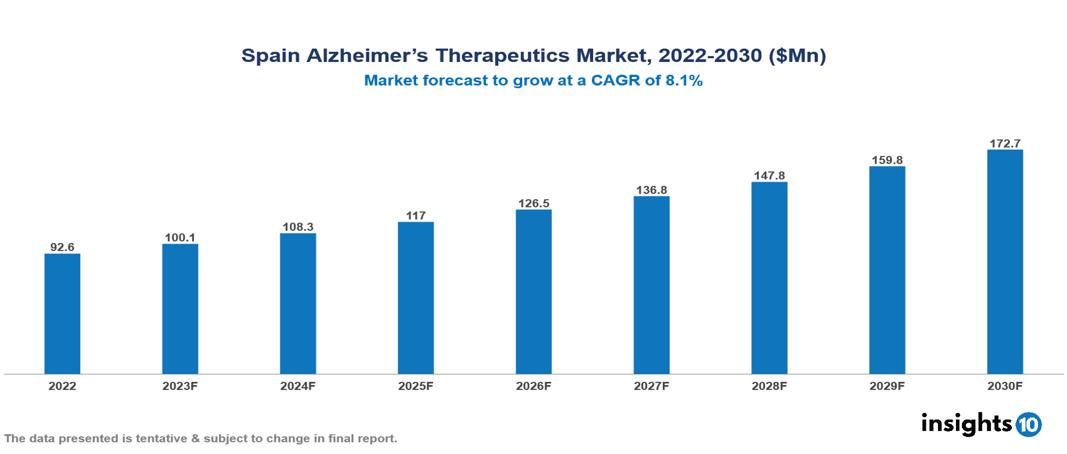
Spain alzheimer’s therapeutics market valued at $93 Mn in 2022, projected to reach $73 Mn by 2030 with a 8.1% CAGR. One key factor propelling the market for Alzheimer's treatment medications is the rising incidence of Alzheimer's disease which is driven by an aging population. Biogen, Eisai Co, Janssen Pharmaceuticals, Novartis, Pfizer, Lundbeck, Merck & Co, AstraZeneca, Eli Lilly and STA Pharmaceutical are leading pharmaceutical companies currently operating in the market.
Buy Now

Spain Alzheimer’s Therapeutics Market Executive Summary
Spain alzheimer’s therapeutics market valued at $93 Mn in 2022, projected to reach $73 Mn by 2030 with a 8.1% CAGR.
Alzheimer's is a neurological condition that impairs memory, behavior, and mental health. Usually, it starts slowly, gets worse with time, and makes it harder for the individual to do daily tasks. Nerve cells in Alzheimer's disease die as a result of abnormal brain alterations such as plaque and tangle formation. Alzheimer's disease does not currently have a cure. In contrast, some drugs can help manage symptoms and enhance quality of life. To treat memory and cognitive issues, these medications, which include donepezil, rivastigmine, and memantine, modulate specific neurotransmitters in the brain. Furthermore, non-pharmacological approaches including maintaining a healthy lifestyle, engaging in social and cognitive activities, and fostering a supportive environment might improve overall illness management.
In Spain, there are over 900,000 people with various forms of cognitive decline, with Alzheimer's disease accounting for 60-70% of these cases, which translates to approximately 540,000 to 630,000 individuals with Alzheimer's as of 2022. The prevalence of Alzheimer's increases with age, affecting 2.4% to 6.9% of individuals aged 65 and above, and 15-20% of those aged 80 and beyond. The aging population in Spain is expected to lead to a substantial increase in Alzheimer's cases in the coming decades, with projections indicating a doubling of the affected population.
Phase 2 trials are presently being conducted by Roche and its Spanish partner, the Alzheimer's Diagnostic and Therapeutic Foundation (FISABIO), for BIIB037, a tau aggregation inhibitor that shows promise for treating moderate cognitive impairment linked to Alzheimer's disease. It is anticipated that the trials will yield findings in late 2024 or early 2025.
The Spanish startup Lumo Pharma is moving on with Phase 2 studies for LMTX-803, a medication that targets amyloid plaques and Tau pathology. Promising cognitive and functional benefits are suggested by initial evidence, which represents a significant advancement in the search for effective treatments for Alzheimer's disease.
Market Dynamics
Market Growth Drivers
Aging Population and Rising Life Expectancy: Spain's population is aging quickly, by 2050, there will be twice as many individuals over 65. Given that the likelihood of acquiring Alzheimer's disease rises with age, this will result in a notable rise in the population affected by the condition. Spain's increasing life expectancy is a result of better living conditions and healthcare, which also implies that more individuals are enduring Alzheimer's for longer periods, which increases the demand for pharmaceuticals treating Alzheimer's.
Emerging Disease-Modifying Therapies: To address the underlying causes of the illness, new treatments that attempt to delay or even reverse the course of the disease have been developed thanks to the tremendous progress made in research toward groundbreaking discoveries. In addition to approved Disease-Modifying Therapies (DMTs) like Leqembi and Aduhelm, promising prospects in the development pipeline are also fuelling industry excitement and propelling market expansion. These developments point to a paradigm-shifting time in Alzheimer's disease treatment and a movement toward more effective therapy.
Increased Awareness and Improved Diagnosis: In Spain, there is a growing public awareness of Alzheimer's disease, which is resulting in earlier diagnosis and a higher propensity to seek treatment. Advocacy initiatives, media attention, and campaigns are what are generating this awareness. Technological developments in biomarkers and diagnostic tools enable an earlier and more precise diagnosis of Alzheimer's disease, which opens the door to early intervention and the possibility of treating the illness in its early stages.
Market Restraints
Lack of Awareness and Stigma: The ongoing social stigma attached to dementia and Alzheimer's disease keeps many people from getting a diagnosis and treatment, especially despite the increasing number of awareness campaigns. This stigma is a major obstacle keeping the market from reaching a larger customer base.
Limited Efficacy and Uncertain Long-Term Benefits: The long-term sustainability and effectiveness of existing drugs, like Leqembi and Aduhelm, to delay cognitive deterioration is under question. Hesitancy can be caused by several things, including the lack of a convincing cure or solid proof of improved health.
High Cost of Drugs: The high cost of branded Alzheimer's medications like Exelon and Aricept places a significant financial burden on patients and their families, which may lead to treatment noncompliance, treatment abandonment, or a delayed diagnosis. The lack of reasonably priced generic substitutes further restricts access for those with lower incomes.
Healthcare Policies and Regulatory Landscape
The Spanish Agency for Medicines and Medical Devices, also known as AEMPS, is primarily in charge of overseeing the country's healthcare policy and treatment drug regulations. AEMPS plays a vital role in guaranteeing the safety, effectiveness, and quality of medications in Spain and is managed by the Ministry of Health, Consumer Affairs, and Social Welfare (Ministerio de Sanidad, Consumo y Bienestar Social). AEMPS is in charge of assessing, approving, and monitoring pharmaceutical products, including medications used for treatment. It works in tandem with the European Medicines Agency (EMA) to ensure compliance with EU legislation. Its operations include pharmacovigilance, post-marketing surveillance, and regulatory clearance procedures.
Competitive Landscape
Key Players
- Biogen
- Eisai Co
- Janssen Pharmaceuticals
- Novartis
- Pfizer
- Lundbeck
- Merck & Co
- AstraZeneca
- Eli Lilly
- STA Pharmaceutical
1. Executive Summary
1.1 Disease Overview
1.2 Global Scenario
1.3 Country Overview
1.4 Healthcare Scenario in Country
1.5 Patient Journey
1.6 Health Insurance Coverage in Country
1.7 Active Pharmaceutical Ingredient (API)
1.8 Recent Developments in the Country
2. Market Size and Forecasting
2.1 Epidemiology of Disease
2.2 Market Size (With Excel & Methodology)
2.3 Market Segmentation (Check all Segments in Segmentation Section)
3. Market Dynamics
3.1 Market Drivers
3.2 Market Restraints
4. Competitive Landscape
4.1 Major Market Share
4.2 Key Company Profile (Check all Companies in the Summary Section)
4.2.1 Company
4.2.1.1 Overview
4.2.1.2 Product Applications and Services
4.2.1.3 Recent Developments
4.2.1.4 Partnerships Ecosystem
4.2.1.5 Financials (Based on Availability)
5. Reimbursement Scenario
5.1 Reimbursement Regulation
5.2 Reimbursement Process for Diagnosis
5.3 Reimbursement Process for Treatment
6. Methodology and Scope
Spain Alzheimer’s Therapeutics Market Segmentation
By Type
- Early-Onset Alzheimer's
- Late-Onset Alzheimer's
- Familial Alzheimer's disease
By Drug Name
- Donepezil
- Rivastigmine
- Memantine
- Galantamine
- Manufactured a combination of memantine and donepezil
By Drug Class
- Cholinesterase Inhibitors
- NMDA Receptor Antagonists
- Manufactured Combination
By End-Users
- Hospitals
- Specialty Clinics
- Homecare
- Others
By Distribution Channel
- Hospital pharmacies
- Drug stores
- Retail pharmacies
- Online pharmacies
- Other distribution channel
Methodology for Database Creation
Our database offers a comprehensive list of healthcare centers, meticulously curated to provide detailed information on a wide range of specialties and services. It includes top-tier hospitals, clinics, and diagnostic facilities across 30 countries and 24 specialties, ensuring users can find the healthcare services they need.
Additionally, we provide a comprehensive list of Key Opinion Leaders (KOLs) based on your requirements. Our curated list captures various crucial aspects of the KOLs, offering more than just general information. Whether you're looking to boost brand awareness, drive engagement, or launch a new product, our extensive list of KOLs ensures you have the right experts by your side. Covering 30 countries and 36 specialties, our database guarantees access to the best KOLs in the healthcare industry, supporting strategic decisions and enhancing your initiatives.
How Do We Get It?
Our database is created and maintained through a combination of secondary and primary research methodologies.
1. Secondary Research
With many years of experience in the healthcare field, we have our own rich proprietary data from various past projects. This historical data serves as the foundation for our database. Our continuous process of gathering data involves:
- Analyzing historical proprietary data collected from multiple projects.
- Regularly updating our existing data sets with new findings and trends.
- Ensuring data consistency and accuracy through rigorous validation processes.
With extensive experience in the field, we have developed a proprietary GenAI-based technology that is uniquely tailored to our organization. This advanced technology enables us to scan a wide array of relevant information sources across the internet. Our data-gathering process includes:
- Searching through academic conferences, published research, citations, and social media platforms
- Collecting and compiling diverse data to build a comprehensive and detailed database
- Continuously updating our database with new information to ensure its relevance and accuracy
2. Primary Research
To complement and validate our secondary data, we engage in primary research through local tie-ups and partnerships. This process involves:
- Collaborating with local healthcare providers, hospitals, and clinics to gather real-time data.
- Conducting surveys, interviews, and field studies to collect fresh data directly from the source.
- Continuously refreshing our database to ensure that the information remains current and reliable.
- Validating secondary data through cross-referencing with primary data to ensure accuracy and relevance.
Combining Secondary and Primary Research
By integrating both secondary and primary research methodologies, we ensure that our database is comprehensive, accurate, and up-to-date. The combined process involves:
- Merging historical data from secondary research with real-time data from primary research.
- Conducting thorough data validation and cleansing to remove inconsistencies and errors.
- Organizing data into a structured format that is easily accessible and usable for various applications.
- Continuously monitoring and updating the database to reflect the latest developments and trends in the healthcare field.
Through this meticulous process, we create a final database tailored to each region and domain within the healthcare industry. This approach ensures that our clients receive reliable and relevant data, empowering them to make informed decisions and drive innovation in their respective fields.
To request a free sample copy of this report, please complete the form below.
We value your inquiry and offer free customization with every report to fulfil your exact research needs.

Related reports (by category)
Pharmaceuticals
France Human Insulin Drugs Market Analysis
Pharmaceuticals
Singapore Dermatological Therapeutics Market Analysis
Pharmaceuticals
Japan Depression Therapeutics Market Analysis
Related reports (by geography)
Pharmaceuticals
Spain Encephalitis Vaccines Market Analysis
Healthcare Services
Spain Non-Invasive Prenatal Testing Market Analysis
Rare Diseases