Digital Health

Singapore 3D Imaging Market Analysis
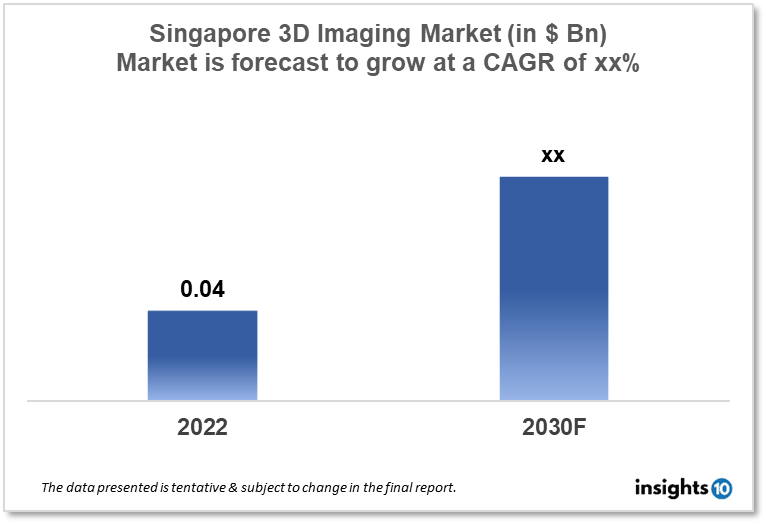
Singapore's 3D imaging market is projected to grow from $0.04 Bn in 2022 to $xx Bn by 2030, registering a CAGR of xx% during the forecast period of 2022-30. The market will be driven by a well-developed healthcare system and a strong emphasis on medical research and innovation. The market is segmented by product, by application, end-user & by portability. Some of the major players include GE Healthcare, Siemens Healthineers & Philips Healthcare.
Buy Now

Singapore 3D Imaging Market Executive Summary
Singapore's 3D imaging market is projected to grow from $0.04 Bn in 2022 to $xx Bn by 2030, registering a CAGR of xx% during the forecast period of 2022-30. Singapore's healthcare spending (including public and private) is expected to account for 5.9% of the GDP. Healthcare spending (as a percentage of GDP) has risen steadily in recent years and is expected to climb further as the population ages and healthcare needs become more complex. Singapore has created world-class healthcare standards, according to the World Health Organization (WHO). Singapore is rated 42 in the world for having the highest cancer rates. According to the statistics, the age-standardized cancer rate in Singapore is 248.9 per 100,000 (both sexes). Each day, 21 Singaporeans die from cardiovascular disease (heart disease and stroke). In 2021, cardiovascular disease was responsible for 32% of all fatalities.
3D Imaging technologies, such as CT and MRI, provide high-resolution pictures that can assist healthcare workers in diagnosing and treating a variety of medical diseases, including cancer, cardiovascular disease, and orthopedic injuries. Singapore's 3D Imaging market is expanding, owing to rising demand for improved imaging technologies in healthcare. The country has a well-developed healthcare system as well as a strong emphasis on medical research and innovation, which has aided in the expansion of the 3D Imaging market. Medical students and professionals benefit from realistic, interactive, and immersive medical training simulations created with 3D Imaging. This technology has the potential to improve medical education and training in Singapore. In January 2023, Seno Medical (US based firm) and Genetik signed a distribution agreement for a breast imaging system in Singapore.
Market Dynamics
Market Growth Drivers
NEVE ILAN, Israel - NANO-X IMAGING LTD ("Nanox"), an imaging technology firm, announced that it has entered into exclusive distribution agreements with Golden Vine International for the expansion of affordable advanced medical imaging services in Singapore. Such private sector investments along with other factors such as the country's strong emphasis on healthcare innovation and research, rising demand for innovative imaging technology, and a well-developed healthcare system are some of the factors driving the market.
Singapore's government has made significant investments in establishing a world-class healthcare system, which has helped to attract top medical experts, academics, and businesses to the nation. This has also contributed to the development and acceptance of cutting-edge medical imaging technologies by fostering a culture of invention and cooperation. Furthermore, the rising frequency of chronic illnesses and an aging population in Singapore have increased the need for more precise and efficient diagnostic technologies, propelling the 3D Imaging market forward.
Market Restraints
The Singapore 3D Imaging market also has several challenges, including the high cost of modern imaging technology, which can limit access for some patients and healthcare providers. Furthermore, there may be concern about the possible health dangers connected with exposure to radiation from some forms of 3D Imaging, such as CT scans. This can lead to over-reliance on alternative imaging technologies that may not be as helpful in certain medical conditions. Furthermore, regulatory issues may develop when adopting new imaging techniques and technologies, particularly when it comes to the approval of artificial intelligence (AI)-based medical imaging solutions.
Competitive Landscape
Key Players
- GE Healthcare
- Siemens Healthineers
- Philips Healthcare
- Canon Medical Systems
- Fujifilm Holdings Corporation
- Hitachi Healthcare
- Toshiba Medical Systems
Notable Deals
- January 2023, Canon Medical Systems Corporation announced a Partnership with ScImage, Inc., as it plans to expand in image exchange solutions and the cardiac market.
- November 2022, At RSNA, Philips introduces new AI-enhanced informatics solutions having an integrated diagnostic strategy that combines radiology, cardiology, pathology, and oncology to securely unify data and pictures throughout the organization, allowing for an earlier and more conclusive diagnosis
- In November 2022, GE HealthCare announced partnerships with Accuray, Elekta, and RaySearch to combine GE HealthCare's imaging capabilities with precision radiation therapy to give cancer patients early diagnosis and improved treatment alternatives.
- June 2022, Siemens Healthineers Cios Spin with The Intuitive Ion System FDA certification allowed for seamless cone beam CT scans during robotic bronchoscopy treatments.
Healthcare Policies and Regulatory Landscape
The Health Sciences Authority (HSA) in Singapore regulates the use of 3D Imaging technology. The HSA is accountable for ensuring the safety, quality, and efficacy of medical devices and equipment used in healthcare. The HSA provides laws and recommendations for the use of 3D Imaging technology, including standards for medical device innovation, production, and testing.
Reimbursement Scenario
Medishield Life, the government's national health insurance system, covers a variety of medical treatments and procedures, including several forms of imaging. Furthermore, several private health insurance companies in Singapore cover imaging services. The level of coverage for 3D Imaging operations, on the other hand, might differ based on the patient's insurance policy and the procedure being performed.
1. Executive Summary
1.1 Digital Health Overview
1.2 Global Scenario
1.3 Country Overview
1.4 Healthcare Scenario in Country
1.5 Digital Health Policy in Country
1.6 Recent Developments in the Country
2. Market Size and Forecasting
2.1 Market Size (With Excel and Methodology)
2.2 Market Segmentation (Check all Segments in Segmentation Section)
3. Market Dynamics
3.1 Market Drivers
3.2 Market Restraints
4. Competitive Landscape
4.1 Major Market Share
4.2 Key Company Profile (Check all Companies in the Summary Section)
4.2.1 Company
4.2.1.1 Overview
4.2.1.2 Product Applications and Services
4.2.1.3 Recent Developments
4.2.1.4 Partnerships Ecosystem
4.2.1.5 Financials (Based on Availability)
5. Reimbursement Scenario
5.1 Reimbursement Regulation
5.2 Reimbursement Process for Diagnosis
5.3 Reimbursement Process for Treatment
6. Methodology and Scope
Singapore 3D Imaging Market Segmentation
By Product (Revenue, USD Billion):
The 3D Imaging Market is divided majorly into X-ray Imaging Systems, Computed Tomography (CT), Magnetic Resonance Imaging (MRI), Ultrasound & Nuclear Imaging Systems. X-ray Imaging systems have the highest market share in the 3D Imaging market. 3D X- rays are mostly utilized for dental and orthopedic applications. 3D Ultrasound is majorly helpful in tracking the dynamic motion of arteries, and veins and also has applications for various fetal, cardiac, obstetric, and rectal examinations, and many more. The ultrasound segment is predicted to develop substantially over the forecast period, primarily to the advancements in technology in the healthcare industry and the several advantages given by 3D ultrasound imaging over standard ultrasound imaging.
- X-ray Imaging Systems
- Computed Tomography (CT)
- Magnetic Resonance Imaging (MRI)
- Ultrasound
- Nuclear Imaging systems
By Application (Revenue, USD Billion):
The market for 3D Imaging has applications covering Cardiology, Neurology, Orthopaedics, Gynaecology, Oncology, and other areas of diagnostics as well. Cardiovascular diseases are the leading cause of death globally. The second biggest cause is cancers because of which Oncology holds the highest market share in the 3D Imaging market followed by cardiology as 3D imaging is highly utilized in these two segments for diagnostics and treatments of the same. Neurosurgeons desire three-dimensional (3D) imagery of intracranial tumors, neural structures, skulls, and veins to establish a clear visual image of the surgical field's anatomical orientation prior to surgical intervention aiding better surgical outcomes for patients. Obstetricians employ 3D ultrasound scans to see the gestational sac, pinpoint the location of an ectopic pregnancy, and evaluate for fetal deformities of the face, spine, limbs, and heart. 3D Imaging applications for gynecology are yet in evolving stage and have a great scope for expansion allowing feasible and quick patient care.
- Cardiology
- Neurology
- Orthopedics
- Gynecology
- Oncology
- Others (Urology, etc.)
By End User (Revenue, USD Billion):
Hospitals, Diagnostic Imaging Centers, and other end-user such as private clinics make up the segments of the 3D Imaging Market. The hospitals among these hold the biggest market share due to the increased uptake of cutting-edge medical technology, the expansion of existing 3D Imaging facilities, the rising affordability of 3D Imaging services, the rising prevalence of chronic conditions such as cardiovascular diseases, cancers, respiratory diseases which lead to rising in demand for precise and quick diagnostic and treatment options. Diagnostic Imaging Centers have also been deploying 3D Imaging equipment to improve their standard of care.
- Hospitals
- Diagnostic Imaging Centers
- Other End Users
By Portability (Revenue, USD Billion):
The 3D Imaging market is divided into two segments Stationary & Mobile, considering the portability of the device. Stationary 3D imaging involves equipment that is installed at a particular location and is operated from the same location of installment whereas mobile ones can be relatively smaller in size and hence moved to the patients who are unable to locate the Imaging room. Mobile MRI, Ultrasound, X–ray & CT allow cutting-edge healthcare to be delivered to nearly any location and are yet in the developing stages of expansion.
- Stationary
- Mobile
Methodology for Database Creation
Our database offers a comprehensive list of healthcare centers, meticulously curated to provide detailed information on a wide range of specialties and services. It includes top-tier hospitals, clinics, and diagnostic facilities across 30 countries and 24 specialties, ensuring users can find the healthcare services they need.
Additionally, we provide a comprehensive list of Key Opinion Leaders (KOLs) based on your requirements. Our curated list captures various crucial aspects of the KOLs, offering more than just general information. Whether you're looking to boost brand awareness, drive engagement, or launch a new product, our extensive list of KOLs ensures you have the right experts by your side. Covering 30 countries and 36 specialties, our database guarantees access to the best KOLs in the healthcare industry, supporting strategic decisions and enhancing your initiatives.
How Do We Get It?
Our database is created and maintained through a combination of secondary and primary research methodologies.
1. Secondary Research
With many years of experience in the healthcare field, we have our own rich proprietary data from various past projects. This historical data serves as the foundation for our database. Our continuous process of gathering data involves:
- Analyzing historical proprietary data collected from multiple projects.
- Regularly updating our existing data sets with new findings and trends.
- Ensuring data consistency and accuracy through rigorous validation processes.
With extensive experience in the field, we have developed a proprietary GenAI-based technology that is uniquely tailored to our organization. This advanced technology enables us to scan a wide array of relevant information sources across the internet. Our data-gathering process includes:
- Searching through academic conferences, published research, citations, and social media platforms
- Collecting and compiling diverse data to build a comprehensive and detailed database
- Continuously updating our database with new information to ensure its relevance and accuracy
2. Primary Research
To complement and validate our secondary data, we engage in primary research through local tie-ups and partnerships. This process involves:
- Collaborating with local healthcare providers, hospitals, and clinics to gather real-time data.
- Conducting surveys, interviews, and field studies to collect fresh data directly from the source.
- Continuously refreshing our database to ensure that the information remains current and reliable.
- Validating secondary data through cross-referencing with primary data to ensure accuracy and relevance.
Combining Secondary and Primary Research
By integrating both secondary and primary research methodologies, we ensure that our database is comprehensive, accurate, and up-to-date. The combined process involves:
- Merging historical data from secondary research with real-time data from primary research.
- Conducting thorough data validation and cleansing to remove inconsistencies and errors.
- Organizing data into a structured format that is easily accessible and usable for various applications.
- Continuously monitoring and updating the database to reflect the latest developments and trends in the healthcare field.
Through this meticulous process, we create a final database tailored to each region and domain within the healthcare industry. This approach ensures that our clients receive reliable and relevant data, empowering them to make informed decisions and drive innovation in their respective fields.
To request a free sample copy of this report, please complete the form below.
We value your inquiry and offer free customization with every report to fulfil your exact research needs.

Related reports (by category)
Digital Health
Brazil eHealth Market Analysis
Related reports (by geography)

Pharmaceuticals
Singapore Seasonal Flu Vaccine Market Analysis
Pharmaceuticals
Singapore Osteoarthritis Drugs Market Analysis
Pharmaceuticals
Singapore Skin Tightening Market Analysis
Pharmaceuticals