Medical Devices
Saudi Arabia CT Scan Market Analysis
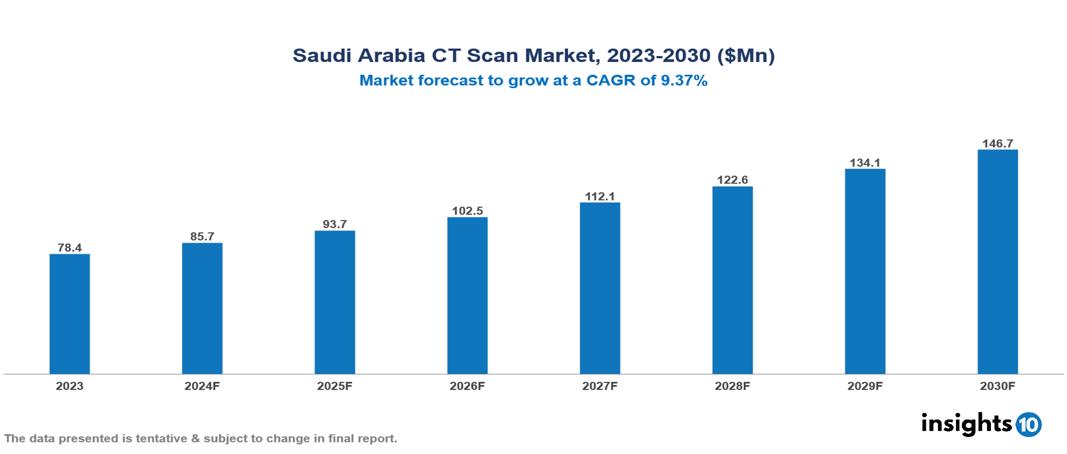
Saudi Arabia CT Scan Market was valued at $78.37 Mn in 2023 and is predicted to grow at a CAGR of 9.37% from 2023 to 2030, to $146.7 Mn by 2030. The key drivers of this industry include the aging population, increasing cancer rates, and technological advancement. The industry is primarily dominated by GE HealthCare, Siemens Healthineers, Canon Medical Systems, and NeuroLogica Corp. among others.
Buy Now

Saudi Arabia CT Scan Market Executive Summary
Saudi Arabia CT Scan Market was valued at $78.37 Mn in 2023 and is predicted to grow at a CAGR of 9.37% from 2023 to 2030, to $146.7 Mn by 2030.
A CT scan, or computed tomography scan, is a sophisticated imaging procedure that uses X-rays to produce detailed cross-sectional images of the body. Unlike traditional X-rays, CT scans capture multiple views from various angles, which a computer then processes into a three-dimensional representation of internal structures such as organs, bones, and soft tissues. Before the scan, patients may prepare by wearing a gown and removing metal objects. Depending on the type of scan, they might need to ingest a contrast material to enhance the visibility of specific tissues. During the scan, patients lie on a table that moves through a donut-shaped scanner while X-ray images are taken. Afterward, a radiologist interprets the images to diagnose conditions like cancer, heart disease, bone fractures, internal bleeding, and injuries. While CT scans offer detailed diagnostic capabilities, they involve radiation exposure and can be costly, though advancements have minimized risks and enhanced safety. Other imaging options like X-rays, ultrasound, and MRI scans are considered based on specific medical needs and radiation concerns.
In Saudi Arabia, the prevalence of chronic diseases is notable, with diabetes mellitus affecting 14.8% of males and 11.7% of females, and hypertension impacting 17.7% of males and 12.5% of females. Chronic obstructive pulmonary disease (COPD) has a prevalence of 2.4%, while end-stage renal disease (ESRD) affects 0.05% of the population. Gastroesophageal reflux disease (GERD) is highly prevalent in the Northern Borders Province, with 61% of adults in Arar City affected. Obesity is particularly widespread in Hail at 63.6%, and diabetes prevalence in the Eastern Province is 17.2%. For diagnosing acute cholecystitis (AC), which has a 24% prevalence rate, CT scans demonstrate a sensitivity of 81.3% and specificity of 62.5%, outperforming ultrasound (US) in sensitivity (37.9%).
The market therefore is driven by significant factors like the aging population, growing population, and government investments in healthcare. However, cost considerations, limited access to CT scanners, and radiation exposure concerns restrict the growth and potential of the market.
A prominent player in this field is GE Healthcare, which launched a new refurbishing unit in Bangladesh for A1-Sure Ultrasound Systems, aiming to enhance accessibility to affordable ultrasound technology in developing regions, and Siemens Healthineers partnered with Microsoft to utilize Azure cloud services for AI-powered medical imaging solutions, aimed at advancing healthcare delivery with secure and scalable cloud computing. Other contributors include Canon Medical Systems, and NeuroLogica Corp. among others.
Market Dynamics
Market Growth Drivers
Rising Burden of Chronic Diseases: Saudi Arabia faces a growing prevalence of chronic diseases like heart disease, cancer, and diabetes. These conditions often require CT scans for diagnosis, treatment monitoring, and follow-up. The World Health Organization (WHO) estimates that non-communicable diseases account for over 70% of deaths in Saudi Arabia.
Increasing Government Investment in Healthcare: The Saudi government is actively investing in upgrading healthcare infrastructure and expanding access to medical technologies. This includes initiatives to increase the availability of CT scanners in hospitals and diagnostic centers.
Growing Aging Population: The population of Saudi Arabia is aging, with a projected increase in the proportion of individuals over 65 years old. This age group is more susceptible to medical conditions often requiring CT scans. Statistics from the World Bank indicate that by 2050, the percentage of people over 65 in Saudi Arabia will reach nearly 12%.
Technological Advancements: Recent advancements in CT scan technologies provide numerous benefits, such as lower radiation doses that increase patient safety, quicker scan times that enhance patient comfort and workflow efficiency, and superior image quality with higher resolution for more accurate diagnoses.
Market Restraints
High Costs: CT scans can be expensive, with the cost varying depending on the type of scan, contrast material used, and facility fees. While specific data on average CT scan costs in Saudi Arabia is limited, industry reports suggest a range between $500 - $1,500 per scan.
Limited Access in Remote Areas: Despite government initiatives, access to CT scans may be limited in remote areas of Saudi Arabia. This can create disparities in healthcare access for certain populations.
Radiation Exposure Concerns: Despite advancements, there's still a small risk associated with CT scans. This may lead to some healthcare providers and patients being cautious about unnecessary CT scans.
Regulatory Landscape and Reimbursement Scenario
The Saudi Arabian CT scan market is regulated by the Saudi Food and Drug Authority (SFDA), which mandates that all CT scanners must be registered before use or marketing in the country to ensure they meet safety and performance standards. Manufacturers and distributors are required to comply with international quality management systems like ISO 13485. Additionally, hospitals and clinics must obtain licenses from the Ministry of Health (MoH) to operate CT scanners, ensuring qualified personnel and proper operation. Regulations also emphasize radiation safety, including protocols for minimizing exposure, mandatory training for operators, and requirements for monitoring and reporting radiation levels.
The reimbursement scenario for CT scans in Saudi Arabia involves both public and private financing. The Saudi Arabian Health Insurance System (SEHIS), a government-sponsored program, covers medically necessary CT scans with specific guidelines, often requiring pre-authorization and physician justification based on the patient's diagnosis. Reimbursement rates may differ depending on whether the hospital is part of the public or private network. Private health insurance plans are also common and offer varying coverage for CT scans depending on the plan details. Patients may need to pay co-payments, deductibles, or a portion of the CT scan costs, depending on their insurance coverage.
Competitive Landscape
Key Players
Here are some of the major key players in the Saudi Arabia CT Scan Market:
- GE HealthCare
- Koninklijke Philips N.V.
- Siemens Healthineers AG
- Canon Medical Systems
- NeuroLogica Corp.
- Shanghai United Imaging Healthcare Co., Ltd.
- Fujifilm Holdings Corporation
- Shenzhen Anke High-tech Co., Ltd.
- Koning Health
- Carestream Dental LLC.
1. Executive Summary
1.1 Device Overview
1.2 Global Scenario
1.3 Country Overview
1.4 Healthcare Scenario in Country
1.5 Regulatory Landscape for Medical Device
1.6 Health Insurance Coverage in Country
1.7 Type of Medical Device
1.8 Recent Developments in the Country
2. Market Size and Forecasting
2.1 Market Size (With Excel and Methodology)
2.2 Market Segmentation (Check all Segments in Segmentation Section)
3. Market Dynamics
3.1 Market Drivers
3.2 Market Restraints
4. Competitive Landscape
4.1 Major Market Share
4.2 Key Company Profile (Check all Companies in the Summary Section)
4.2.1 Company
4.2.1.1 Overview
4.2.1.2 Product Applications and Services
4.2.1.3 Recent Developments
4.2.1.4 Partnerships Ecosystem
4.2.1.5 Financials (Based on Availability)
5. Reimbursement Scenario
5.1 Reimbursement Regulation
5.2 Reimbursement Process for Diagnosis
5.3 Reimbursement Process for Treatment
6. Methodology and Scope
By Technology
- High-end Slice CT
- Mid-end Slice CT
- Low-end Slice CT
- Cone Beam CT (CBCT)
By Application
- Oncology
- Cardiology
- Vascular
- Neurology
- Musculoskeletal
- Others
By Modality
- O-Arms
- C- Arms
By End-User
- Hospitals
- Diagnostic Imaging Centers
- Others
Methodology for Database Creation
Our database offers a comprehensive list of healthcare centers, meticulously curated to provide detailed information on a wide range of specialties and services. It includes top-tier hospitals, clinics, and diagnostic facilities across 30 countries and 24 specialties, ensuring users can find the healthcare services they need.
Additionally, we provide a comprehensive list of Key Opinion Leaders (KOLs) based on your requirements. Our curated list captures various crucial aspects of the KOLs, offering more than just general information. Whether you're looking to boost brand awareness, drive engagement, or launch a new product, our extensive list of KOLs ensures you have the right experts by your side. Covering 30 countries and 36 specialties, our database guarantees access to the best KOLs in the healthcare industry, supporting strategic decisions and enhancing your initiatives.
How Do We Get It?
Our database is created and maintained through a combination of secondary and primary research methodologies.
1. Secondary Research
With many years of experience in the healthcare field, we have our own rich proprietary data from various past projects. This historical data serves as the foundation for our database. Our continuous process of gathering data involves:
- Analyzing historical proprietary data collected from multiple projects.
- Regularly updating our existing data sets with new findings and trends.
- Ensuring data consistency and accuracy through rigorous validation processes.
With extensive experience in the field, we have developed a proprietary GenAI-based technology that is uniquely tailored to our organization. This advanced technology enables us to scan a wide array of relevant information sources across the internet. Our data-gathering process includes:
- Searching through academic conferences, published research, citations, and social media platforms
- Collecting and compiling diverse data to build a comprehensive and detailed database
- Continuously updating our database with new information to ensure its relevance and accuracy
2. Primary Research
To complement and validate our secondary data, we engage in primary research through local tie-ups and partnerships. This process involves:
- Collaborating with local healthcare providers, hospitals, and clinics to gather real-time data.
- Conducting surveys, interviews, and field studies to collect fresh data directly from the source.
- Continuously refreshing our database to ensure that the information remains current and reliable.
- Validating secondary data through cross-referencing with primary data to ensure accuracy and relevance.
Combining Secondary and Primary Research
By integrating both secondary and primary research methodologies, we ensure that our database is comprehensive, accurate, and up-to-date. The combined process involves:
- Merging historical data from secondary research with real-time data from primary research.
- Conducting thorough data validation and cleansing to remove inconsistencies and errors.
- Organizing data into a structured format that is easily accessible and usable for various applications.
- Continuously monitoring and updating the database to reflect the latest developments and trends in the healthcare field.
Through this meticulous process, we create a final database tailored to each region and domain within the healthcare industry. This approach ensures that our clients receive reliable and relevant data, empowering them to make informed decisions and drive innovation in their respective fields.
To request a free sample copy of this report, please complete the form below.
We value your inquiry and offer free customization with every report to fulfil your exact research needs.

Related reports (by category)
Medical Devices
Thailand Pain Management Devices Market Analysis
Medical Devices
Russia 3D Printing Medical Devices Market Analysis
Medical Devices
New Zealand Neurology Devices Market Analysis
Related reports (by geography)

Pharmaceuticals
Saudi Arabia Anti-Aging Drugs Market Analysis
Pharmaceuticals
Saudi Arabia Outpatient Rehabilitation Centers Market Analysis
Pharmaceuticals