Healthcare Services

North America Physiotherapy Market Analysis
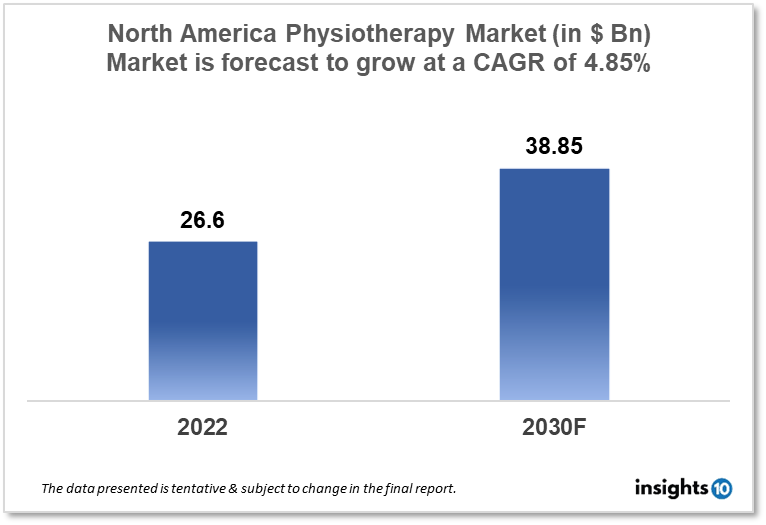
North America's physiotherapy market size was valued at $26.6 Bn in 2022 and is estimated to expand at a compound annual growth rate (CAGR) of 4.85% from 2022 to 2030 and will reach $38.85 Bn in 2030. The North American physiotherapy market is expected due to an increase in the frequency of chronic illnesses, and growing public awareness of the benefits of physiotherapy. The market is segmented by Product Type Application Type and End User. The major players in the North American physiotherapy market are BTL, EMS Physio Ltd., Dynatronics Corporation, RICHMAR, and others.
Buy Now

North America Physiotherapy Market Executive Summary
North American physiotherapy market size was valued at $26.6 Bn in 2022 and is estimated to expand at a compound annual growth rate (CAGR) of 4.85% from 2022 to 2030 and will reach $38.85 Bn in 2030. The GDP of North America, which includes Canada, and the United States is among the highest in the world. According to the World Bank, the GDP of North America was approximately $20.5 trillion in 2020. Healthcare expenditure in North America varies by country, but in general, it is high. According to the World Health Organization, the United States had the highest healthcare expenditure as a percentage of GDP among North American countries at 17.2%. Canada's healthcare expenditure as a percentage of GDP was 10.3% and Mexico's was 6.2%.
The physiotherapy service is offered when movement and function are threatened by old age, injury, pain, illnesses, disorders, conditions, and/or environmental factors since functional mobility is essential for maximum health. During physical therapy, the physical therapist collaborates with patients, clients, other medical professionals, families, carers, and communities. Physical therapists assess movement potential and establish goals using their specialized knowledge and skills. Through promotion, prevention, treatment, and rehabilitation, physical therapists seek to find and maximize each patient's potential for mobility and quality of life. Some of the causes causing the rapid expansion of the North American physiotherapy market include an ageing population, an increase in the frequency of chronic illnesses, and growing public awareness of the benefits of physiotherapy.
Market Dynamics
Market Growth Drivers
The North America market for physiotherapy is anticipated to grow in the next years as a result of an aging population, an increase in the number of people with chronic illnesses including diabetes and obesity, and other factors. This increase in demand for physiotherapy services is expected to create opportunities for physiotherapists and physiotherapy clinics around the country.
There are various factors that could have an effect on the North America physiotherapy industry. These include the availability of certified physical therapists, the cost of physiotherapy services, and the scope of insurance coverage for physiotherapy. The adoption of cutting-edge technology like telemedicine could potentially have an impact on the market.
Market Restraints
The North American physiotherapy market may be affected by a variety of issues, such as restricted access to healthcare: In some regions of the country, access to healthcare, including physiotherapy, may be limited due to a lack of facilities or competent employees. As a result, people could have trouble getting the therapy they need.
The high cost of physiotherapy services may be a disincentive for some people, especially those who lack insurance or have insufficient insurance. Additionally, some patients may choose not to receive treatment due to the unfavorable stereotypes connected with physiotherapy.
Competitive Landscape
Key Players
- BTL
- EMS Physio
- Dynatronics Corporation
- RICHMAR
- Performance Health
- Storz Medical AG
- Zimmer MedizinSysteme
- ITO Co.
- Enraf-Nonius B.V.
- Whitehall Manufacturing
- Kinetec
- Thera-Band
- Mettler Electronics
- Chattanooga Group
Healthcare Policies and Regulatory Landscape
The Food and Drug Administration (FDA) and the Federal Trade Commission are largely in charge of overseeing the regulation of physiotherapy equipment in the United States (FTC). The FDA is in charge of ensuring the efficacy and safety of medical items, including physiotherapy equipment. Medical devices are divided into a number of classes according to the level of risk they pose to patients, and each class has its own set of regulations. For instance, Class I devices are subject to the least amount of oversight whereas Class III devices, which provide the most risk, are subject to the harshest regulations. The FTC is in charge of ensuring that ads and labeling for physiotherapy equipment are truthful and not misleading.
Physiotherapy equipment in Canada is subject to regulation by Health Canada, the federal government body is responsible for ensuring that medical devices are reliable and secure. Health Canada regulates the manufacture, importation, and marketing of medical devices in Canada through the Medical Equipment Regulations. According to these regulations, producers and importers of medical devices, including physiotherapy equipment, must first obtain a Medical Device Establishment License (MDEL) from Health Canada in order to legally market their products in Canada. The MDEL examines whether the manufacturer or importer has the necessary quality control procedures in place to ensure the safety and effectiveness of the products they produce or import.
1. Executive Summary
1.1 Service Overview
1.2 Global Scenario
1.3 Country Overview
1.4 Healthcare Scenario in Country
1.5 Healthcare Services Market in Country
1.6 Recent Developments in the Country
2. Market Size and Forecasting
2.1 Market Size (With Excel and Methodology)
2.2 Market Segmentation (Check all Segments in Segmentation Section)
3. Market Dynamics
3.1 Market Drivers
3.2 Market Restraints
4. Competitive Landscape
4.1 Major Market Share
4.2 Key Company Profile (Check all Companies in the Summary Section)
4.2.1 Company
4.2.1.1 Overview
4.2.1.2 Product Applications and Services
4.2.1.3 Recent Developments
4.2.1.4 Partnerships Ecosystem
4.2.1.5 Financials (Based on Availability)
5. Reimbursement Scenario
5.1 Reimbursement Regulation
5.2 Reimbursement Process for Services
5.3 Reimbursement Process for Treatment
6. Methodology and Scope
Physiotherapy Market Segmentation
By Product: (Revenue, USD Billion):
Based on product, the physiotherapy equipment market is divided into two major segments: equipment and accessories. The equipment segment accounted for the largest share of the physiotherapy equipment market in 2021. The equipment segment is further segmented into electrotherapy equipment, ultrasound equipment, exercise therapy equipment, heat therapy equipment, cryotherapy equipment, combination therapy equipment, continuous passive motion therapy equipment, shockwave therapy equipment, laser therapy equipment, magnetic pressure therapy equipment, traction therapy, and other physiotherapy equipment (hydrotherapy and vacuum therapy). Due to the increasing use of electrotherapy equipment in the treatment of musculoskeletal disorders and increasing concerns for patients’ safety and minimal/no side-effects during the physiotherapy treatments.
- Equipment
- Electrotherapy equipment
- Ultrasound equipment
- Exercise therapy equipment
- Heat therapy equipment
- Cryotherapy equipment
- Combination therapy equipment
- Continous passive motion therapy equipment
- Shockwave therapy equipment
- Laser therapy equipment
- Magnetic pressure therapy equipment
- Traction therapy
- Other physiotherapy equipment
- Accessories
- Manual Therapy
- Specialized treatment
- Joint Mobilization Techniques
- Suspension Therapy
By Application (Revenue, USD Billion):
Based on application, the physiotherapy equipment market is segmented into musculoskeletal applications, neurological applications, cardiovascular and pulmonary applications, pediatric applications, gynecological applications, and other applications (including sports and palliative care). The musculoskeletal applications segment holds a dominating share attributed to the increasing adoption of physiotherapies to accelerate recovery of accidental injuries, rising incidence of musculoskeletal disorders, and growth in the geriatric population.
By Applications
- Musculoskeletal applications
- Neurological applications
- Cardiovascular and pulmonary applications
- Pediatric applications
- Gynecological applications
- Other applications
By End-user (Revenue, USD Billion):
Based on end users, the physiotherapy equipment market is segmented into physiotherapy & rehabilitation centers, hospitals, home care settings, physician offices, and other end users (community health centers and elderly care facilities). In 2021, the physiotherapy & rehabilitation centers segment accounted for the largest share of the physiotherapy equipment market due to increasing demand for advanced physiotherapy equipment and their wide usage across the care continuum across these centers.
- Physiotherapy & Rehabilitation centers
- Hospitals
- Home care settings
- Physician offices
Methodology for Database Creation
Our database offers a comprehensive list of healthcare centers, meticulously curated to provide detailed information on a wide range of specialties and services. It includes top-tier hospitals, clinics, and diagnostic facilities across 30 countries and 24 specialties, ensuring users can find the healthcare services they need.
Additionally, we provide a comprehensive list of Key Opinion Leaders (KOLs) based on your requirements. Our curated list captures various crucial aspects of the KOLs, offering more than just general information. Whether you're looking to boost brand awareness, drive engagement, or launch a new product, our extensive list of KOLs ensures you have the right experts by your side. Covering 30 countries and 36 specialties, our database guarantees access to the best KOLs in the healthcare industry, supporting strategic decisions and enhancing your initiatives.
How Do We Get It?
Our database is created and maintained through a combination of secondary and primary research methodologies.
1. Secondary Research
With many years of experience in the healthcare field, we have our own rich proprietary data from various past projects. This historical data serves as the foundation for our database. Our continuous process of gathering data involves:
- Analyzing historical proprietary data collected from multiple projects.
- Regularly updating our existing data sets with new findings and trends.
- Ensuring data consistency and accuracy through rigorous validation processes.
With extensive experience in the field, we have developed a proprietary GenAI-based technology that is uniquely tailored to our organization. This advanced technology enables us to scan a wide array of relevant information sources across the internet. Our data-gathering process includes:
- Searching through academic conferences, published research, citations, and social media platforms
- Collecting and compiling diverse data to build a comprehensive and detailed database
- Continuously updating our database with new information to ensure its relevance and accuracy
2. Primary Research
To complement and validate our secondary data, we engage in primary research through local tie-ups and partnerships. This process involves:
- Collaborating with local healthcare providers, hospitals, and clinics to gather real-time data.
- Conducting surveys, interviews, and field studies to collect fresh data directly from the source.
- Continuously refreshing our database to ensure that the information remains current and reliable.
- Validating secondary data through cross-referencing with primary data to ensure accuracy and relevance.
Combining Secondary and Primary Research
By integrating both secondary and primary research methodologies, we ensure that our database is comprehensive, accurate, and up-to-date. The combined process involves:
- Merging historical data from secondary research with real-time data from primary research.
- Conducting thorough data validation and cleansing to remove inconsistencies and errors.
- Organizing data into a structured format that is easily accessible and usable for various applications.
- Continuously monitoring and updating the database to reflect the latest developments and trends in the healthcare field.
Through this meticulous process, we create a final database tailored to each region and domain within the healthcare industry. This approach ensures that our clients receive reliable and relevant data, empowering them to make informed decisions and drive innovation in their respective fields.
To request a free sample copy of this report, please complete the form below.
We value your inquiry and offer free customization with every report to fulfil your exact research needs.

Related reports (by category)
Healthcare Services
France Laboratory Information System Market Analysis
Healthcare Services
Finland Women Health Diagnostic Market Analysis
Healthcare Services
Finland Physiotherapy Market Analysis
Related reports (by geography)
Digital Health
North America Electronic Health Records Market Analysis
Digital Health
North America 3D Imaging Market Analysis

Pharmaceuticals
North America Lung Cancer Therapeutics Market Analysis
Pharmaceuticals