Digital Health

North America Electronic Health Records Market Analysis
The North America Electronic Health Record (EHR) market size was valued at $11.88 Bn in 2022 and is estimated to expand at a compound annual growth rate (CAGR) of 2% from 2022 to 2030 and will reach $13.92 Bn in 2030. This growth can be attributed to the increasing adoption of EHR in healthcare facilities. The market is segmented by product, application, and end North America. Some of the major players are Epic Systems, Allscripts, McKesson, Meditech, and others.
Buy Now

North America Electronic Health Record (EHR) Market Executive Summary
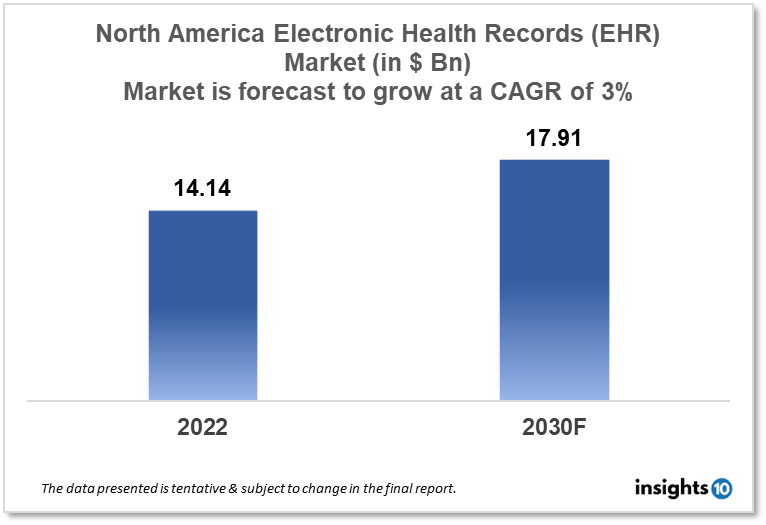
The North America Electronic Health Record (EHR) market size was valued at $14.14 Bn in 2022 and is estimated to expand at a compound annual growth rate (CAGR) of 3% from 2022 to 2030 and will reach $17.91 Bn in 2030. According to the World Health Organization (WHO), the total health expenditure in North America as a percentage of gross domestic product (GDP) is around 11%. The United States, which makes up a large portion of the North American market, has among the highest health care expenditure in the world, with a total expenditure of around 17% of GDP. Canada's healthcare expenditure is around 11% of the GDP.
The systematic electronic gathering and storage of patient medical data is the primary function of an electronic health record, or EHR, system. EHR systems encourage patient data accessibility, which improves the overall effectiveness and efficiency of patient treatment. The broad features, useful applications, and interoperability of electronic health records in a range of healthcare settings are expected to lead to a rise in their use in the future.
The primary factors driving the market are expanding government programs to entice healthcare organizations to invest in North American healthcare IT and raise awareness among mental health practitioners of the benefits of electronic health records (EHR). Since technology has advanced, doctors can now use the same EHR software for clinical evaluation documentation, telemedicine, e-prescribing, and other clinical and administrative functions in addition to storing patient data.
Market Dynamics
Market Growth Drivers
Government regulations and incentives for the use of EHR systems, the demand for better patient care and safety, and the advantages of data analytics and population health management are some of the drivers driving the North American EHR industry. The federal government set aside $27 billion in 2009 as part of the Health Information Technology for Economic and Clinical Health (HITECH) Act for an incentive programme to encourage hospitals and providers to use North American electronic health records systems, which is one of the main factors driving the EHR market (EHR). The need for EHR systems that can support data analytics and population health management is also being driven by the trend toward value-based care and population health management.
The market is expanding as a result of an increase in market participants' mergers and acquisitions. For instance, in January 2021, the U.S. Orthopedic Alliance and Allscripts Healthcare Solutions established a strategic partnership. (USOA). Orthopaedic practises will be able to scale more quickly thanks to this relationship, as will the use of electronic health records, the provision of evidence-based guidelines to support evolving clinical protocols, and the use of value-based care analytics to link the entire community.
Market Restraints
One of the main challenges facing the EHR industry is the high cost of adoption and maintenance, the lack of system compatibility, and concerns about data security and privacy. The inconsistency of EHR systems might also limit their potential benefits by making it difficult for healthcare professionals to interact and share information with other professionals.
Competitive Landscape
Key Players
- Epic Systems
- Allscripts
- McKesson
- Meditech
- Athenahealth
- NextGen Healthcare
- eClinicalWorks
- Greenway Health
- Modernizing Medicine
- GE Healthcare
- Practice FNorth Americaion (acquired by Allscripts)
- Drchrono
Healthcare Policies and Regulatory Landscape
Policy changes and Reimbursement scenario
In the United States, the regulations for electronic health records (EHRs) are primarily set by the Department of Health and Human Services (HHS) through the Office of the National Coordinator for Health Information Technology (ONC) and the Centers for Medicare & Medicaid Services (CMS).
The HITECH Act, which was passed in 2009 as part of the American Recovery and Reinvestment Act, provides financial incentives for healthcare providers to adopt and effectively North America EHR systems. The HITECH Act also established the meaningful North America program, which establishes standards for the North America EHR systems in order to qualify for these incentives.
In Canada, electronic health records (EHRs) are regulated by the provinces and territories. Each jurisdiction has its own legislation and regulations regarding the use and management of EHRs. The federal government also has laws and guidelines that apply to EHRs, such as the Personal Information Protection and Electronic Documents Act (PIPEDA), which sets out rules for the collection, use, and disclosure of personal information in the private sector, including health information. Additionally, the Canadian Medical Association has developed guidelines for the use and management of EHRs in the healthcare sector.
1. Executive Summary
1.1 Digital Health Overview
1.2 Global Scenario
1.3 Country Overview
1.4 Healthcare Scenario in Country
1.5 Digital Health Policy in Country
1.6 Recent Developments in the Country
2. Market Size and Forecasting
2.1 Market Size (With Excel and Methodology)
2.2 Market Segmentation (Check all Segments in Segmentation Section)
3. Market Dynamics
3.1 Market Drivers
3.2 Market Restraints
4. Competitive Landscape
4.1 Major Market Share
4.2 Key Company Profile (Check all Companies in the Summary Section)
4.2.1 Company
4.2.1.1 Overview
4.2.1.2 Product Applications and Services
4.2.1.3 Recent Developments
4.2.1.4 Partnerships Ecosystem
4.2.1.5 Financials (Based on Availability)
5. Reimbursement Scenario
5.1 Reimbursement Regulation
5.2 Reimbursement Process for Diagnosis
5.3 Reimbursement Process for Treatment
6. Methodology and Scope
Electronic Health Records Market Segmentation
By Product (Revenue, USD Billion):
Web-based and cloud-based software is more affordable since it saves on additional costs like license fees, regular upgrades, and device upkeep. Additionally, it reduces the need for IT workers because SaaS providers help with software installation, configuration, testing, operation, and upgrades. The cost-effectiveness of cloud-based EHR systems in small healthcare organizations will therefore fuel developments as well as the expansion of the category. MHealth services
- Web/Cloud-based EHR software
- On-premise EHR software
By Application Type (Revenue, USD Billion):
Large amounts of patient health data may be stored and processed by EHRs, which aids doctors in automating both financial and operational operations with rapid and simple access. Therefore, integrated EHR and practice management software navigates all tasks, making it easier for front-line healthcare providers to do their jobs, and will therefore drive the segment's revenue during the anticipated time period.
- E-prescription
- Practice management
- Referral management
- Patient management
- Population health management
By End User (Revenue, USD Billion):
By 2027, the category of ambulatory surgical centres is expected to rise at a 7.1% annual rate. The acceptance of EHR in these facilities will be fueled by ambulatory surgical centres' growing preference for digital technologies to efficiently manage workflow. These are outpatient facilities offering planned surgeries and same-day surgical services.
- Hospitals
- Specialty centers
- Clinics
- Ambulatory surgical centers
- Others
Methodology for Database Creation
Our database offers a comprehensive list of healthcare centers, meticulously curated to provide detailed information on a wide range of specialties and services. It includes top-tier hospitals, clinics, and diagnostic facilities across 30 countries and 24 specialties, ensuring users can find the healthcare services they need.
Additionally, we provide a comprehensive list of Key Opinion Leaders (KOLs) based on your requirements. Our curated list captures various crucial aspects of the KOLs, offering more than just general information. Whether you're looking to boost brand awareness, drive engagement, or launch a new product, our extensive list of KOLs ensures you have the right experts by your side. Covering 30 countries and 36 specialties, our database guarantees access to the best KOLs in the healthcare industry, supporting strategic decisions and enhancing your initiatives.
How Do We Get It?
Our database is created and maintained through a combination of secondary and primary research methodologies.
1. Secondary Research
With many years of experience in the healthcare field, we have our own rich proprietary data from various past projects. This historical data serves as the foundation for our database. Our continuous process of gathering data involves:
- Analyzing historical proprietary data collected from multiple projects.
- Regularly updating our existing data sets with new findings and trends.
- Ensuring data consistency and accuracy through rigorous validation processes.
With extensive experience in the field, we have developed a proprietary GenAI-based technology that is uniquely tailored to our organization. This advanced technology enables us to scan a wide array of relevant information sources across the internet. Our data-gathering process includes:
- Searching through academic conferences, published research, citations, and social media platforms
- Collecting and compiling diverse data to build a comprehensive and detailed database
- Continuously updating our database with new information to ensure its relevance and accuracy
2. Primary Research
To complement and validate our secondary data, we engage in primary research through local tie-ups and partnerships. This process involves:
- Collaborating with local healthcare providers, hospitals, and clinics to gather real-time data.
- Conducting surveys, interviews, and field studies to collect fresh data directly from the source.
- Continuously refreshing our database to ensure that the information remains current and reliable.
- Validating secondary data through cross-referencing with primary data to ensure accuracy and relevance.
Combining Secondary and Primary Research
By integrating both secondary and primary research methodologies, we ensure that our database is comprehensive, accurate, and up-to-date. The combined process involves:
- Merging historical data from secondary research with real-time data from primary research.
- Conducting thorough data validation and cleansing to remove inconsistencies and errors.
- Organizing data into a structured format that is easily accessible and usable for various applications.
- Continuously monitoring and updating the database to reflect the latest developments and trends in the healthcare field.
Through this meticulous process, we create a final database tailored to each region and domain within the healthcare industry. This approach ensures that our clients receive reliable and relevant data, empowering them to make informed decisions and drive innovation in their respective fields.
To request a free sample copy of this report, please complete the form below.
We value your inquiry and offer free customization with every report to fulfil your exact research needs.

Related reports (by category)
Digital Health
Canada Healthcare Financial Analytics Market Analysis
Digital Health
Canada Medical Digital Imaging System Market Analysis
Related reports (by geography)

Pharmaceuticals
North America Liver Disease Drugs Market Analysis

Healthcare Services
North America Home Healthcare Market Analysis
Pharmaceuticals
North America Acne Therapeutics Market Analysis
Pharmaceuticals