Medical Devices
Mexico Hemodialysis Equipment Market Analysis
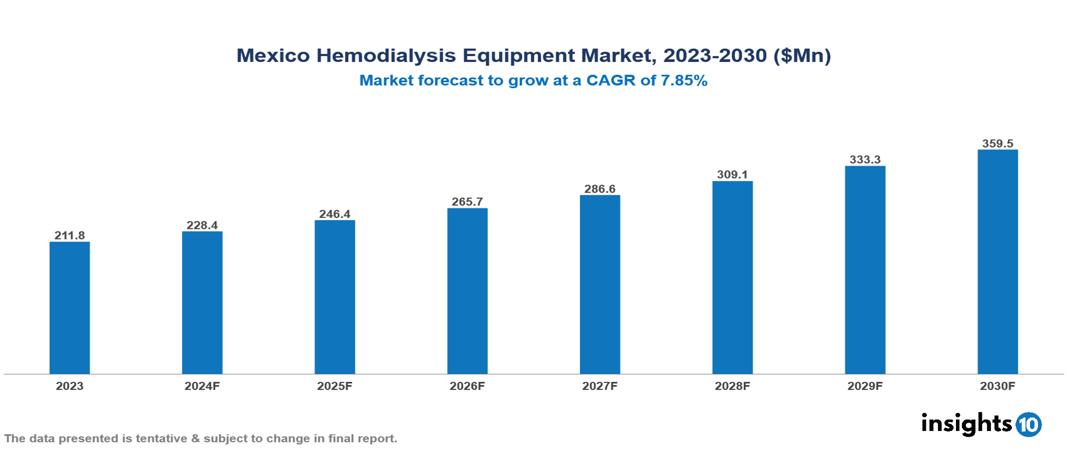
The Mexico Hemodialysis Equipment Market was valued at $211.8 Mn in 2023 and is projected to grow at a CAGR of 7.85% from 2023 to 2023, to $359.5 Mn by 2030. The key drivers of this industry are increasing incidence of chronic kidney disease (CKD) and end-stage renal disease (ESRD), availability of advanced dialysis machines and consumables, government initiatives to improve dialysis accessibility, growing adoption of home haemodialysis, expansion of dialysis service providers which has contributed to market growth. The industry is primarily dominated by players such as Stryker, Boston Scientific Corporation, Baxter, B. Braun SE, Fresenius Medical Care AG, Medtronic among others.
Buy Now

Mexico Hemodialysis Equipment Market Executive Summary
The Mexico Hemodialysis Equipment Market is at around $211.8 Mn in 2023 and is projected to reach $359.5 Mn in 2030, exhibiting a CAGR of 7.85% during the forecast period 2023-2030.Hemodialysis is a critical treatment for patients with end-stage renal disease, and it relies on specialized medical devices to function effectively. The main components of a haemodialysis machine include the dialyzer (artificial kidney), blood pump, dialysate pump, air detector, heparin pump, temperature monitor, and conductivity monitor.
The dialyzer is a filter that removes waste and excess fluid from the blood. The blood pump pulls blood from the body into the dialyzer, while the dialysate pump sends a special fluid into the dialyzer to help remove the waste and fluid. The air detector monitors for air bubbles in the blood line and stops the blood pump if air is detected to prevent air embolism. The heparin pump delivers an anticoagulant into the blood to prevent clotting during the dialysis process. The temperature monitor ensures the dialysate remains within a safe temperature range, and the conductivity monitor checks the concentration of electrolytes in the dialysate. These various components work together as part of the hemodialysis machine to filter the patient's blood, maintain the proper fluid and electrolyte balance, and prevent complications. Advancements in dialysis technology have helped improve the safety and efficacy of this life-saving treatment.
The number of people receiving dialysis treatment in Mexico reached 130 thousand in 2021, a 4% increase from 2020. The hemodialysis market is driven by significant factors like aging population, increase prevalence rate of chronic diseases, increasing incidence of chronic kidney disease (CKD) and end-stage renal disease (ESRD), availability of advanced dialysis machines and consumables, government initiatives to improve dialysis accessibility, growing adoption of home haemodialysis, expansion of dialysis service providers which has contributed to market growth.
Some of the major players operating in the Mexico Hemodialysis Equipment Market are Stryker, Boston Scientific Corporation, Baxter, B. Braun SE, Fresenius Medical Care AG, Medtronic among others.
Market Dynamics
Market Drivers
Rising Prevalence of Chronic Kidney Disease: The increasing prevalence of diabetes and hypertension in Mexico is a major contributor to the growing incidence of chronic kidney disease (CKD). As these chronic conditions lead to kidney damage and failure, it drives the demand for dialysis treatments in the country. The number of people receiving dialysis treatment in Mexico reached 130,000 in 2021, a 4% increase from 2020.
Aging Population: Mexico's population is aging, with the number of adults aged 60 and older projected to reach 22.1 Mn by 2030. The higher risk of CKD in the elderly population, often linked to diabetes and hypertension, is contributing to the growth of the dialysis market.
Expansion of Private Healthcare Sector: The private healthcare sector in Mexico is expanding, with an increasing number of private dialysis centres being established. This is driven by rising private healthcare expenditure and the availability of health insurance coverage for dialysis treatments.
Market Restraints
Risks Associated with Dialysis: Dialysis procedures carry inherent risks of infections and other complications, which can be exacerbated by the high prevalence of chronic conditions like diabetes and hypertension. Inadequate adherence to hygiene protocols and sterilization measures can increase the risk of complications, hindering market growth.
Limited Awareness about Kidney Disease: There is a lack of awareness among the general population in Mexico about the importance of early detection and prevention of CKD, especially in the context of diabetes and hypertension. This can lead to late diagnosis and increased demand for dialysis treatments, putting a strain on the healthcare system.
Access to Care: The high prevalence of diabetes and hypertension, coupled with limited healthcare infrastructure and resources, can restrict access to dialysis treatments for some patients in Mexico. This can be a significant restraint, as the high cost of dialysis and limited reimbursement coverage can make it inaccessible for lower-income individuals.
Regulatory Landscape and Reimbursement Scenario
In Mexico, the regulation and reimbursement of hemodialysis medical devices operate within a complex healthcare system that combines public, private, and social security institutions. The Federal Commission for Protection against Sanitary Risk (COFEPRIS) is the primary regulatory body responsible for overseeing medical devices, including hemodialysis equipment. COFEPRIS enforces regulations on device registration, quality control, and safety standards, aligning with international norms to ensure the efficacy and safety of hemodialysis devices used in the country.
Reimbursement for hemodialysis services in Mexico varies depending on the patient's affiliation with different health insurance schemes. The public sector, primarily through the Ministry of Health (Secretaría de Salud) and the Institute of Health for Well-being (INSABI), provides coverage for uninsured populations. The Mexican Social Security Institute (IMSS) and the Institute for Social Security and Services for State Workers (ISSSTE) cover formal sector employees and government workers, respectively. These institutions offer hemodialysis services to their beneficiaries, typically with minimal or no out-of-pocket costs.
The private healthcare sector plays a significant role in providing dialysis services, especially for those who can afford it or have private insurance. Private clinics and hospitals often offer more timely access to treatment and may use more advanced technologies. However, the costs can be substantial for patients paying out-of-pocket. Reimbursement rates and coverage policies can vary significantly between different insurance schemes and providers. The fragmentation of the healthcare system can lead to disparities in access and quality of care across different population segments.
Competitive Landscape
Key Players
Here are some of the major key players in the Mexico Hemodialysis Equipment Market:
- Boston Scientific Corporation
- F. Hoffman-La Roche Ltd
- Stryker
- Koninklijke Philips N.V.
- Fresenius Medical Care
- Baxter International
- B. Braun
- Nipro Corporation
- Medtronic
1. Executive Summary
1.1 Device Overview
1.2 Global Scenario
1.3 Country Overview
1.4 Healthcare Scenario in Country
1.5 Regulatory Landscape for Medical Device
1.6 Health Insurance Coverage in Country
1.7 Type of Medical Device
1.8 Recent Developments in the Country
2. Market Size and Forecasting
2.1 Market Size (With Excel and Methodology)
2.2 Market Segmentation (Check all Segments in Segmentation Section)
3. Market Dynamics
3.1 Market Drivers
3.2 Market Restraints
4. Competitive Landscape
4.1 Major Market Share
4.2 Key Company Profile (Check all Companies in the Summary Section)
4.2.1 Company
4.2.1.1 Overview
4.2.1.2 Product Applications and Services
4.2.1.3 Recent Developments
4.2.1.4 Partnerships Ecosystem
4.2.1.5 Financials (Based on Availability)
5. Reimbursement Scenario
5.1 Reimbursement Regulation
5.2 Reimbursement Process for Diagnosis
5.3 Reimbursement Process for Treatment
6. Methodology and Scope
Mexico Hemodialysis Equipment Market Segmentation
By Hemodialysis Type
- Conventional Hemodialysis
- Short Daily Hemodialysis
- Nocturnal Hemodialysis
By Product & Services
- Equipment
- Consumables
- Dialysis Drugs
- Services
By End Use
- Home-based
- Hospital-based
Methodology for Database Creation
Our database offers a comprehensive list of healthcare centers, meticulously curated to provide detailed information on a wide range of specialties and services. It includes top-tier hospitals, clinics, and diagnostic facilities across 30 countries and 24 specialties, ensuring users can find the healthcare services they need.
Additionally, we provide a comprehensive list of Key Opinion Leaders (KOLs) based on your requirements. Our curated list captures various crucial aspects of the KOLs, offering more than just general information. Whether you're looking to boost brand awareness, drive engagement, or launch a new product, our extensive list of KOLs ensures you have the right experts by your side. Covering 30 countries and 36 specialties, our database guarantees access to the best KOLs in the healthcare industry, supporting strategic decisions and enhancing your initiatives.
How Do We Get It?
Our database is created and maintained through a combination of secondary and primary research methodologies.
1. Secondary Research
With many years of experience in the healthcare field, we have our own rich proprietary data from various past projects. This historical data serves as the foundation for our database. Our continuous process of gathering data involves:
- Analyzing historical proprietary data collected from multiple projects.
- Regularly updating our existing data sets with new findings and trends.
- Ensuring data consistency and accuracy through rigorous validation processes.
With extensive experience in the field, we have developed a proprietary GenAI-based technology that is uniquely tailored to our organization. This advanced technology enables us to scan a wide array of relevant information sources across the internet. Our data-gathering process includes:
- Searching through academic conferences, published research, citations, and social media platforms
- Collecting and compiling diverse data to build a comprehensive and detailed database
- Continuously updating our database with new information to ensure its relevance and accuracy
2. Primary Research
To complement and validate our secondary data, we engage in primary research through local tie-ups and partnerships. This process involves:
- Collaborating with local healthcare providers, hospitals, and clinics to gather real-time data.
- Conducting surveys, interviews, and field studies to collect fresh data directly from the source.
- Continuously refreshing our database to ensure that the information remains current and reliable.
- Validating secondary data through cross-referencing with primary data to ensure accuracy and relevance.
Combining Secondary and Primary Research
By integrating both secondary and primary research methodologies, we ensure that our database is comprehensive, accurate, and up-to-date. The combined process involves:
- Merging historical data from secondary research with real-time data from primary research.
- Conducting thorough data validation and cleansing to remove inconsistencies and errors.
- Organizing data into a structured format that is easily accessible and usable for various applications.
- Continuously monitoring and updating the database to reflect the latest developments and trends in the healthcare field.
Through this meticulous process, we create a final database tailored to each region and domain within the healthcare industry. This approach ensures that our clients receive reliable and relevant data, empowering them to make informed decisions and drive innovation in their respective fields.
To request a free sample copy of this report, please complete the form below.
We value your inquiry and offer free customization with every report to fulfil your exact research needs.

Related reports (by category)
Medical Devices
Switzerland Pain Management Devices Market Analysis
Medical Devices
Malaysia Medical Devices Market Analysis
Medical Devices
Japan MRI Market Analysis
Related reports (by geography)
Digital Health
Mexico 3D Imaging Market Analysis
Medical Devices
Mexico Diabetes Devices Market Analysis
Digital Health