Pharmaceuticals
Malaysia Antifungal Drugs Market Analysis
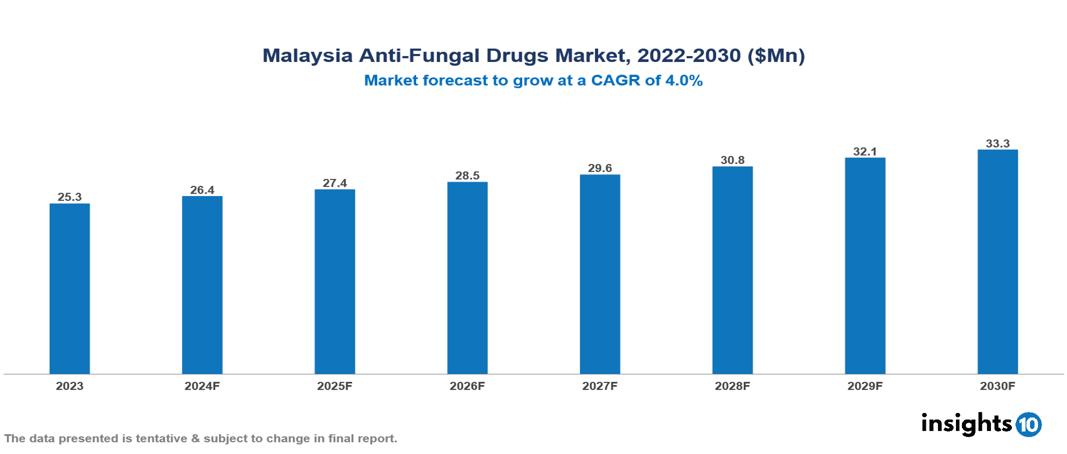
Malaysia Antifungal Drugs Market is at around $0.025 Bn in 2023 and is projected to reach $0.033 Bn in 2030, exhibiting a CAGR of 4% during the forecast period. The market is being driven by rising rates of fungal infections, rising healthcare costs, and improvements in healthcare infrastructure. The market is dominated by key players like Pharmaniaga Bhd., Duipharma Biotech Bhd., Pfizer Inc., Novartis AG, Merck & Co., Inc., Abbott Laboratories, Astellas Pharma Inc., GlaxoSmithKline plc, Bayer AG, Glenmark Pharmaceuticals Limited, Sanofi S.A., and Gilead Sciences Inc.
Buy Now

Malaysia Antifungal Drugs Market Executive Summary
Malaysia Antifungal Drugs Market is at around $0.025 Bn in 2023 and is projected to reach $0.033 Bn in 2030, exhibiting a CAGR of 4% during the forecast period.
Malaysia's Antifungal Drugs Market caters to drugs intended to cure fungal infections in the nation. This market covers a variety of antifungal pharmaceuticals for treating different fungal infections that are common in Malaysia, such as topical creams, oral medications, and intravenous treatments. Growing rates of fungal infections, rising healthcare costs, and developments in drug discovery are some of the factors driving this market's growth and dynamics within Malaysia's healthcare system.
The market for antifungal medications in Malaysia is expanding steadily, propelled by growing healthcare costs and increased awareness of fungal illnesses. To increase their market share, major firms are concentrating on developing innovative products and forming strategic alliances. However, short-term market expansion may be hampered by pricing pressures and regulatory obstacles.
Sales of antifungal drugs reached $15.8 Bn globally in 2023. Antifungal drugs have improved significantly in terms of dependability and effectiveness. The antifungal medicine industry has also seen significant investment, which has been crucial to the industry's consistent growth pattern. The pharmaceutical antifungal market has a lot of potential because of its increased productivity, profitability, and industrial innovation.
Pharmaniaga Bhd. commands a market share of more than 20%, making it a major player in the Malaysian Antifungal industry. A variety of Antifungal products, including tablets, capsules, creams, and ointments, are available from Pharmaniaga Bhd. Popular Antifungal brands from the company include Micatin, Lotrimin, and Canesten. Patients in Malaysia can easily access Pharmaniaga Bhd.'s Antifungal medications because of the company's well-established distribution network.
Market Dynamics
Market Growth Drivers:
Growing Frequency of Fungal Infections: As the number of people with weakened conditions from HIV/AIDS, cancer, and diabetes rises, so does their vulnerability to fungal infections, which is fueling the market for Antifungal medications.
Growing Healthcare Expenditure: As Malaysia's economy expands, so does the amount spent on healthcare, making Antifungal medications and other medical facilities more easily accessible.
Developments in Healthcare Infrastructure: Better diagnosis and treatment of fungal infections are made possible by the expansion of hospitals, clinics, and pharmacies, which in turn increases demand for Antifungal medications.
Market Restraints:
Antimicrobial Resistance: Treating fungal infections is significantly hampered by the advent of resistant fungal strains. Antifungal resistance has the potential to reduce the efficacy of already prescribed medications and force the expensive and time-consuming creation of alternative treatment options.
Regulatory Obstacles: Strict legal regulations for Antifungal medication approval and marketing can lengthen the time to market and raise the total cost of introducing new medications to the market. The availability of some medications may be impacted by regulatory barriers, which would reduce patients' options for treatment.
Preference for Alternative Therapies or Traditional Remedies: In certain situations, traditional therapies or remedies may be preferred culturally over antifungal medications. This preference may affect market expansion and the uptake of medicinal therapies.
Healthcare Policies and Regulatory Landscape
According to the Control of Medicines and Cosmetics Regulations of 1984, the Drug Control Authority (DCA) is the executive agency in charge of managing the registration procedure for innovative medicines and biologics in Malaysia. It is necessary to apply online through the QUEST3 system. With QUEST online membership registration, users can securely complete online tasks for product registration applications. DCA requires high-quality data and strict protocol adherence to comply with international requirements for Good Clinical Practice and Good Manufacturing Practice, such as those set forth by the International Council on Harmonization (ICH). This can add complexity and potentially extend timelines. Comprehensive assessments of the safety and effectiveness of medications across diverse populations are necessary in Malaysia, given the country's vast ethnic diversity. More clinical studies or data analysis may be necessary for this, which would increase costs and complicate matters.
Competitive Landscape
Key Players:
- Pharmaniaga Bhd.
- Duopharma Biotech Bhd.
- Pfizer Inc.
- Novartis AG
- Merck & Co., Inc.
- Abbott Laboratories
- Astellas Pharma Inc.
- GlaxoSmithKline plc
- Bayer AG
- Glenmark Pharmaceuticals Limited
- Sanofi S.A.
- Gilead Sciences Inc.
1. Executive Summary
1.1 Disease Overview
1.2 Global Scenario
1.3 Country Overview
1.4 Healthcare Scenario in Country
1.5 Patient Journey
1.6 Health Insurance Coverage in Country
1.7 Active Pharmaceutical Ingredient (API)
1.8 Recent Developments in the Country
2. Market Size and Forecasting
2.1 Epidemiology of Disease
2.2 Market Size (With Excel & Methodology)
2.3 Market Segmentation (Check all Segments in Segmentation Section)
3. Market Dynamics
3.1 Market Drivers
3.2 Market Restraints
4. Competitive Landscape
4.1 Major Market Share
4.2 Key Company Profile (Check all Companies in the Summary Section)
4.2.1 Company
4.2.1.1 Overview
4.2.1.2 Product Applications and Services
4.2.1.3 Recent Developments
4.2.1.4 Partnerships Ecosystem
4.2.1.5 Financials (Based on Availability)
5. Reimbursement Scenario
5.1 Reimbursement Regulation
5.2 Reimbursement Process for Diagnosis
5.3 Reimbursement Process for Treatment
6. Methodology and Scope
Malaysia Antifungal Drugs Market Segmentation
By Drug Class
- Azoles
- Echinocandins
- Polyenes
- Allylamines
- Others
By Drug Indication
- Dermatophytosis
- Aspergillosis
- Candidiasis
- Others
By Drug Dosage
- Oral drugs
- Ointments
- Powders
- Others
By Infection
- Systemic Antifungal Infections
- Superficial Antifungal Infections
By Drug Distribution
- Hospital Pharmacies
- Retail Pharmacies
- Others
Methodology for Database Creation
Our database offers a comprehensive list of healthcare centers, meticulously curated to provide detailed information on a wide range of specialties and services. It includes top-tier hospitals, clinics, and diagnostic facilities across 30 countries and 24 specialties, ensuring users can find the healthcare services they need.
Additionally, we provide a comprehensive list of Key Opinion Leaders (KOLs) based on your requirements. Our curated list captures various crucial aspects of the KOLs, offering more than just general information. Whether you're looking to boost brand awareness, drive engagement, or launch a new product, our extensive list of KOLs ensures you have the right experts by your side. Covering 30 countries and 36 specialties, our database guarantees access to the best KOLs in the healthcare industry, supporting strategic decisions and enhancing your initiatives.
How Do We Get It?
Our database is created and maintained through a combination of secondary and primary research methodologies.
1. Secondary Research
With many years of experience in the healthcare field, we have our own rich proprietary data from various past projects. This historical data serves as the foundation for our database. Our continuous process of gathering data involves:
- Analyzing historical proprietary data collected from multiple projects.
- Regularly updating our existing data sets with new findings and trends.
- Ensuring data consistency and accuracy through rigorous validation processes.
With extensive experience in the field, we have developed a proprietary GenAI-based technology that is uniquely tailored to our organization. This advanced technology enables us to scan a wide array of relevant information sources across the internet. Our data-gathering process includes:
- Searching through academic conferences, published research, citations, and social media platforms
- Collecting and compiling diverse data to build a comprehensive and detailed database
- Continuously updating our database with new information to ensure its relevance and accuracy
2. Primary Research
To complement and validate our secondary data, we engage in primary research through local tie-ups and partnerships. This process involves:
- Collaborating with local healthcare providers, hospitals, and clinics to gather real-time data.
- Conducting surveys, interviews, and field studies to collect fresh data directly from the source.
- Continuously refreshing our database to ensure that the information remains current and reliable.
- Validating secondary data through cross-referencing with primary data to ensure accuracy and relevance.
Combining Secondary and Primary Research
By integrating both secondary and primary research methodologies, we ensure that our database is comprehensive, accurate, and up-to-date. The combined process involves:
- Merging historical data from secondary research with real-time data from primary research.
- Conducting thorough data validation and cleansing to remove inconsistencies and errors.
- Organizing data into a structured format that is easily accessible and usable for various applications.
- Continuously monitoring and updating the database to reflect the latest developments and trends in the healthcare field.
Through this meticulous process, we create a final database tailored to each region and domain within the healthcare industry. This approach ensures that our clients receive reliable and relevant data, empowering them to make informed decisions and drive innovation in their respective fields.
To request a free sample copy of this report, please complete the form below.
We value your inquiry and offer free customization with every report to fulfil your exact research needs.

Related reports (by category)
Pharmaceuticals
UK Home Infusion Therapy Market
Pharmaceuticals
France Gram Positive Bacterial Infections Market Analysis
Pharmaceuticals
Japan Immune Checkpoint Inhibitors Market Analysis
Related reports (by geography)
Pharmaceuticals
Malaysia Glutathione Market Analysis
OTC & Nutraceuticals
Malaysia Over The Counter (OTC) Pharmaceuticals Market Analysis
Pharmaceuticals
Malaysia T-Cell Lymphoma Market Analysis
Pharmaceuticals