Pharmaceuticals
Kuwait Breast Cancer Therapeutics Market Analysis
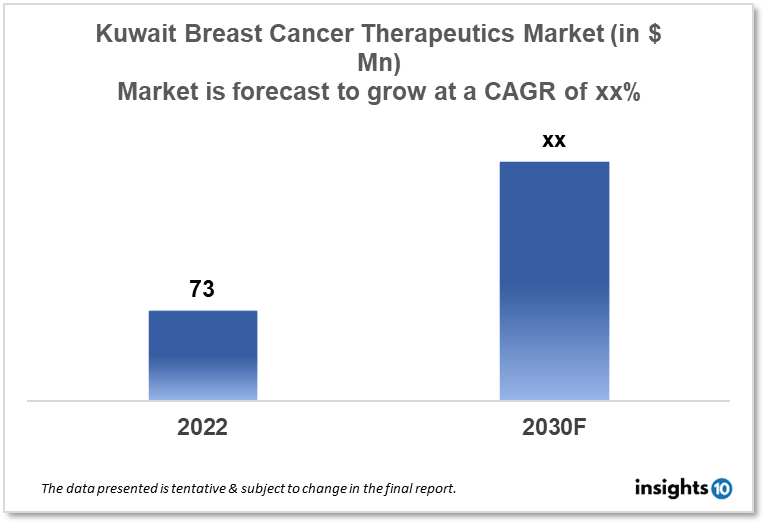
Rising breast cancer incidences and implementation of rapid acceptance of new therapies for the treatment of breast cancer are leading to the increase in market size of Kuwait breast cancer therapeutics from $73 Mn in 2022 to $xx Mn in 2030 with a CAGR of xx% for the forecasted year 2022-2030. The market is segmented by therapy, by cancer type, and by distribution channel. Bader Sultan & Brothers, GSK, and Bristol-Myers Squibb are some major market players in Kuwait's breast cancer therapeutics market.
Buy Now

Kuwait Breast Cancer Therapeutics Market Executive Analysis
The Kuwait breast cancer therapeutics market size is at around $73 Mn in 2022 and is projected to reach $xx Mn in 2030, exhibiting a CAGR of xx% during the forecast period. One of the Gulf Cooperation Council’s (GCC) highest healthcare-spending countries in Kuwait. A sizable governmental sector and a modest but quickly expanding private sector define the healthcare industry. Kuwait's healthcare system is under tremendous pressure from the nation's growing population, fast-paced lifestyle, and mounting health concerns. Kuwait is a welfare state, and the public sector offers healthcare at incredibly reduced costs. Budgeted for the period 2021–2022, Kuwait's healthcare costs totaled a staggering $8.9 Bn. The Kuwaiti Ministry of Health spent more than $950 Mn Kuwaiti dinars on medicine in 2021, which was the largest healthcare expenditure. In that year, Kuwait's public sector spent about half a Bn dollars on healthcare overall.
According to estimates, 222 people were predicted to have died from breast cancer in Kuwait in 2018. When age-standardized, the breast cancer death rate among Kuwaiti women aged 40–85+ years ranges from 94.4 to 233.3 per 100 000. With a mortality rate of 267 per 100 000, women aged 70 to 75 have the greatest mortality rate. Breast cancer is a complex condition that is affected differently by genetic and environmental risk factors. After menopause, the risk of developing breast cancer doubles, but early detection and advancing treatment options have increased survival rates. Hormones played a role in the majority of breast cancer incidences. One of the risk factors for younger Kuwaiti women is hormonal medication, such as oral contraceptives.
Market Dynamics
Market Growth Drivers
The primary market drivers of Kuwait's breast cancer therapeutics market include rising breast cancer incidences in Kuwait, rapid acceptance of new screening programs, and expansion of pharmaceutical drug development. Additionally, the excellent health infrastructure of Kuwait that promotes healthcare developments is also responsible for boosting the breast cancer therapeutics market in Kuwait.
Market Restraints
The forecasted period is likely to see a slower expansion of the Kuwait breast cancer therapeutics market due to the high cost of surgeries and medications and the harmful consequences of radiation exposure.
Competitive Landscape
Key Players
- Al Mojil Drug (KWT)
- Al- Hajery (KWT)
- Bader Sultan & Brothers (KWT)
- GSK (KWT)
- Bristol-Myers Squibb
- Eli Lilly
- Halozyme
- Merck
Healthcare Policies and Regulatory Landscape
The Ministry of Health in Kuwait administers the national health insurance program, which provides coverage for breast cancer. This implies that those who have breast cancer are eligible for free care and treatment. Furthermore, Kuwait is home to various cancer treatment facilities that offer complete care for patients with breast cancer, including surgery, radiation therapy, and chemotherapy. The government also offers financial support to anyone who needs to leave the nation for medical treatment.
1. Executive Summary
1.1 Disease Overview
1.2 Global Scenario
1.3 Country Overview
1.4 Healthcare Scenario in Country
1.5 Patient Journey
1.6 Health Insurance Coverage in Country
1.7 Active Pharmaceutical Ingredient (API)
1.8 Recent Developments in the Country
2. Market Size and Forecasting
2.1 Epidemiology of Disease
2.2 Market Size (With Excel & Methodology)
2.3 Market Segmentation (Check all Segments in Segmentation Section)
3. Market Dynamics
3.1 Market Drivers
3.2 Market Restraints
4. Competitive Landscape
4.1 Major Market Share
4.2 Key Company Profile (Check all Companies in the Summary Section)
4.2.1 Company
4.2.1.1 Overview
4.2.1.2 Product Applications and Services
4.2.1.3 Recent Developments
4.2.1.4 Partnerships Ecosystem
4.2.1.5 Financials (Based on Availability)
5. Reimbursement Scenario
5.1 Reimbursement Regulation
5.2 Reimbursement Process for Diagnosis
5.3 Reimbursement Process for Treatment
6. Methodology and Scope
Breast Cancer Therapeutics Segmentation
By Therapy (Revenue, USD Billion):
- Radiation Therapy
- Targeted Therapy
- Ribociclib
- Abemaciclib
- Afinitor
- Everolimus
- Trastuzumab
- Olaparib
- Ado-Trastuzumab Emtansine
- Palbociclib
- Pertuzumab
- Herceptin
- Tykerb (Lapatinib)
- Others
- Targeted Therapy
- Hormonal Therapy
- Selective Estrogen Receptor Modulators (SERMs)
- Aromatase Inhibitors
- Estrogen Receptor Downregulators (ERDs)
- Chemotherapy
- Taxanes
- Anthracyclines
- Anti-metabolites
- Alkylating Agents
- Immunotherapy
By Cancer Type (Revenue, USD Billion):
- Hormone Receptor
- HER+
By Distribution Channel (Revenue, USD Billion):
- Hospital Pharmacies
- Retail Pharmacies
- Online Pharmacies
- Others
Methodology for Database Creation
Our database offers a comprehensive list of healthcare centers, meticulously curated to provide detailed information on a wide range of specialties and services. It includes top-tier hospitals, clinics, and diagnostic facilities across 30 countries and 24 specialties, ensuring users can find the healthcare services they need.
Additionally, we provide a comprehensive list of Key Opinion Leaders (KOLs) based on your requirements. Our curated list captures various crucial aspects of the KOLs, offering more than just general information. Whether you're looking to boost brand awareness, drive engagement, or launch a new product, our extensive list of KOLs ensures you have the right experts by your side. Covering 30 countries and 36 specialties, our database guarantees access to the best KOLs in the healthcare industry, supporting strategic decisions and enhancing your initiatives.
How Do We Get It?
Our database is created and maintained through a combination of secondary and primary research methodologies.
1. Secondary Research
With many years of experience in the healthcare field, we have our own rich proprietary data from various past projects. This historical data serves as the foundation for our database. Our continuous process of gathering data involves:
- Analyzing historical proprietary data collected from multiple projects.
- Regularly updating our existing data sets with new findings and trends.
- Ensuring data consistency and accuracy through rigorous validation processes.
With extensive experience in the field, we have developed a proprietary GenAI-based technology that is uniquely tailored to our organization. This advanced technology enables us to scan a wide array of relevant information sources across the internet. Our data-gathering process includes:
- Searching through academic conferences, published research, citations, and social media platforms
- Collecting and compiling diverse data to build a comprehensive and detailed database
- Continuously updating our database with new information to ensure its relevance and accuracy
2. Primary Research
To complement and validate our secondary data, we engage in primary research through local tie-ups and partnerships. This process involves:
- Collaborating with local healthcare providers, hospitals, and clinics to gather real-time data.
- Conducting surveys, interviews, and field studies to collect fresh data directly from the source.
- Continuously refreshing our database to ensure that the information remains current and reliable.
- Validating secondary data through cross-referencing with primary data to ensure accuracy and relevance.
Combining Secondary and Primary Research
By integrating both secondary and primary research methodologies, we ensure that our database is comprehensive, accurate, and up-to-date. The combined process involves:
- Merging historical data from secondary research with real-time data from primary research.
- Conducting thorough data validation and cleansing to remove inconsistencies and errors.
- Organizing data into a structured format that is easily accessible and usable for various applications.
- Continuously monitoring and updating the database to reflect the latest developments and trends in the healthcare field.
Through this meticulous process, we create a final database tailored to each region and domain within the healthcare industry. This approach ensures that our clients receive reliable and relevant data, empowering them to make informed decisions and drive innovation in their respective fields.
To request a free sample copy of this report, please complete the form below.
We value your inquiry and offer free customization with every report to fulfil your exact research needs.

Related reports (by category)
Pharmaceuticals
Mexico Metabolic Disorder Drugs Market Analysis
Pharmaceuticals
Belgium Diabetes Drugs Market Analysis
Pharmaceuticals
North America HIV Therapeutics Market Analysis
Related reports (by geography)
Medical Devices
Kuwait Cardiac Surgery Instruments Market Analysis
Medical Devices
Kuwait ENT Devices Market Analysis
Healthcare Services
Kuwait Bioinformatics Market Analysis
Healthcare Services