Pharmaceuticals
Japan HIV Drugs Market Analysis
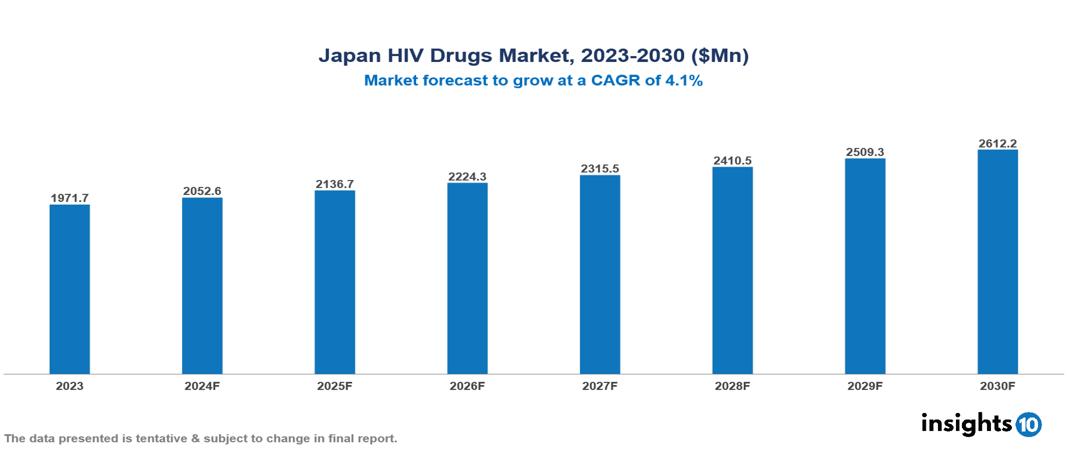
Japan HIV Drugs Market is at around $1.97 Bn in 2023 and is projected to reach $2.61 Bn in 2030, exhibiting a CAGR of 4.1% during the forecast period. The market is growing as a result of government initiatives, rising HIV prevalence, and the expansion of healthcare infrastructure. The market is dominated by key players like Takeda Pharmaceutical Company, Eisai Co., Ltd., Daiichi Sankyo Company, Limited, Gilead Sciences, ViiV Healthcare, Boehringer Ingelheim International GmbH, Janssen Pharmaceuticals, Merck & Co., Bristol-Myers Squibb, AbbVie Inc., and F. Hoffmann-La Roche Ltd.
Buy Now

Japan HIV Drugs Market Executive Summary
Japan HIV Drugs Market is at around $1.97 Bn in 2023 and is projected to reach $2.61 Bn in 2030, exhibiting a CAGR of 4.1% during the forecast period.
A variety of antiretroviral drugs, including combination therapy, are available on the Japanese market for HIV drugs intending to control HIV infection and enhance patient's quality of life. Japan's market is distinguished by continuous research, development, and access programs to serve the changing requirements of people living with HIV/ AIDS in the nation. This is due to Japan's dedication to healthcare innovation and its aging population.
The market for HIV medications in Japan is expanding steadily as a result of government initiatives, growing awareness, and improvements in treatment options. Major firms are putting money into R&D to bring new treatments to the market, which is helping it grow. Furthermore, partnerships between pharmaceutical companies and healthcare professionals are improving the accessibility and affordability of drugs for HIV in Japan.
The market for HIV drugs has expanded significantly; in 2023, it was estimated to be worth $31.7 Bn. The primary driver for this growth is an increase in HIV diagnoses. However, the market is changing as generic alternatives become readily available and competition increases. Moving forward will involve addressing the financial barriers to treatment, reducing the stigma around HIV, and offering support services to make therapy more accessible in underdeveloped countries.
Takeda is presently creating novel HIV medications and vaccines as part of its significant commitment to HIV research and development. The business is also a part of the Japan Initiative for Combating AIDS (JICA), a public-private alliance that seeks to increase Japan's access to HIV prevention and treatment. With a 22% market share, Takeda ranked as the second-largest supplier of HIV medications in Japan in 2020. The company's HIV medications produced $203 Mn in sales in Japan in 2020.
Market Dynamics
Market Growth Drivers:
Rising HIV Incidence: The need for HIV drugs is fuelled by the fact that new cases of HIV continue to surface despite efforts to stop the virus's transmission.
Improved Access to Healthcare: Early diagnosis and treatment initiation results from improved access to healthcare services, which raises the demand for HIV medications. This includes HIV screening and treatment.
Government Initiatives: Government-led programs, preventative campaigns, and subsidized treatment that aim to combat HIV/ AIDS lead to a higher uptake of drugs for HIV.
Market Restraints:
Regulatory Obstacles: Japan's strict regulations and licensing procedures may cause delays in the release of new HIV medications onto the market.
Expensive Treatment: HIV therapy frequently requires a mix of medications, which can be costly. Some patients may find their accessibility limited by the high expense of treatment, especially if they lack sufficient insurance coverage.
Low Awareness and Stigma: In Japan, stigma related to HIV/ AIDS persists despite efforts to increase awareness. This stigma might discourage people from getting tested and treated, which would slow the expansion of the industry.
Healthcare Policies and Regulatory Landscape
Cooperating with the Ministry of Health, Labour, and Welfare is the regulatory agency recognized as the Pharmaceuticals and Medical Devices Agency (PMDA) of Japan. The PMDA must receive the NDA dossier and the required funds. Upon examining the NDA dossier, the PMDA could request more information. If the PMDA approves the medicine with the NDA dossier, it will be authorized for sale in Japan. Japan's drug approval procedure is extremely stringent and comprehensive. An extensive assessment of the submitted New Drug Application (NDA) is required. This process ensures that only drugs meeting the highest quality standards may be sold, which increases the complexity of drug regulation in Japan.
Competitive Landscape
Key Players:
- Takeda Pharmaceutical Company
- Eisai Co., Ltd.
- Daiichi Sankyo Company, Limited
- Gilead Sciences
- ViiV Healthcare
- Boehringer Ingelheim International GmbH
- Janssen Pharmaceuticals
- Merck & Co.
- Bristol-Myers Squibb
- AbbVie Inc.
- F. Hoffmann-La Roche Ltd
1. Executive Summary
1.1 Disease Overview
1.2 Global Scenario
1.3 Country Overview
1.4 Healthcare Scenario in Country
1.5 Patient Journey
1.6 Health Insurance Coverage in Country
1.7 Active Pharmaceutical Ingredient (API)
1.8 Recent Developments in the Country
2. Market Size and Forecasting
2.1 Epidemiology of Disease
2.2 Market Size (With Excel & Methodology)
2.3 Market Segmentation (Check all Segments in Segmentation Section)
3. Market Dynamics
3.1 Market Drivers
3.2 Market Restraints
4. Competitive Landscape
4.1 Major Market Share
4.2 Key Company Profile (Check all Companies in the Summary Section)
4.2.1 Company
4.2.1.1 Overview
4.2.1.2 Product Applications and Services
4.2.1.3 Recent Developments
4.2.1.4 Partnerships Ecosystem
4.2.1.5 Financials (Based on Availability)
5. Reimbursement Scenario
5.1 Reimbursement Regulation
5.2 Reimbursement Process for Diagnosis
5.3 Reimbursement Process for Treatment
6. Methodology and Scope
HIV Drugs Market Segmentation
By Drug Class
- Integrase Inhibitors
- Non- Nucleoside Reverse Transcriptase Inhibitors (NRTIs)
- Combination HIV Medicines
- Others
By Distribution Channel
- Hospital Pharmacies
- Retail Pharmacies
- Online Pharmacies
- Others
Methodology for Database Creation
Our database offers a comprehensive list of healthcare centers, meticulously curated to provide detailed information on a wide range of specialties and services. It includes top-tier hospitals, clinics, and diagnostic facilities across 30 countries and 24 specialties, ensuring users can find the healthcare services they need.
Additionally, we provide a comprehensive list of Key Opinion Leaders (KOLs) based on your requirements. Our curated list captures various crucial aspects of the KOLs, offering more than just general information. Whether you're looking to boost brand awareness, drive engagement, or launch a new product, our extensive list of KOLs ensures you have the right experts by your side. Covering 30 countries and 36 specialties, our database guarantees access to the best KOLs in the healthcare industry, supporting strategic decisions and enhancing your initiatives.
How Do We Get It?
Our database is created and maintained through a combination of secondary and primary research methodologies.
1. Secondary Research
With many years of experience in the healthcare field, we have our own rich proprietary data from various past projects. This historical data serves as the foundation for our database. Our continuous process of gathering data involves:
- Analyzing historical proprietary data collected from multiple projects.
- Regularly updating our existing data sets with new findings and trends.
- Ensuring data consistency and accuracy through rigorous validation processes.
With extensive experience in the field, we have developed a proprietary GenAI-based technology that is uniquely tailored to our organization. This advanced technology enables us to scan a wide array of relevant information sources across the internet. Our data-gathering process includes:
- Searching through academic conferences, published research, citations, and social media platforms
- Collecting and compiling diverse data to build a comprehensive and detailed database
- Continuously updating our database with new information to ensure its relevance and accuracy
2. Primary Research
To complement and validate our secondary data, we engage in primary research through local tie-ups and partnerships. This process involves:
- Collaborating with local healthcare providers, hospitals, and clinics to gather real-time data.
- Conducting surveys, interviews, and field studies to collect fresh data directly from the source.
- Continuously refreshing our database to ensure that the information remains current and reliable.
- Validating secondary data through cross-referencing with primary data to ensure accuracy and relevance.
Combining Secondary and Primary Research
By integrating both secondary and primary research methodologies, we ensure that our database is comprehensive, accurate, and up-to-date. The combined process involves:
- Merging historical data from secondary research with real-time data from primary research.
- Conducting thorough data validation and cleansing to remove inconsistencies and errors.
- Organizing data into a structured format that is easily accessible and usable for various applications.
- Continuously monitoring and updating the database to reflect the latest developments and trends in the healthcare field.
Through this meticulous process, we create a final database tailored to each region and domain within the healthcare industry. This approach ensures that our clients receive reliable and relevant data, empowering them to make informed decisions and drive innovation in their respective fields.
To request a free sample copy of this report, please complete the form below.
We value your inquiry and offer free customization with every report to fulfil your exact research needs.

Related reports (by category)
Pharmaceuticals
Malaysia Opioid Pain Management Market Analysis
Pharmaceuticals
Switzerland Sleep Disorders Market Analysis
Pharmaceuticals
Argentina Infectious Disease Drugs Market Analysis
Related reports (by geography)
Pharmaceuticals
Japan Type 2 Diabetes Mellitus Drugs Market Analysis
Pharmaceuticals
Japan Coenzyme Q10 Market Analysis
Medical Devices
Japan Pharmacy Automation Device Market Analysis
Pharmaceuticals