Medical Devices
Japan Biosensors Market Analysis
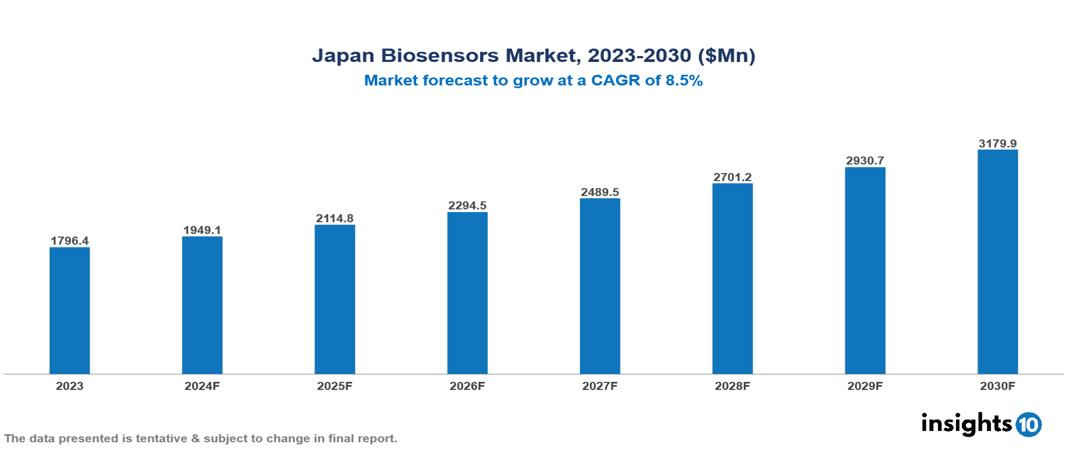
The Japan Biosensors Market was valued at $1796.4 Mn in 2023 and is predicted to grow at a CAGR of 8.5% from 2023 to 2030, to $3179.9 Mn by 2030. The key drivers of the market include increasing burden of chronic diseases, increasing demand for accurate disease diagnosis, and growing demand for Point-of-Care (POC) testing. The prominent players of the Japan Biosensors Market are Nipro, Terumo Corporation, Abbott Laboratories, Medtronic, Bio-Rad International, Siemens Healthcare, and F. Hoffmann- La Roche, among others.
Buy Now

Japan Biosensors Market Executive Summary
The Japan Biosensors market is at around $1796.4 Mn in 2023 and is projected to reach $3179.9 Mn in 2030, exhibiting a CAGR of 8.5% during the forecast period.
Biosensors, short for biological sensors, are analytical devices which combine a biological component with physicochemical detector in order to detect the presence of analytes in sample. There are certain static and dynamic attributes that every biosensor possesses. The optimisation of these properties is reflected on the performance of the biosensor. One of the most important features of a biosensor is selectivity. Selectivity is the ability of a bioreceptor to detect a specific analyte in a sample containing other admixtures and contaminants. Next crucial feature is the stability of biosensors which refers to how susceptible the biosensor is to internal and external disturbances. Due to disturbances, output signals can vary which may result in measurement errors in the concentration and can affect the biosensor’s accuracy and precision. Sensitivity is the minimum amount of analyte that can be detected by a biosensor which also defines its limit of detection (LOD). In a number of medical and environmental monitoring applications, a biosensor is required to detect analyte concentration of as low as ng/ml or even fg/ml to confirm the presence of traces of analytes in a sample. Linearity is the next attribute which represents the accuracy of the measured response with varying concentrations of analyte. Usually, a straight line in the form of equation y=mc (where c is the concentration of the analyte, y is the output signal, and m is the sensitivity of the biosensor) is used. Lastly, resolution is closely associated with linearity which is the smallest change in the concentration of an analyte which results in a change in the response of the biosensor.
The disease burden in Japan is particularly high for cardiovascular disease, cancer, mental illness, diabetes, and gastrointestinal disease. The Japan Biosensors Market is thus driven by significant factors such as the increasing burden of chronic diseases, increasing demand for accurate disease diagnosis, and growing demand for Point-of-Care (POC) testing. However, high costs and limited reimbursement, technical challenges, and data privacy and security issues restrict the growth and potential of the market.
The major players of the Japan Biosensors Market are Nipro, Terumo Corporation, Abbott Laboratories, Medtronic, Bio-Rad International, Siemens Healthcare, and F. Hoffmann- La Roche, among others.
Market Dynamics
Market Growth Drivers
Increasing Burden of Chronic Diseases: About 82% of the total number of deaths are due to Non-Communicable Diseases (NCDs), which highlights this burden. The increasing prevalence of chronic diseases, such as cardiac disorders, obesity, and hypertension requires continuous health management for effective prognosis. Biosensors are extremely valuable medical devices which help in the monitoring of health parameters remotely without having to visit the hospitals. This increase patient compliance drastically and increases the demand of biosensors which results in the growth of the Biosensors Market.
Increasing Demand for Accurate Disease Diagnosis: Effective treatment and positive patient outcomes rely on early and accurate disease detection. Biosensors allow for the rapid, precise, and convenient detection of various diseases, including diabetes, cancer, and infectious diseases, often before symptoms arise. Early diagnosis is crucial for many diseases, enhancing the chances of successful treatment and improving patient quality of life. This increasing demand for precise disease diagnostics is driving the expansion of the biosensors market, offering faster, more convenient, and potentially cost-effective diagnostic solutions that lead to better patient care.
Growing Demand for Point-Of-Care (POC) Testing: The demand for Point-Of-Care (POC) testing is a key driver of growth in the biosensors market. Biosensors are perfectly suited for POC testing due to their numerous benefits over traditional lab-based techniques, such as portability, ease of use, and quick results. Additionally, POC testing with biosensors makes healthcare more accessible, especially in remote areas or for patients with limited mobility. The COVID-19 pandemic demonstrated the crucial role of POC testing, where biosensors were instrumental in managing the crisis. As a result, the increasing demand for POC testing is driving the growth of the biosensors market.
Market Restraints
High Costs and Limited Reimbursement: The production of biosensors is often expensive, which can hinder innovation and lead to high initial costs to cover production expenses. If biosensors are not more cost-effective than traditional methods, healthcare providers may be hesitant to invest in and recommend them. Additionally, insurance companies may not fully reimburse these costs, limiting patient access to biosensor technologies. Therefore, the high costs and limited affordability of biosensors can stifle market growth.
Technical Challenges: Although much progress has been made in the field of biosensors, there are still certain technical hurdles which need to be addressed such as biofouling and biocompatibility. Biofouling refers to the accumulation of unwanted material such as proteins, cells, and bacteria. Biofouling leads to reduced sensitivity, signal drift, calibration issues, and sensor damage all of which affects the overall biosensor performance. Issues in biocompatibility are encountered which is crucial for biosensors used in medical applications to avoid adverse reactions with biological tissues. Thus, these challenges can lead to prevention of the growth of the Biosensors Market.
Data Privacy and Security Concerns: Containing sensitive personal information like patients' genetic data and health metrics, biosensor data must be protected against misuse, unauthorized access, and breaches. Greater interconnectivity of biosensors makes them more susceptible to cyberattacks, including data manipulation, sensor disruptions, and theft of sensitive information. Data encryption is necessary to prevent unauthorized access, requiring the implementation of robust and costly authentication and access control measures. These security challenges impact the overall biosensors market.
Regulatory Landscape and Reimbursement Scenario
The PMDA (Pharmaceuticals and Medical Devices Agency) is Japanese regulatory agency, working together with Ministry of Health, Labour and Welfare (MHLW). Their core purpose is to ensure the safety, quality, and efficacy of the pharmaceuticals and medical devices in the Japan.
The PMDA conducts thorough review and evaluation of the new drugs based on safety, quality, and efficacy seeking marketing authorization in Japan. This minimizes the risk of patients experiencing adverse effects from medications or faulty medical devices. The PMDA’s responsibility extends beyond granting market authorization and includes post-marketing surveillance for reporting any adverse drug reactions. As a founding country, Japan is an important member in the development and application of ICH (International Council for Harmonisation of Technical Requirements for Pharmaceuticals for Human Use) guidelines. The PMDA regularly participates in ICH meetings and contributes to establishing harmonized standards for the pharmaceutical industry. Japanese pharmaceutical companies can expedite the registration of their products in Japan and other ICH member nations by following ICH rules. This makes it easier for innovative drugs to be marketed internationally more quickly.
The reimbursement system in Japan plays a crucial role in balancing access to care with affordability. The majority of Japanese citizens are covered by the National Health Insurance (NHI), a government-mandated insurance scheme. For inpatient and outpatient services at approved medical facilities, NHI reimburses a significant percentage of medical expenses. However, deductibles and copayments may be necessary based on the service, the patient’s age, and income. Government subsidies are provided for certain services, such long-term care and some chronic conditions, the government offers extra funding. In comparison to NHI, voluntary private insurance policies may provide more coverage and better reimbursement rates. These plans can pay for expenses that NHI does not cover, such as sophisticated procedures and diagnostics, shorter waiting times for some medical procedures, and individual hospital rooms.
Competitive Landscape
Key Players
Here are some of the major key players in the Japan Biosensors Market:
- Nipro
- Terumo Corporation
- Medtronic
- Abbott Laboratories
- Johnson & Johnson
- Siemens Healthcare
- F. Hoffman- La Roche
- Bio-Rad International
- Meridian Bioscience
- B Dot Medical
1. Executive Summary
1.1 Device Overview
1.2 Global Scenario
1.3 Country Overview
1.4 Healthcare Scenario in Country
1.5 Regulatory Landscape for Medical Device
1.6 Health Insurance Coverage in Country
1.7 Type of Medical Device
1.8 Recent Developments in the Country
2. Market Size and Forecasting
2.1 Market Size (With Excel and Methodology)
2.2 Market Segmentation (Check all Segments in Segmentation Section)
3. Market Dynamics
3.1 Market Drivers
3.2 Market Restraints
4. Competitive Landscape
4.1 Major Market Share
4.2 Key Company Profile (Check all Companies in the Summary Section)
4.2.1 Company
4.2.1.1 Overview
4.2.1.2 Product Applications and Services
4.2.1.3 Recent Developments
4.2.1.4 Partnerships Ecosystem
4.2.1.5 Financials (Based on Availability)
5. Reimbursement Scenario
5.1 Reimbursement Regulation
5.2 Reimbursement Process for Diagnosis
5.3 Reimbursement Process for Treatment
6. Methodology and Scope
Japan Biosensors Market Segmentation
By Technology
- Electrochemical Biosensors
- Optical Biosensors
- Piezoelectric Biosensors
- Thermal Biosensors
- Nanomechanical Biosensors
By Product
- Wearable Biosensors
- Non-wearable Biosensors
By Application
- Medical Diagnostics
- Food Safety
- Environmental Monitoring
- Agriculture and Bioreactor Monitoring
- Other
Methodology for Database Creation
Our database offers a comprehensive list of healthcare centers, meticulously curated to provide detailed information on a wide range of specialties and services. It includes top-tier hospitals, clinics, and diagnostic facilities across 30 countries and 24 specialties, ensuring users can find the healthcare services they need.
Additionally, we provide a comprehensive list of Key Opinion Leaders (KOLs) based on your requirements. Our curated list captures various crucial aspects of the KOLs, offering more than just general information. Whether you're looking to boost brand awareness, drive engagement, or launch a new product, our extensive list of KOLs ensures you have the right experts by your side. Covering 30 countries and 36 specialties, our database guarantees access to the best KOLs in the healthcare industry, supporting strategic decisions and enhancing your initiatives.
How Do We Get It?
Our database is created and maintained through a combination of secondary and primary research methodologies.
1. Secondary Research
With many years of experience in the healthcare field, we have our own rich proprietary data from various past projects. This historical data serves as the foundation for our database. Our continuous process of gathering data involves:
- Analyzing historical proprietary data collected from multiple projects.
- Regularly updating our existing data sets with new findings and trends.
- Ensuring data consistency and accuracy through rigorous validation processes.
With extensive experience in the field, we have developed a proprietary GenAI-based technology that is uniquely tailored to our organization. This advanced technology enables us to scan a wide array of relevant information sources across the internet. Our data-gathering process includes:
- Searching through academic conferences, published research, citations, and social media platforms
- Collecting and compiling diverse data to build a comprehensive and detailed database
- Continuously updating our database with new information to ensure its relevance and accuracy
2. Primary Research
To complement and validate our secondary data, we engage in primary research through local tie-ups and partnerships. This process involves:
- Collaborating with local healthcare providers, hospitals, and clinics to gather real-time data.
- Conducting surveys, interviews, and field studies to collect fresh data directly from the source.
- Continuously refreshing our database to ensure that the information remains current and reliable.
- Validating secondary data through cross-referencing with primary data to ensure accuracy and relevance.
Combining Secondary and Primary Research
By integrating both secondary and primary research methodologies, we ensure that our database is comprehensive, accurate, and up-to-date. The combined process involves:
- Merging historical data from secondary research with real-time data from primary research.
- Conducting thorough data validation and cleansing to remove inconsistencies and errors.
- Organizing data into a structured format that is easily accessible and usable for various applications.
- Continuously monitoring and updating the database to reflect the latest developments and trends in the healthcare field.
Through this meticulous process, we create a final database tailored to each region and domain within the healthcare industry. This approach ensures that our clients receive reliable and relevant data, empowering them to make informed decisions and drive innovation in their respective fields.
To request a free sample copy of this report, please complete the form below.
We value your inquiry and offer free customization with every report to fulfil your exact research needs.

Related reports (by category)
Medical Devices
Hong Kong Medical Devices Market Analysis
Medical Devices
New Zealand Biomaterials in Healthcare Market Analysis
Medical Devices
Mexico CT Scan Market Analysis
Related reports (by geography)
Rare Diseases
Japan Acromegaly Therapeutics Market Analysis
Pharmaceuticals
Japan Topical Pain Relief Market Analysis
Pharmaceuticals