Pharmaceuticals
Japan Anti Aging Therapeutics Market Analysis
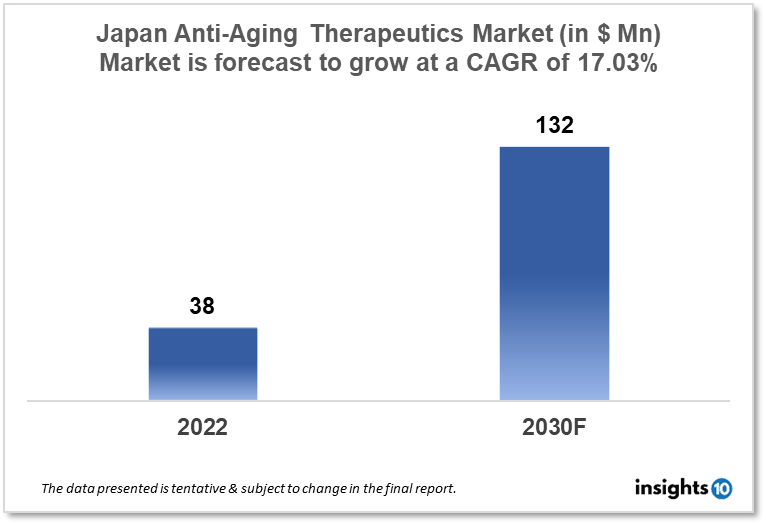
Japan anti-aging therapeutics market is projected to grow from $38 Mn in 2022 to $132 Mn in 2030 with a CAGR of 17.03% for the year 2022-2030. Japan has the fastest-growing geriatric population which results in increased demand for anti-aging treatments. Further, in Japan, there is the presence of highly advanced technology which results in the expansion of the market. The Japan anti-aging therapeutics market is segmented by product, treatment, target group, type of aging, type of molecules, mechanism of action, ingredient, and by distribution channel. Modulus Discovery, Noile-Immune Biotech, and NeuroTrack are some of the top players in the market.
Buy Now

Japan Anti-Aging Therapeutics Market Executive Summary
The Japan anti-aging therapeutics market size is at around $38 Mn in 2022 and is projected to reach $132 Mn in 2030, exhibiting a CAGR of 17.03% during the forecast period. For the upcoming fiscal year, Japan passed a record-breaking draft budget of $865 Bn. The present welfare system in Japan sees a significant reduction in out-of-pocket medical expenses once residents reach the age of 75. In exchange, the government pays a larger share of the cost of healthcare for people in this age category. According to Japan's federation of health insurers, government spending on healthcare for those 75 and elderly is anticipated to reach $229.45 Bn in fiscal 2025, an increase of two-thirds from fiscal 2015. It is anticipated that healthcare expenditure will total $420 Bn, up from $310 Bn in fiscal 2015.
Encouraged by the promise of regenerative medicine based on induced pluripotent stem (iPS) cells, which were discovered by Shinya Yamanaka, the winner of the Nobel Prize, anti-aging medicine has developed into a broad, interdisciplinary discipline that is being advanced by researchers in nations like Japan and the United States. In Japan, rapamycin and its derivatives have undergone and are still undergoing extensive clinical testing for a variety of chronic disease indications. The medicines have also already received approval for use in certain types of cancer, including renal carcinomas. The findings establish proof in principle that it is possible to slow aging and, when accomplished, delay the onset or progression of at least a subset of age-related chronic diseases. Whether rapalogs prove effective to slow aging in humans is yet to be determined. Numerous anti-aging drugs are being developed in Japan that target the mimicking of calorie restriction, autophagy induction, and potential enhancement of cell regeneration. Other drugs target the epigenetic regulation of gene activity, such as the inhibition of histone deacetylases and DNA methyltransferases.
Market Dynamics
Market Growth Drivers Analysis
With a sizable %age of the population over 65, Japan has one of the fastest-aging populations in the world. Due to the desire to preserve health and quality of life as people age, this demographic tendency has increased the demand for anti-aging therapeutics. Some of the most cutting-edge and novel medical technologies, including those pertaining to anti-aging therapeutics, can be found in Japan. These developments have sparked an influx of fresh, more efficient remedies. In Japan, preserving one's health and vigor as one age is highly valued culturally. As a result, people are now more conscious of and accepting of anti-aging therapeutics.
Market Restraints
Numerous anti-aging treatments can be costly, which restricts their availability to a larger populace. Even if they could possibly benefit from them, some treatments' high costs can discourage people from seeking them out. The regulatory procedure to introduce novel anti-aging therapeutics to the market can be difficult and drawn out. This may restrict the number of approved therapies available and raise entry barriers for businesses looking to develop novel treatments. Anti-aging therapies are the subject of a growing field of study, but there isn't enough solid clinical proof to support their safety and effectiveness. Customers may become unsure as a result, which could prevent these therapies from being widely used.
Competitive Landscape
Key Players
- Chordia Therapeutics (JPN)
- Heartseed (JPN)
- LUCA Science (JPN)
- Modulus Discovery (JPN)
- Noile-Immune Biotech (JPN)
- NeuroTrack
- Nuchido
- NuSirt
- OneSkin Technologies
- PharmatrophiX
- Proteostasis Therapeutics
- Retrotope
Healthcare Policies and Regulatory Landscape
Pharmaceuticals and Medical Devices Agency (PMDA) is the regulatory authority in Japan in charge of approving and regulating medications, including anti-aging medications. The Ministry of Health, Labour, and Welfare oversees the PMDA, an autonomous administrative organization. In Japan, the PMDA examines and assesses pharmaceuticals, medical equipment, and goods for regenerative medicine. This involves evaluating the safety and effectiveness of novel medications and making sure that regulatory requirements are met. A company must submit a New Drug Application (NDA) to the PMDA, which includes data from preclinical and clinical trials as well as details on manufacturing and quality control, in order to get approval for an anti-aging drug in Japan. The PMDA then carefully examines the application to ascertain whether the medication is secure and efficient for the use for which it is being prescribed.
1. Executive Summary
1.1 Disease Overview
1.2 Global Scenario
1.3 Country Overview
1.4 Healthcare Scenario in Country
1.5 Patient Journey
1.6 Health Insurance Coverage in Country
1.7 Active Pharmaceutical Ingredient (API)
1.8 Recent Developments in the Country
2. Market Size and Forecasting
2.1 Epidemiology of Disease
2.2 Market Size (With Excel & Methodology)
2.3 Market Segmentation (Check all Segments in Segmentation Section)
3. Market Dynamics
3.1 Market Drivers
3.2 Market Restraints
4. Competitive Landscape
4.1 Major Market Share
4.2 Key Company Profile (Check all Companies in the Summary Section)
4.2.1 Company
4.2.1.1 Overview
4.2.1.2 Product Applications and Services
4.2.1.3 Recent Developments
4.2.1.4 Partnerships Ecosystem
4.2.1.5 Financials (Based on Availability)
5. Reimbursement Scenario
5.1 Reimbursement Regulation
5.2 Reimbursement Process for Diagnosis
5.3 Reimbursement Process for Treatment
6. Methodology and Scope
Anti-Aging Therapeutics Market Segmentation
By Product (Revenue, USD Billion):
- Anti-Wrinkle
- Hair Color
- Ultraviolet (UV) Absorption
- Anti-Stretch Mark
- Others
By Treatment (Revenue, USD Billion):
- Hair Restoration
- Anti-Pigmentation
- Adult Acne Therapy
- Breast Augmentation
- Liposuction
- Chemical Peel
- Others
By Target Group (Revenue, USD Billion):
- Male
- Female
By Type of Aging (Revenue, USD Billion):
- Cellular Aging
- Immune Aging
- Metabolic Aging
- Others
By Type of Molecules (Revenue, USD Billion):
- Biologics
- Small Molecules
By Mechanism of Action (Revenue, USD Billion):
- Senolytic
- Cell Regeneration
- mTOR inhibitor/Modulator
- AMP-kinase/AMP Activator
- Mitochondria Inhibitor/Modulator
- Others
By Ingredient (Revenue, USD Billion):
- Retinoid
- Hyaluronic Acid
- Alpha Hydroxy Acid
- Others
By Distribution Channel (Revenue, USD Billion):
- Pharmacies
- Stores
- Online Stores
Methodology for Database Creation
Our database offers a comprehensive list of healthcare centers, meticulously curated to provide detailed information on a wide range of specialties and services. It includes top-tier hospitals, clinics, and diagnostic facilities across 30 countries and 24 specialties, ensuring users can find the healthcare services they need.
Additionally, we provide a comprehensive list of Key Opinion Leaders (KOLs) based on your requirements. Our curated list captures various crucial aspects of the KOLs, offering more than just general information. Whether you're looking to boost brand awareness, drive engagement, or launch a new product, our extensive list of KOLs ensures you have the right experts by your side. Covering 30 countries and 36 specialties, our database guarantees access to the best KOLs in the healthcare industry, supporting strategic decisions and enhancing your initiatives.
How Do We Get It?
Our database is created and maintained through a combination of secondary and primary research methodologies.
1. Secondary Research
With many years of experience in the healthcare field, we have our own rich proprietary data from various past projects. This historical data serves as the foundation for our database. Our continuous process of gathering data involves:
- Analyzing historical proprietary data collected from multiple projects.
- Regularly updating our existing data sets with new findings and trends.
- Ensuring data consistency and accuracy through rigorous validation processes.
With extensive experience in the field, we have developed a proprietary GenAI-based technology that is uniquely tailored to our organization. This advanced technology enables us to scan a wide array of relevant information sources across the internet. Our data-gathering process includes:
- Searching through academic conferences, published research, citations, and social media platforms
- Collecting and compiling diverse data to build a comprehensive and detailed database
- Continuously updating our database with new information to ensure its relevance and accuracy
2. Primary Research
To complement and validate our secondary data, we engage in primary research through local tie-ups and partnerships. This process involves:
- Collaborating with local healthcare providers, hospitals, and clinics to gather real-time data.
- Conducting surveys, interviews, and field studies to collect fresh data directly from the source.
- Continuously refreshing our database to ensure that the information remains current and reliable.
- Validating secondary data through cross-referencing with primary data to ensure accuracy and relevance.
Combining Secondary and Primary Research
By integrating both secondary and primary research methodologies, we ensure that our database is comprehensive, accurate, and up-to-date. The combined process involves:
- Merging historical data from secondary research with real-time data from primary research.
- Conducting thorough data validation and cleansing to remove inconsistencies and errors.
- Organizing data into a structured format that is easily accessible and usable for various applications.
- Continuously monitoring and updating the database to reflect the latest developments and trends in the healthcare field.
Through this meticulous process, we create a final database tailored to each region and domain within the healthcare industry. This approach ensures that our clients receive reliable and relevant data, empowering them to make informed decisions and drive innovation in their respective fields.
To request a free sample copy of this report, please complete the form below.
We value your inquiry and offer free customization with every report to fulfil your exact research needs.

Related reports (by category)
Pharmaceuticals
Mexico Dry Eye Medication Market Analysis
Pharmaceuticals
France Prostate Cancer Drugs Market Analysis
Pharmaceuticals
Germany Respiratory Drugs Market Analysis
Related reports (by geography)
Healthcare Services
Japan DNA Sequencing Market Analysis
Rare Diseases
Japan Angelman Syndrome Therapeutics Market Analysis
Pharmaceuticals