Digital Health
Indonesia Digital Biomarkers Market Analysis
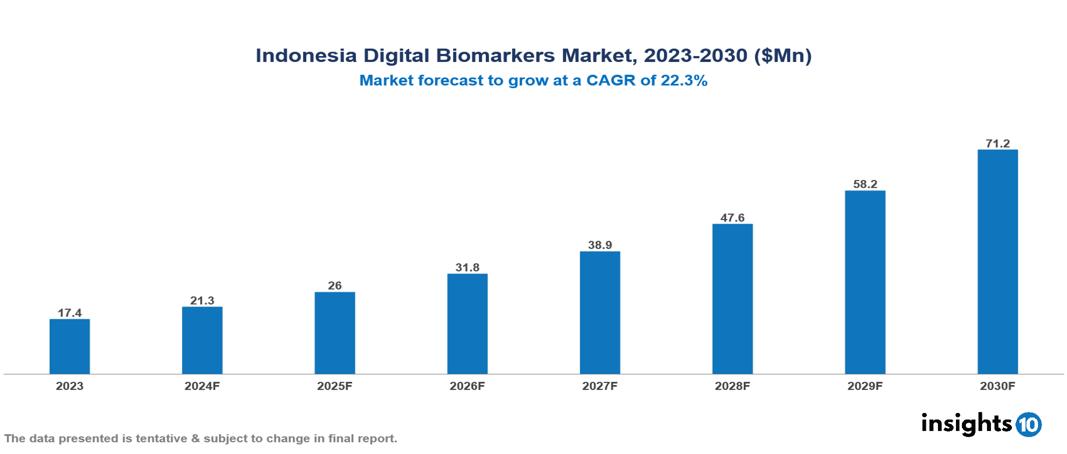
Indonesia Digital Biomarkers Market was valued at $17.40 Mn in 2023 and is predicted to grow at a CAGR of 22.3% from 2023 to 2030, to $71.21 Mn by 2030. The key drivers of this industry include the growing prevalence of chronic diseases, government initiatives, and a growing focus on preventative care. The industry is primarily dominated by ActiGraph LLC, AliveCor Inc., Koneksa, and Altoida Inc. among others.
Buy Now

Indonesia Digital Biomarkers Market Executive Summary
Indonesia Digital Biomarkers Market was valued at $17.40 Mn in 2023 and is predicted to grow at a CAGR of 22.3% from 2023 to 2030, to $71.21 Mn by 2030.
Digital biomarkers are quantifiable physiological and behavioral data collected by digital devices like wearables and smartphones. They provide insights into health, including disease progression and treatment response, enabling continuous monitoring and real-time data collection. These biomarkers are used for various health conditions, such as diabetes, cardiovascular disorders, mental health issues, and neurodegenerative diseases. By tracking metrics like physical activity, heart rate, and sleep patterns, digital biomarkers help clinicians make informed decisions and support research with real-world evidence. As technology advances, their potential to transform healthcare and improve patient outcomes grows.
Chronic noncommunicable diseases (NCDs) are a significant health concern in Indonesia, accounting for 73% of all deaths in 2020. The market therefore is driven by significant factors like the growing prevalence of chronic diseases, government initiatives, and growing focus on preventative care. However, data privacy and security concerns, integration with healthcare systems, and high development costs restrict the growth and potential of the market.
Prominent players in this field are ActiGraph LLC which specializes in wearable devices and data analytics for physical activity and sleep monitoring, contributing to clinical research through reliable digital biomarkers. AliveCor Inc. excels in portable ECG monitoring and AI-driven cardiac analysis, enhancing early diagnosis and intervention with FDA-cleared devices like KardiaMobile. Others contributors include Koneksa, and Altoida Inc. among others.
Market Dynamics
Market Growth Drivers
Growing Prevalence of Chronic Diseases: Indonesia faces a growing burden of chronic diseases like diabetes, heart disease, and obesity. Digital biomarkers offer valuable tools for early detection, monitoring, and management of these conditions, driving market growth.
Government Initiatives: The Indonesian government is actively promoting digital healthcare solutions. Initiatives like the "Indonesia Healthcare 4.0" strategy aim to leverage technology to improve healthcare delivery. This fosters a supportive environment for the digital biomarkers market.
Growing Focus on Preventative Care: There's an increasing emphasis on preventative healthcare in Indonesia. Digital biomarkers can empower individuals to take a more proactive approach to their health by tracking health indicators and identifying potential risks early on.
Market Restraints
Data Privacy and Security Concerns: Data security and privacy are major concerns in Indonesia. Building trust with users regarding data collection, storage, and usage practices is crucial for market growth.
Integration with Healthcare Systems: Seamless integration of digital biomarker data with existing healthcare information systems in Indonesia is necessary for optimal utilization by healthcare professionals. Currently, this integration might be limited.
High Development Costs: The research and development of digital biomarkers involve significant investment in technology, clinical validation, and regulatory compliance. High costs can be a barrier for small and medium-sized enterprises entering the market.
Regulatory Landscape and Reimbursement Scenario
The regulatory landscape for digital biomarkers in Indonesia is in a state of evolution, driven by growing recognition of their potential impact on healthcare. The Ministry of Health (Kemenkes) and the National Agency for Food and Drug Control (BPOM) are key authorities overseeing the regulation of medical devices, including the potential classification and regulation of digital biomarkers. Stakeholders should monitor updates on the Kemenkes and BPOM websites for forthcoming guidelines or regulations specific to digital biomarkers, which will shape the regulatory pathway and approval process in Indonesia. Compliance with Indonesia's emerging data privacy regulations, particularly under the Personal Data Protection Law (UU PDN), is critical for ensuring legality in data handling practices.
Despite the evolving regulatory framework, reimbursement for digital biomarkers in Indonesia remains limited. Currently, the national health insurance provider, BPJS Kesehatan, rarely covers digital biomarkers. However, opportunities may arise through private health insurance plans, which are expanding in Indonesia. Some insurers may offer coverage for digital health solutions incorporating digital biomarkers, contingent on the specific technology and insurance plan.
Competitive Landscape
Key Players
Here are some of the major key players in the Indonesia Digital Biomarkers Market
- ActiGraph LLC
- AliveCor Inc.
- Koneksa
- Altoida Inc.
- Amgen Inc.
- Biogen Inc.
- Empatica Inc.
- Vivo Sense
- IXICO plc
- Adherium Limited
1. Executive Summary
1.1 Digital Health Overview
1.2 Global Scenario
1.3 Country Overview
1.4 Healthcare Scenario in Country
1.5 Digital Health Policy in Country
1.6 Recent Developments in the Country
2. Market Size and Forecasting
2.1 Market Size (With Excel and Methodology)
2.2 Market Segmentation (Check all Segments in Segmentation Section)
3. Market Dynamics
3.1 Market Drivers
3.2 Market Restraints
4. Competitive Landscape
4.1 Major Market Share
4.2 Key Company Profile (Check all Companies in the Summary Section)
4.2.1 Company
4.2.1.1 Overview
4.2.1.2 Product Applications and Services
4.2.1.3 Recent Developments
4.2.1.4 Partnerships Ecosystem
4.2.1.5 Financials (Based on Availability)
5. Reimbursement Scenario
5.1 Reimbursement Regulation
5.2 Reimbursement Process for Diagnosis
5.3 Reimbursement Process for Treatment
6. Methodology and Scope
Indonesia Digital Biomarkers Market Segmentation
By Type
- Wearable
- Mobile-based Applications
- Sensors
- Others
By Clinical Practice
- Diagnostic digital biomarkers
- Monitoring digital biomarkers
- Predictive and Prognostic digital biomarkers
- Other's (Safety, Pharmacodynamics/ Response, Susceptibility)
By Therapeutic Area
- Cardiovascular and metabolic disorders (CVMD)
- Respiratory disorders
- Psychiatric disorders
- Sleep & Movement Disease
- Neurological disorders
- Musculoskeletal disorders
- Others (Diabetes, Pain Management)
By End-Use
- Healthcare companies
- Healthcare Providers
- Payers
- Others (Patients, caregivers)
Methodology for Database Creation
Our database offers a comprehensive list of healthcare centers, meticulously curated to provide detailed information on a wide range of specialties and services. It includes top-tier hospitals, clinics, and diagnostic facilities across 30 countries and 24 specialties, ensuring users can find the healthcare services they need.
Additionally, we provide a comprehensive list of Key Opinion Leaders (KOLs) based on your requirements. Our curated list captures various crucial aspects of the KOLs, offering more than just general information. Whether you're looking to boost brand awareness, drive engagement, or launch a new product, our extensive list of KOLs ensures you have the right experts by your side. Covering 30 countries and 36 specialties, our database guarantees access to the best KOLs in the healthcare industry, supporting strategic decisions and enhancing your initiatives.
How Do We Get It?
Our database is created and maintained through a combination of secondary and primary research methodologies.
1. Secondary Research
With many years of experience in the healthcare field, we have our own rich proprietary data from various past projects. This historical data serves as the foundation for our database. Our continuous process of gathering data involves:
- Analyzing historical proprietary data collected from multiple projects.
- Regularly updating our existing data sets with new findings and trends.
- Ensuring data consistency and accuracy through rigorous validation processes.
With extensive experience in the field, we have developed a proprietary GenAI-based technology that is uniquely tailored to our organization. This advanced technology enables us to scan a wide array of relevant information sources across the internet. Our data-gathering process includes:
- Searching through academic conferences, published research, citations, and social media platforms
- Collecting and compiling diverse data to build a comprehensive and detailed database
- Continuously updating our database with new information to ensure its relevance and accuracy
2. Primary Research
To complement and validate our secondary data, we engage in primary research through local tie-ups and partnerships. This process involves:
- Collaborating with local healthcare providers, hospitals, and clinics to gather real-time data.
- Conducting surveys, interviews, and field studies to collect fresh data directly from the source.
- Continuously refreshing our database to ensure that the information remains current and reliable.
- Validating secondary data through cross-referencing with primary data to ensure accuracy and relevance.
Combining Secondary and Primary Research
By integrating both secondary and primary research methodologies, we ensure that our database is comprehensive, accurate, and up-to-date. The combined process involves:
- Merging historical data from secondary research with real-time data from primary research.
- Conducting thorough data validation and cleansing to remove inconsistencies and errors.
- Organizing data into a structured format that is easily accessible and usable for various applications.
- Continuously monitoring and updating the database to reflect the latest developments and trends in the healthcare field.
Through this meticulous process, we create a final database tailored to each region and domain within the healthcare industry. This approach ensures that our clients receive reliable and relevant data, empowering them to make informed decisions and drive innovation in their respective fields.
To request a free sample copy of this report, please complete the form below.
We value your inquiry and offer free customization with every report to fulfil your exact research needs.

Related reports (by category)
Digital Health
Ireland Blockchain Technology in Healthcare Market Analysis
Digital Health
US Digital Health Market Analysis
Digital Health
South Africa Telemedicine Market Analysis
Related reports (by geography)

Pharmaceuticals
Indonesia Retail Pharmacy Market Analysis
Pharmaceuticals
Indonesia Oral Thin Films Market Analysis
Pharmaceuticals
Indonesia Coenzyme Q10 Market Analysis
Digital Health