Pharmaceuticals

China Cancer Induced Bone Disease Therapeutics Market
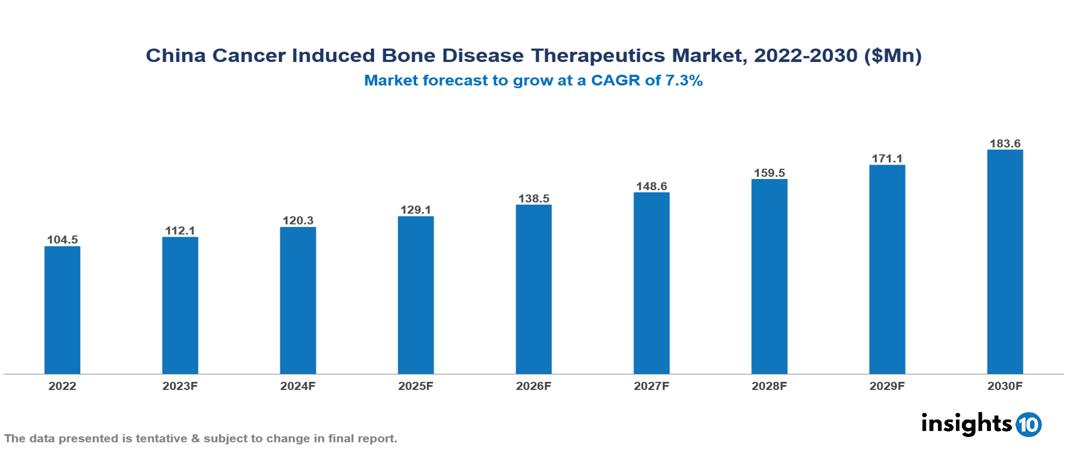
China Cancer Induced Bone Disease Therapeutics Market valued at $105 Mn in 2022, projected to reach $184 Mn by 2030 with a 7.3% CAGR. The key drivers of this industry include the rising incidence of cancers, government initiatives, and untapped market potential. The industry is primarily dominated by players such as Siemen, Hengrui, Shanghai Pharma, Johnson & Johnson, Novartis, and Amgen among others.
Buy Now

China Cancer Induced Bone Diseases Therapeutics Market Analysis
China Cancer Induced Bone Disease Therapeutics Market valued at $105 Mn in 2022, projected to reach $184 Mn by 2030 with a 7.3% CAGR.
Cancer-induced bone diseases refer to conditions where cancer cells metastasize, affecting the bones and leading to complications like bone destruction, fractures, and pain. Common causes include the spread of cancer from primary tumors to the bones, commonly observed in breast, prostate, lung cancers, and multiple myeloma. Symptoms typically include localized pain, bone fractures, and reduced mobility, significantly impacting the overall quality of life for those affected. The current approach to treating cancer-induced bone diseases involves a comprehensive strategy. Medical interventions comprise chemotherapy, radiation therapy, and targeted therapies to address the underlying cancer. Additionally, bisphosphonates and other bone-targeted agents may be utilized to strengthen bones and alleviate pain. Key pharmaceutical companies, such as Amgen, Novartis, and Eli Lilly, play a crucial role in developing and manufacturing medications. These companies have introduced drugs like denosumab and bisphosphonates to manage bone complications in cancer patients.
In China, there is an increasing prevalence of cancers such as breast (around 18%), prostate (more than 25%), and lung cancer (about 20%) that result in the development of bone metastases. The market is being driven by factors such as the upward trend in cancer incidence, government initiatives, and untapped market potential However, conditions such as limited reimbursement limited research and development, and others limit the growth and potential of the market.
Market Dynamics
Market Growth Drivers
Increasing cancer incidence: China is witnessing an increasing occurrence of diverse cancers like lung (approximately 20%), breast (around 18%), and prostate (more than 25%), all of which have the potential to lead to bone diseases. This trend results in a growing number of patients seeking effective treatments for CIBD. The accelerated aging of the population in China contributes to a higher susceptibility to bone-related problems, with a concurrent rise in cancer prevalence within this age demographic. This demographic shift intensifies the need for therapeutics addressing cancer-induced bone diseases.
Government initiatives: Government efforts encouraging local research and development of innovative therapies for CIBD boost market expansion and decrease dependence on imported medications. A positive regulatory climate, characterized by streamlined processes and accelerated drug approvals, has the potential to hasten the introduction of new CIBD treatments into the Chinese market.
Untapped market potential: The immense population in China creates a significant demand for efficient treatment solutions for CIBD. Diverse patient requirements, stemming from variations in cancer types, disease progression, and individual responses, underscore the necessity for a range of therapeutic options for CIBD to address the diverse needs of patients.
Market Restraints
Limited reimbursement: Securing reimbursement from the National Healthcare Security Administration (NHSA) for novel therapies targeting Cancer-Induced Bone Diseases (CIBD) can be difficult due to rigorous cost-effectiveness evaluations, prolonged negotiation processes, and regional policy variations. This introduces uncertainty for manufacturers and has the potential to restrict the market acceptance of new, potentially costly drugs.
Limited research and development: In contrast to Western nations, China encounters constraints in research funding specifically allocated for CIBD, which may impede the innovation and development of new therapies. Furthermore, recruiting and retaining proficient researchers in this particular domain pose a challenge.
Health system disparities: Although healthcare expenditure is on the rise, discrepancies persist between urban and rural regions, restricting a significant portion of the population's access to costly therapies for CIBD. The availability of advanced diagnostic tools, such as advanced imaging and specific biomarkers, is constrained, impeding the provision of optimal patient care and influencing treatment decisions.
Healthcare Policies and Regulatory Landscape
In China, the primary regulatory authority overseeing pharmaceuticals, drugs, and medical products is the National Medical Products Administration (NMPA), formerly known as the China Food and Drug Administration (CFDA). NMPA operates under the State Administration for Market Regulation (SAMR) and is responsible for the regulation and supervision of the safety and efficacy of pharmaceuticals, medical devices, and other health products.
The process of obtaining a license for pharmaceuticals and medical products in China involves a comprehensive evaluation by the NMPA. The regulatory approval process may include on-site inspections of manufacturing facilities to ensure compliance with Good Manufacturing Practice (GMP) standards. However, new entrants should be prepared to navigate a complex regulatory landscape, invest in research and development, and adhere to stringent quality and safety requirements to successfully bring their products to the Chinese market.
Competitive Landscape
Key Players
- Amgen
- Bayer
- Novartis
- Hengrui
- CSPC
- Shanghai Pharma
- Eli Lilly
- Pfizer
- Johnson & Johnson
- Siemen Healthineers
1. Executive Summary
1.1 Disease Overview
1.2 Global Scenario
1.3 Country Overview
1.4 Healthcare Scenario in Country
1.5 Patient Journey
1.6 Health Insurance Coverage in Country
1.7 Active Pharmaceutical Ingredient (API)
1.8 Recent Developments in the Country
2. Market Size and Forecasting
2.1 Epidemiology of Disease
2.2 Market Size (With Excel & Methodology)
2.3 Market Segmentation (Check all Segments in Segmentation Section)
3. Market Dynamics
3.1 Market Drivers
3.2 Market Restraints
4. Competitive Landscape
4.1 Major Market Share
4.2 Key Company Profile (Check all Companies in the Summary Section)
4.2.1 Company
4.2.1.1 Overview
4.2.1.2 Product Applications and Services
4.2.1.3 Recent Developments
4.2.1.4 Partnerships Ecosystem
4.2.1.5 Financials (Based on Availability)
5. Reimbursement Scenario
5.1 Reimbursement Regulation
5.2 Reimbursement Process for Diagnosis
5.3 Reimbursement Process for Treatment
6. Methodology and Scope
China Cancer Induced Bone Diseases Therapeutics Market Segmentation
By Cancer Type
- Breast cancer
- Prostate cancer
- Lung cancer
- Others
By Treatment Type
- Bisphosphonates
- Denosumab
- Radiation Therapy
- Pain Management Medications
- Surgical Intervention
- Targeted Therapy
By Distribution channel
- Hospitals
- Pharmacies
- Oncology clinics
- Others
By Stage of Treatment
- Early stage CIBD
- Advanced stage CIBD
Methodology for Database Creation
Our database offers a comprehensive list of healthcare centers, meticulously curated to provide detailed information on a wide range of specialties and services. It includes top-tier hospitals, clinics, and diagnostic facilities across 30 countries and 24 specialties, ensuring users can find the healthcare services they need.
Additionally, we provide a comprehensive list of Key Opinion Leaders (KOLs) based on your requirements. Our curated list captures various crucial aspects of the KOLs, offering more than just general information. Whether you're looking to boost brand awareness, drive engagement, or launch a new product, our extensive list of KOLs ensures you have the right experts by your side. Covering 30 countries and 36 specialties, our database guarantees access to the best KOLs in the healthcare industry, supporting strategic decisions and enhancing your initiatives.
How Do We Get It?
Our database is created and maintained through a combination of secondary and primary research methodologies.
1. Secondary Research
With many years of experience in the healthcare field, we have our own rich proprietary data from various past projects. This historical data serves as the foundation for our database. Our continuous process of gathering data involves:
- Analyzing historical proprietary data collected from multiple projects.
- Regularly updating our existing data sets with new findings and trends.
- Ensuring data consistency and accuracy through rigorous validation processes.
With extensive experience in the field, we have developed a proprietary GenAI-based technology that is uniquely tailored to our organization. This advanced technology enables us to scan a wide array of relevant information sources across the internet. Our data-gathering process includes:
- Searching through academic conferences, published research, citations, and social media platforms
- Collecting and compiling diverse data to build a comprehensive and detailed database
- Continuously updating our database with new information to ensure its relevance and accuracy
2. Primary Research
To complement and validate our secondary data, we engage in primary research through local tie-ups and partnerships. This process involves:
- Collaborating with local healthcare providers, hospitals, and clinics to gather real-time data.
- Conducting surveys, interviews, and field studies to collect fresh data directly from the source.
- Continuously refreshing our database to ensure that the information remains current and reliable.
- Validating secondary data through cross-referencing with primary data to ensure accuracy and relevance.
Combining Secondary and Primary Research
By integrating both secondary and primary research methodologies, we ensure that our database is comprehensive, accurate, and up-to-date. The combined process involves:
- Merging historical data from secondary research with real-time data from primary research.
- Conducting thorough data validation and cleansing to remove inconsistencies and errors.
- Organizing data into a structured format that is easily accessible and usable for various applications.
- Continuously monitoring and updating the database to reflect the latest developments and trends in the healthcare field.
Through this meticulous process, we create a final database tailored to each region and domain within the healthcare industry. This approach ensures that our clients receive reliable and relevant data, empowering them to make informed decisions and drive innovation in their respective fields.
To request a free sample copy of this report, please complete the form below.
We value your inquiry and offer free customization with every report to fulfil your exact research needs.

Related reports (by category)
Pharmaceuticals
Mexico Oncology/Cancer Drugs Market Analysis
Pharmaceuticals
UAE Rituximab Biosimilars Market Analysis
Pharmaceuticals
Turkey Vaccines Market Analysis
Related reports (by geography)
Healthcare Services
China Computer-Aided Drugs Discovery Market Analysis
Healthcare Services
China Ovarian Cancer Diagnostic Market Analysis
Rare Diseases
China Retinal Detachment Therapeutics Market Analysis
Healthcare Services