Pharmaceuticals

Brazil Alopecia (Hair Loss) Therapeutics Market Analysis
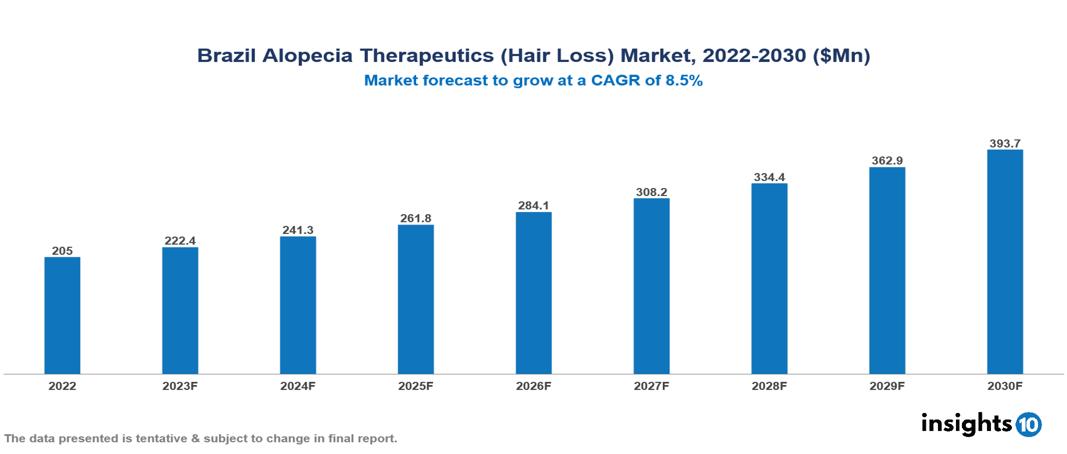
The Brazil Alopecia (Hair Loss) Therapeutics Market was valued at US $205 Mn in 2022, and is predicted to grow at (CAGR) of 8.5% from 2023 to 2030, to US $394 Mn by 2030. The key drivers of this industry include the surge in the prevalence of alopecia (hair loss), increased disposable income, lifestyle changes, and others. The industry is primarily dominated by players such as Johnson & Johnson, Eli Lilly, Merck, Cipla, Sun Pharmaceuticals, Theradome, and Pfizer, among others.
Buy Now

Brazil Alopecia Therapeutics Market Analysis: Executive Summary
The Brazil Alopecia (Hair Loss) Therapeutics Market is at around US $205 Mn in 2022 and is projected to reach US $394 Mn in 2030, exhibiting a CAGR of 8.5% during the forecast period.
Alopecia, characterized by irregular hair loss, affects a considerable number of individuals, exhibiting as localized or diffuse, temporary or permanent, and impacting people of all ages and genders. The condition, which arises from diverse causes including elevated stress levels, diabetes, poor nutrition, and environmental influences, can induce significant distress among patients, impacting their overall quality of life. Common symptoms include hair loss, thinning hair, and bald patches on the scalp. Treatment options range from applying topical medications like Minoxidil or corticosteroids directly to the scalp to utilizing injections and oral medications with more potent immunosuppressive effects. Light therapy and hair transplantation are also feasible alternatives. Notably, companies such as Eli Lilly, with their JAK inhibitor Baricitinib, and Bayer, with Rogaine (minoxidil), are actively leading advancements in treatments for this condition.
The overall prevalence of alopecia is approximately 1.2% in Brazil, which is similar to global estimates. The increased prevalence of alopecia in Brazil is attributed to risk factors like stress, changes in the environmental landscape, and shifts in lifestyle. The market is being fuelled by important factors such as the growing aging population and the subsequent rise in alopecia, increasing disposable income, and lifestyle changes contributing to the therapeutics industry. However, challenges such as the high costs of treatments like gene therapy, limited access are a few factors that limit the market's potential.
Market Dynamics
Market Growth Drivers
Surge in prevalence of Alopecia: Similar to other countries, Alopecia is on the rise in Brazil, particularly among young adults and women. The overall prevalence of Alopecia is roughly 1.2% in Brazil. The growing population affected by this condition increases the market potential for diverse treatment options. Factors such as stress, environmental changes, and lifestyle shifts contribute to the increasing cases of Alopecia, further elevating the demand in the market.
Increasing disposable income and changing lifestyle: The increasing disposable income and evolving lifestyles of the populace have resulted in an elevated demand for Alopecia treatments. Within Latin America, Brazil stands out as a significant market for Alopecia treatment, given its substantial population and an increasing emphasis on personal appearance. With an increased awareness and a growing disposable income, individuals have increased financial means to afford innovative and potentially costly treatments for Alopecia.
Advanced treatment options: The endorsement of JAK inhibitors like Baricitinib (Olumiant) provides an oral medication option for Alopecia, potentially attracting patients seeking more contemporary and effective treatments. Ongoing research and progress in various Alopecia therapies, such as hair follicle cloning, gene therapy, and mesotherapy, hold the potential for revolutionary advancements in the future, contributing to investments in the market. Brazil's rise as a medical tourism destination especially for transplant procedures is attractive to individuals from neighbouring countries seeking advanced Alopecia treatment options not easily accessible in their own regions.
Market Restraints
High costs of medications: JAK inhibitors such as Xeljanz and Baricitinib often have coverage limits that are higher than usual for insurance, which results in high expenditures for many patients. Financial burden is increased even by topical treatments and surgeries, making it difficult for those with low incomes to finance these therapies.
Limited access: Even though Brazil provides public healthcare, certain Alopecia treatments, such as JAK inhibitors, may not be completely covered by all Unified Health System (SUS) plans. This results in patients having to bear co-payments or assume full responsibility for the associated costs dissuading them from continuing treatment and restricting market growth.
Competition from alternative treatments: The potential constraints on market growth include the presence of alternative treatments like herbal medications and the increasing influence of advanced technology in the healthcare industry.
Healthcare Policies and Regulatory Landscape
The primary regulatory authority for pharmaceuticals and healthcare supplies in Brazil is the National Health Surveillance Agency (ANVISA). ANVISA is responsible for the registration, regulation, and oversight of pharmaceuticals and medical devices. Alongside ANVISA the National Supplementary Health Agency (ANS) also hold significant roles in healthcare regulation within the country. The ANS specifically governs the private healthcare industry by establishing and monitoring norms for healthcare activities.
Brazil operates a decentralized, universal public healthcare system funded by taxes and contributions from federal, state, and municipal governments. The management and provision of healthcare services fall under the responsibility of municipalities or states.
Compliance with ANVISA standards is mandatory for obtaining a license in Brazil. Companies must secure an ANVISA registration and marketing authorization before commercializing treatments. The registration process involves presenting technical and scientific data to verify the efficacy, safety, and quality of the product.
Overall, Brazil's healthcare policy and regulatory framework involve various authorities and agencies, with ANVISA playing a crucial role.
Competitive Landscape
Key Players
- Eli Lilly
- Pfizer
- Johnson & Johnson
- Merck & Co
- Cipla Limited
- Sun Pharmaceuticals
- GlaxoSmithKline plc
- Aurobindo Pharma
- iRestore Hair Growth system
- Theradome
1. Executive Summary
1.1 Disease Overview
1.2 Global Scenario
1.3 Country Overview
1.4 Healthcare Scenario in Country
1.5 Patient Journey
1.6 Health Insurance Coverage in Country
1.7 Active Pharmaceutical Ingredient (API)
1.8 Recent Developments in the Country
2. Market Size and Forecasting
2.1 Epidemiology of Disease
2.2 Market Size (With Excel & Methodology)
2.3 Market Segmentation (Check all Segments in Segmentation Section)
3. Market Dynamics
3.1 Market Drivers
3.2 Market Restraints
4. Competitive Landscape
4.1 Major Market Share
4.2 Key Company Profile (Check all Companies in the Summary Section)
4.2.1 Company
4.2.1.1 Overview
4.2.1.2 Product Applications and Services
4.2.1.3 Recent Developments
4.2.1.4 Partnerships Ecosystem
4.2.1.5 Financials (Based on Availability)
5. Reimbursement Scenario
5.1 Reimbursement Regulation
5.2 Reimbursement Process for Diagnosis
5.3 Reimbursement Process for Treatment
6. Methodology and Scope
Brazil Alopecia Therapeutics Market Segmentation
By Disease Type
- Alopecia Areata
- Cicatricial Alopecia
- Traction Alopecia
- Alopecia Totalis
- Androgenetic Alopecia
- Alopecia Universalis
- Others
By Treatment Type
- Pharmaceuticals
- Devices
- Others
By Gender
- Male
- Female
By Route of Administration
- Topical
- Injectable
- Oral
By Age Group
- Below 18 years
- 18-34 years
- 35-49 years
- 50 years and above
By End User
- Hospitals
- Physician’s Office
- Dermatology clinics
- Others
By Sales Channel
- Prescriptions
- OTC
Methodology for Database Creation
Our database offers a comprehensive list of healthcare centers, meticulously curated to provide detailed information on a wide range of specialties and services. It includes top-tier hospitals, clinics, and diagnostic facilities across 30 countries and 24 specialties, ensuring users can find the healthcare services they need.
Additionally, we provide a comprehensive list of Key Opinion Leaders (KOLs) based on your requirements. Our curated list captures various crucial aspects of the KOLs, offering more than just general information. Whether you're looking to boost brand awareness, drive engagement, or launch a new product, our extensive list of KOLs ensures you have the right experts by your side. Covering 30 countries and 36 specialties, our database guarantees access to the best KOLs in the healthcare industry, supporting strategic decisions and enhancing your initiatives.
How Do We Get It?
Our database is created and maintained through a combination of secondary and primary research methodologies.
1. Secondary Research
With many years of experience in the healthcare field, we have our own rich proprietary data from various past projects. This historical data serves as the foundation for our database. Our continuous process of gathering data involves:
- Analyzing historical proprietary data collected from multiple projects.
- Regularly updating our existing data sets with new findings and trends.
- Ensuring data consistency and accuracy through rigorous validation processes.
With extensive experience in the field, we have developed a proprietary GenAI-based technology that is uniquely tailored to our organization. This advanced technology enables us to scan a wide array of relevant information sources across the internet. Our data-gathering process includes:
- Searching through academic conferences, published research, citations, and social media platforms
- Collecting and compiling diverse data to build a comprehensive and detailed database
- Continuously updating our database with new information to ensure its relevance and accuracy
2. Primary Research
To complement and validate our secondary data, we engage in primary research through local tie-ups and partnerships. This process involves:
- Collaborating with local healthcare providers, hospitals, and clinics to gather real-time data.
- Conducting surveys, interviews, and field studies to collect fresh data directly from the source.
- Continuously refreshing our database to ensure that the information remains current and reliable.
- Validating secondary data through cross-referencing with primary data to ensure accuracy and relevance.
Combining Secondary and Primary Research
By integrating both secondary and primary research methodologies, we ensure that our database is comprehensive, accurate, and up-to-date. The combined process involves:
- Merging historical data from secondary research with real-time data from primary research.
- Conducting thorough data validation and cleansing to remove inconsistencies and errors.
- Organizing data into a structured format that is easily accessible and usable for various applications.
- Continuously monitoring and updating the database to reflect the latest developments and trends in the healthcare field.
Through this meticulous process, we create a final database tailored to each region and domain within the healthcare industry. This approach ensures that our clients receive reliable and relevant data, empowering them to make informed decisions and drive innovation in their respective fields.
To request a free sample copy of this report, please complete the form below.
We value your inquiry and offer free customization with every report to fulfil your exact research needs.

Related reports (by category)
Pharmaceuticals
Singapore Human Insulin Drugs Market Analysis
Pharmaceuticals
Saudi Arabia Enzymatic Wound Debridement Market Analysis
Pharmaceuticals
Egypt Paracetamol Market Analysis
Related reports (by geography)
Pharmaceuticals
Brazil Cardiac Resynchronization Therapy Market
Pharmaceuticals
Brazil Dry Eye Medication Market Analysis
Healthcare Services