Healthcare Services
APAC Bioinformatics Market Analysis
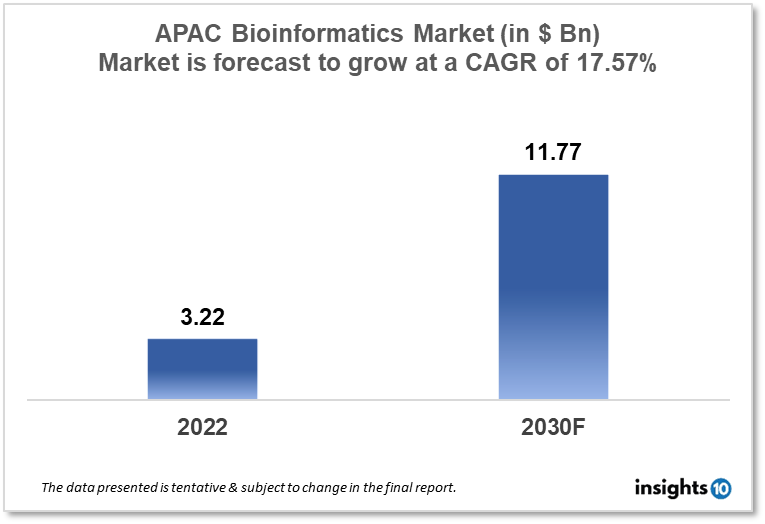
The APAC Bioinformatics market is projected to grow from $3.22 Bn in 2022 to $11.77 Bn by 2030, registering a CAGR of 17.57% during the forecast period of 2022 - 2030. The main factors driving the growth would be the increased use of bioinformatics in personalized medicine and the increase in the public-private sector in the field. The market is segmented by technology and by application. Some of the major players include Strand Life Sciences, Thermo Fisher Scientific, Illumina, Qiagen, Agilent Technologies, and BGI Group.
Buy Now

APAC Bioinformatics Market Executive Summary
The APAC Bioinformatics market is projected to grow from $3.22 Bn in 2022 to $11.77 Bn by 2030, registering a CAGR of 17.57% during the forecast period of 2022 - 2030. The WHO Western Pacific Area, which comprises various nations in the Asia-Pacific region, had a total health spending as a proportion of gross domestic product (GDP) of 7.2% in 2017. However, this proportion can differ significantly from one nation to another within the region.
Bioinformatics is a scientific area that integrates biology and information technology. Bioinformatics uses a variety of approaches, such as data management, data mining, data warehousing, and data generation. Bioinformatics software and tools are used as integrated solutions to provide statistical techniques and data processing algorithms for applications including next-generation sequencing, modeling of genomic and proteomic structure, and three-dimensional drug discovery.
Market Dynamics
Market Growth Drivers
The Global bioinformatics market is expected to be driven by factors such as increased use of bioinformatics in personalized medicine and an increase in the public-private sector in the field. Federal agencies, as well as public and commercial organizations, are funding scientists for research and bioinformatics initiatives in order to enhance the workflow for this field. Bioinformatics firms and initiatives would grow as a result of funding from the public and commercial sectors. The funds would enable the institute's technical infrastructure to advance and grow. This entails adopting fresh data storage options and expanding current data resources.
Market Restraints
The challenges in the implementation of bioinformatics technology in clinical labs and the high cost of research and development and cyber security concerns will limit the growth of the bioinformatics market in APAC. Bio-cyber security issues are now being brought up by the rising computerization of DNA technology and biotechnology. There are now vulnerabilities in biotechnology that are more commonly seen in conventional computer systems, such as the handling of untrusted input, side-channel leaks, weak authentication, false data, and vulnerabilities in cyber-physical systems. DNA-Information Systems in bioinformatics are under threat from the new bio-cyber security risks.
Competitive Landscape
Key Players
- Strand Life Sciences
- Thermo Fisher Scientific
- Illumina
- Qiagen
- Agilent Technologies
- BGI Group
Notable Recent Deals
June 2021: Strand Life Sciences entered into an agreement to acquire the India medical diagnostics business of Quest Diagnostics. With the acquisition, Strand Life Sciences becomes India's top specialized diagnostics company, with a strong North India presence and a marquee customer that includes top corporations, hospital networks, and pharmaceutical companies.
August 2021: Agilent and Partek entered into a deal to offer a complete end-to-end, dependable, customized, and flexible analysis process in order to meet the needs of their clients. Agilent's RNA-Seq method has been implemented into Partek Flow as a result of this agreement. The arrangement also permits Agilent to market Partek Flow software as a one-stop shop through the Alissa Portal.
Healthcare Policies and Regulatory Landscape
A number of government organizations, such as the China Food and Drug Administration (CFDA), the Australian Therapeutic Goods Administration (TGA), and the Pharmaceuticals and Medical Devices Agency (PMDA) in Japan, influence healthcare regulations and the bioinformatics market in the APAC. These organizations are in charge of policing the creation, endorsement, and promotion of bioinformatics goods and services in the APAC region. The use and storage of sensitive personal health information in the APAC bioinformatics market are also impacted by data privacy laws and regulations, such as the Personal Information Protection Act in Japan and the Personal Data Protection Act in Singapore.
The APAC bioinformatics industry is shaped in part by intellectual property regulations, which include patents, trademarks, and copyrights. These laws defend businesses' rights to use and market their bioinformatics goods and services.
Reimbursement Scenario
Depending on the nation and region, several reimbursement procedures are used in the APAC bioinformatics market. Public health insurance systems may offer compensation for bioinformatics goods and services in some nations, whilst private health insurance policies may do so in other nations. The exact product or service being reimbursed, as well as the nation or location, can affect the amount of compensation offered by these schemes. Programs or grants from the government may also be accessible in some nations to support the creation and application of bioinformatics goods and services.
1. Executive Summary
1.1 Service Overview
1.2 Global Scenario
1.3 Country Overview
1.4 Healthcare Scenario in Country
1.5 Healthcare Services Market in Country
1.6 Recent Developments in the Country
2. Market Size and Forecasting
2.1 Market Size (With Excel and Methodology)
2.2 Market Segmentation (Check all Segments in Segmentation Section)
3. Market Dynamics
3.1 Market Drivers
3.2 Market Restraints
4. Competitive Landscape
4.1 Major Market Share
4.2 Key Company Profile (Check all Companies in the Summary Section)
4.2.1 Company
4.2.1.1 Overview
4.2.1.2 Product Applications and Services
4.2.1.3 Recent Developments
4.2.1.4 Partnerships Ecosystem
4.2.1.5 Financials (Based on Availability)
5. Reimbursement Scenario
5.1 Reimbursement Regulation
5.2 Reimbursement Process for Services
5.3 Reimbursement Process for Treatment
6. Methodology and Scope
Bioinformatics Market Segmentation
By Technology (Revenue, USD Billion):
- Knowledge Management Tools
- Bioinformatics Platforms
- Bioinformatics Services
By Application (Revenue, USD Billion):
- Metabolomics
- Molecular phylogenetics
- Transcriptomics
- Chemoinformatic & drug design
- Genomics
- Others
Methodology for Database Creation
Our database offers a comprehensive list of healthcare centers, meticulously curated to provide detailed information on a wide range of specialties and services. It includes top-tier hospitals, clinics, and diagnostic facilities across 30 countries and 24 specialties, ensuring users can find the healthcare services they need.
Additionally, we provide a comprehensive list of Key Opinion Leaders (KOLs) based on your requirements. Our curated list captures various crucial aspects of the KOLs, offering more than just general information. Whether you're looking to boost brand awareness, drive engagement, or launch a new product, our extensive list of KOLs ensures you have the right experts by your side. Covering 30 countries and 36 specialties, our database guarantees access to the best KOLs in the healthcare industry, supporting strategic decisions and enhancing your initiatives.
How Do We Get It?
Our database is created and maintained through a combination of secondary and primary research methodologies.
1. Secondary Research
With many years of experience in the healthcare field, we have our own rich proprietary data from various past projects. This historical data serves as the foundation for our database. Our continuous process of gathering data involves:
- Analyzing historical proprietary data collected from multiple projects.
- Regularly updating our existing data sets with new findings and trends.
- Ensuring data consistency and accuracy through rigorous validation processes.
With extensive experience in the field, we have developed a proprietary GenAI-based technology that is uniquely tailored to our organization. This advanced technology enables us to scan a wide array of relevant information sources across the internet. Our data-gathering process includes:
- Searching through academic conferences, published research, citations, and social media platforms
- Collecting and compiling diverse data to build a comprehensive and detailed database
- Continuously updating our database with new information to ensure its relevance and accuracy
2. Primary Research
To complement and validate our secondary data, we engage in primary research through local tie-ups and partnerships. This process involves:
- Collaborating with local healthcare providers, hospitals, and clinics to gather real-time data.
- Conducting surveys, interviews, and field studies to collect fresh data directly from the source.
- Continuously refreshing our database to ensure that the information remains current and reliable.
- Validating secondary data through cross-referencing with primary data to ensure accuracy and relevance.
Combining Secondary and Primary Research
By integrating both secondary and primary research methodologies, we ensure that our database is comprehensive, accurate, and up-to-date. The combined process involves:
- Merging historical data from secondary research with real-time data from primary research.
- Conducting thorough data validation and cleansing to remove inconsistencies and errors.
- Organizing data into a structured format that is easily accessible and usable for various applications.
- Continuously monitoring and updating the database to reflect the latest developments and trends in the healthcare field.
Through this meticulous process, we create a final database tailored to each region and domain within the healthcare industry. This approach ensures that our clients receive reliable and relevant data, empowering them to make informed decisions and drive innovation in their respective fields.
To request a free sample copy of this report, please complete the form below.
We value your inquiry and offer free customization with every report to fulfil your exact research needs.

Related reports (by category)
Healthcare Services
Kenya Radiology Service Market Analysis
Healthcare Services
APAC Patient Engagement Solutions Market Analysis
Healthcare Services
Germany Medication Adherence Market Analysis
Related reports (by geography)
OTC & Nutraceuticals
APAC Nutritional Supplements Market Analysis
Medical Devices
APAC ENT Devices Market Analysis
Pharmaceuticals
APAC Cardiovascular Diseases Therapeutics Market Analysis
Pharmaceuticals